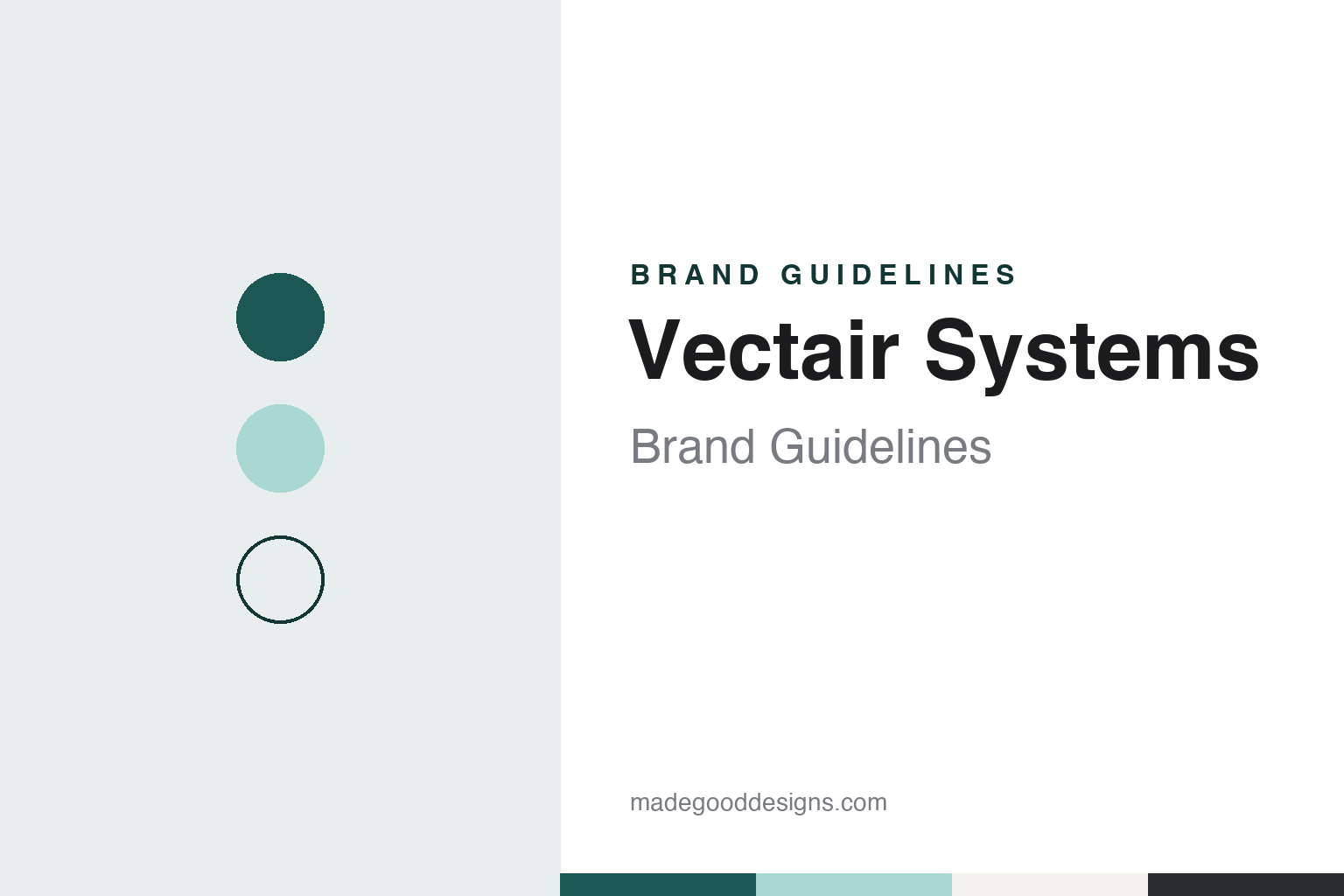
Vectair Systems Brand Guidelines
The 1988 start-up behind Airoma, V-Air and V-Screen.
Aa
Two constants: a deep teal, aqua and warm white palette and a rounded geometric sans register. Abstract homage — not a Vectair product or mark; no dispenser, logo or pack is reproduced.
A 1988 start-up
From one room in the UK to two head offices.
Vectair Systems dates from April 1988. Companies House records that the company was incorporated in England on 19 April 1988 under the name Lustre Limited and took the Vectair Systems name in early May the same year. Its registered office today is in Basingstoke, Hampshire, and the register files its business under “other manufacturing.”
The cleaning-trade newsletter The Cleanzine, marking the company’s 30th anniversary in May 2018, said Vectair was founded by Paul Wonnacott, then its chief executive, “from his small bedroom in the UK.” By that anniversary, the newsletter reported, the company had separate head offices for Europe, the Middle East and Africa and for North America, marketing offices in the UK and sales to more than 130 countries, and it chose the Interclean trade show in Amsterdam to celebrate the date. The newsletter quoted Wonnacott on the company’s pride in “the quality, design and innovation” invested in its products.
The American side came later. In its entry in the European Cleaning Journal business directory, the company says it was founded in the UK in 1988 and expanded into Memphis, Tennessee, in 2007 to support its growing presence in the Americas. Its website now calls Memphis its global headquarters and Basingstoke its EMEA head office, which it describes as placed between London and Southampton for access to major transport links. The same site gives the company more than 35 years of trading.
Colour
Aircare, urinal screens and dispensers.
Vectair describes itself as an innovator and supplier of aircare and hygiene products for business-to-business markets, sold through distributors and service companies; its website says its products are used in more than 90 countries. Its customers are facilities such as airports, offices, hotels, shopping centres, stadiums and schools rather than households.
The aircare range divides into what the company calls active and passive systems. On the active side are aerosol dispensers in the Airoma family and non-aerosol systems such as Vibe Pro, which Vectair says uses patented precision dosing, and SensaMist diffusers for larger spaces. On the passive side, the V-Air dispensers and solid refills work without batteries or propellant, according to the company. In 2018 The Cleanzine singled out V-Air Solid as a product that had won several industry awards, and quoted Wonnacott saying vibrating-mesh fragrance technology had changed the way facilities think about aircare.
The washroom side carries more of the company’s trademarked names. Its urinal screens include the 30-day V-Screen, the Wee-Screen and the 60-day P-Screen. It also lists the Quadrasan drip system for urinals and toilets, Safeseat seat-cleaning dispensers and Sanitex soap and sanitiser dispensers. Femcare disposal units and Babyminder baby-changing stations complete the range.
The company also makes products to other firms’ specifications: its website offers private-label, OEM and what it calls “OEM light” arrangements to distributors. Vectair says it designs and manufactures its products. On sustainability, it says its UK business achieved an EcoVadis Gold rating in 2026, and in July 2026 the European Cleaning Journal reported that it had joined the United Nations Global Compact, quoting the managing director, Chris Wakefield, on keeping “environmental and social responsibility at the heart” of the business.
Typography
The washroom trade.
Washroom hygiene is a design field most people meet without noticing. The hand dryer by the airport gate, the towel dispenser in an office corridor and the soap unit above a stadium basin are chosen not by the people who use them but by architects, facility managers and cleaning contractors. The makers of these products speak first to that professional buyer, and their brands are built to read clearly in a specification sheet or a trade catalogue as much as on a wall.
Much of the work is systems design. A paper towel or soap brand usually sells a dispenser together with the refill made to fit it, so the visible object on the wall carries the name while the paper, foam or gel inside is what is bought again and again. Hand dryer makers sell the opposite way: one machine, mounted once, with filters, covers and accessories around it. Both approaches lean on a small number of named ranges rather than long product lists.
Materials do much of the talking. Stainless steel fittings, white and grey plastics and plain labelling recur across catalogues, for products that may end up in very different washrooms, from a hospital to a hotel lobby. Colour tends to appear in small accents, on a cover, a light or a refill pack, rather than across the whole object.
The category also presents itself in person. Trade fairs such as Interclean and the ISSA Show, where cleaning and facility-management suppliers gather, give makers a place to launch dispensers, dryers and digital refill services, and some fairs run innovation awards of their own. The guides in this series look at how individual makers handle those shared conventions.
Aa
A rounded geometric sans for a family of trademarked product names. (Specimen set in Manrope, a sans STAND-IN; NOT the Vectair logo.)
Vectair Systems
From Basingstoke to Memphis.
The ownership records show how the company changed hands. Companies House lists a UK parent, Vectair Holdings Limited, as holding more than three-quarters of the shares from April 2016 until November 2020. From then until April 2026 the controlling shareholder was Vectair Acquisition Holdings, a limited liability company incorporated in Delaware. Since April 2026 the register has carried a statement that the company has no registrable controlling person or entity.
Leadership changed in the same period. The European Cleaning Journal reported in February 2026 that Peter Lipke had been chief executive since December 2020; he then became executive chairman, and the president, Steve Schoembs, became chief executive. Schoembs had joined in October 2025 after serving as chief executive of Royal Paper and spending nearly 20 years at Procter & Gamble, the journal said, and it described Vectair as headquartered in the US.
During Lipke’s time as chief executive Vectair bought two American companies. In June 2025 it completed the purchase of Big D Industries, an odour-control and air-freshener maker in Oklahoma City that Vectair says has more than 50 years of history, the European Cleaning Journal reported. In November 2025 Vectair announced the acquisition of WizKid Products of Dalton, Georgia, a maker of urinal screens and mats whose range includes the Splash Hog vertical urinal screen, which now appears in Vectair’s own catalogue. Big D, according to Vectair’s announcement, sells in all 50 US states and in Canada, South America, Australia and the Pacific Rim. Vectair’s website points visitors to both companies for further products.
For a design guide, Vectair Systems shows how a firm built on small washroom devices can carry a long family of trademarked product names across two continents. Compare GOJO and Rubbermaid Commercial Products, two other brands in commercial washroom hygiene. For this guide we use a deep teal, a soft aqua and a warm white with a sans, an unofficial interpretation; no product or logo is reproduced.
Explore & save
Keep Vectair Systems’s identity on hand — save it to a board in the Made Good inspiration library.
Vectair Systems identity set
Pin the Vectair Systems deep teal, aqua and warm white palette and the rounded geometric sans register to your own board.