GOJO Brand Guidelines
The Akron hand-cleaner maker whose sanitizer outgrew its name.
Aa
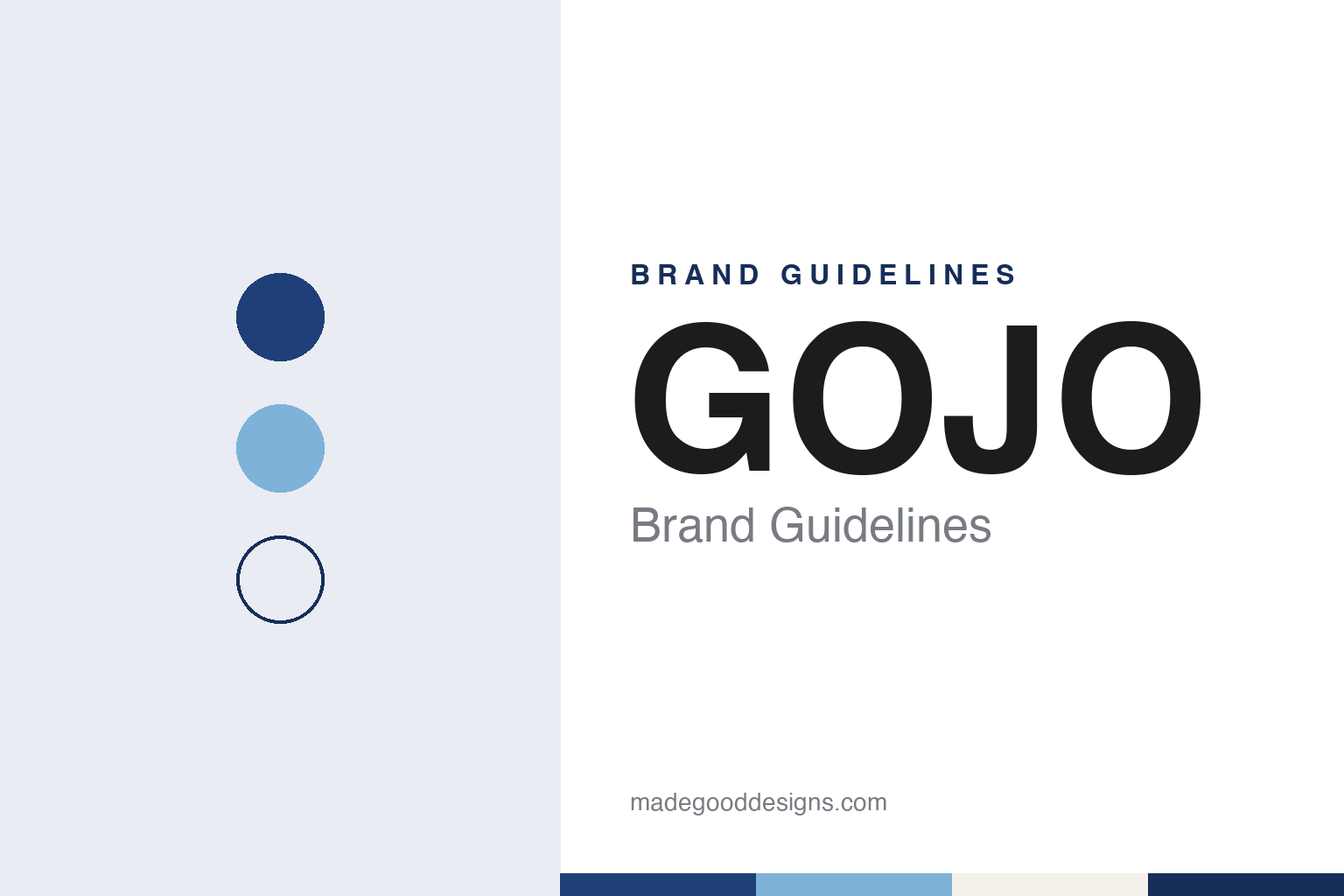
Two constants: a blue, sky and soft white palette and a clean sans register. Abstract homage — not a GOJO or Purell product or mark; no bottle, dispenser or logo is reproduced.
Akron, 1946
A hand cleaner for rubber-factory hands.
GOJO began in Akron, Ohio, in 1946. Its founders were Goldie and Jerry Lippman, and its first product, GOJO Hand Cleaner, was made to help rubber-factory workers remove carbon black and grease from their hands, according to the January 2026 announcement in which The Clorox Company set out its purchase of the business. English Wikipedia says the heavy-duty cleaner was developed with a chemistry professor at Kent State University.
The product gave the company its name. CBS News reported in April 2013 that the cleaner was called Gojo and became the namesake of the company, and that early batches were mixed in a family basement, in a washing machine.
Dispensers came next. Wikipedia says GOJO introduced a portion-control liquid soap dispenser in 1950, which Jerry Lippman patented in 1952. CBS News said he made one of the industry’s first dispensers, and that early versions were built with old window cranks. Wikipedia describes GOJO as a maker of hand hygiene and skin care products, and Clorox’s 2026 announcement lists its customers as consumers, hospitals, schools and restaurants.
The business stayed in northeast Ohio. Clorox’s announcement says the Lippman Kanfer family founded and led it for three generations in the region, and that it makes its products there.
Colour
Purell, sold and bought back.
The company’s second big brand came in the late 1980s. CBS News reported that GOJO developed an alcohol-based hand sanitizer at that time, first aimed at food-service and health-care workers, and that the name Purell was taken from the word “pure.” English Wikipedia dates Purell to 1988. Clorox’s 2026 announcement credits GOJO with inventing Purell Instant Hand Sanitizer and with an early touch-free soap dispenser; those are the buyer’s claims.
Leadership passed within the family. CBS News reported that Jerry Lippman gave Joe Kanfer half of the company when Kanfer was in his twenties. Wikipedia names Marcella Kanfer Rolnick of the family as chair, and says Carey Jaros became president and chief executive on 1 January 2020.
Purell itself changed hands twice before returning. In 2004, Wikipedia says, GOJO sold Pfizer the exclusive rights to Purell in the consumer market while keeping its industrial markets; in 2006 Pfizer sold its consumer health business, Purell included, to Johnson & Johnson; and in 2010 GOJO bought the brand back.
Other moves are recorded on Wikipedia. In 2000 GOJO bought a downtown Akron office building from the city, formerly used by Goodrich and Michelin, and made it its headquarters as One GOJO Plaza. In February 2014 it acquired Laboratoires Prodene Klint of Croissy-Beaubourg, France, and in June 2015 it launched the GOJO SMARTLINK Observation System, a mobile and web tool for recording hand-hygiene compliance in hospitals. Wikipedia says the company has offices in the United Kingdom, France, Australia, Japan and Brazil, and that its main manufacturing and distribution site is the Lippman Campus in Cuyahoga Falls, Ohio, with further factories in North America, Latin America, South America, Europe and Asia. It puts the workforce at about 2,500 people, some 600 of them at the Akron headquarters, a building of about 213,000 square feet.
The range grew around the two founding ideas, a formula and the dispenser that delivers it. Clorox’s announcement describes GOJO and Purell products as including soaps, hand sanitizers and surface products, sold to customers around the world, and CBS News reported in 2013 that Purell had first been meant for food-service and health-care settings before it reached shops for consumers. Those two names, GOJO for the original hand cleaner and Purell for the sanitizer, carried the company from a basement in Akron to factories on several continents.
Typography
Washroom equipment as a category.
Washroom hygiene is a design field most people meet without noticing. The hand dryer by the airport gate, the towel dispenser in an office corridor and the soap unit above a stadium basin are chosen not by the people who use them but by architects, facility managers and cleaning contractors. The makers of these products speak first to that professional buyer, and their brands are built to read clearly in a specification sheet or a trade catalogue as much as on a wall.
Much of the work is systems design. A paper towel or soap brand usually sells a dispenser together with the refill made to fit it, so the visible object on the wall carries the name while the paper, foam or gel inside is what is bought again and again. Hand dryer makers sell the opposite way: one machine, mounted once, with filters, covers and accessories around it. Both approaches lean on a small number of named ranges rather than long product lists.
Materials do much of the talking. Stainless steel fittings, white and grey plastics and plain labelling recur across catalogues, for products that may end up in very different washrooms, from a hospital to a hotel lobby. Colour tends to appear in small accents, on a cover, a light or a refill pack, rather than across the whole object.
The category also presents itself in person. Trade fairs such as Interclean and the ISSA Show, where cleaning and facility-management suppliers gather, give makers a place to launch dispensers, dryers and digital refill services, and some fairs run innovation awards of their own. The guides in this series look at how individual makers handle those shared conventions.
Aa
A clean sans for a hygiene maker’s plain register. (Specimen set in Work Sans, a sans STAND-IN; NOT the GOJO or Purell logo.)
Clorox Purell
The company takes its sanitizer’s name.
GOJO is no longer an independent company. On 22 January 2026 The Clorox Company announced it had agreed to acquire GOJO Industries, describing it as a family-owned business headquartered in Akron that makes its products in northeast Ohio. Clorox completed the purchase on 1 April 2026, Cleaning & Maintenance Management, the ISSA trade magazine, reported the next day, and the GOJO business now operates as Clorox Purell.
According to that report and one in Personal Care Insights on 2 April 2026, Clorox Purell remains headquartered in Akron, its existing facilities in Ashland, Cuyahoga Falls and Wooster, Ohio, stay in place, and Carey Jaros, previously GOJO’s president and chief executive, leads it as president. Clorox’s chief executive, Linda Rendle, said in the announcement that Purell was “virtually synonymous with skin hygiene.”
The GOJO name has not disappeared from the shelf. Clorox’s announcement refers to GOJO and Purell products together, naming the original GOJO Hand Cleaner, but the company that carried the GOJO name for eighty years now trades under its sanitizer’s name inside a larger group.
For a design guide, GOJO shows how a product name can outgrow the company that made it: a hand cleaner named in 1946, then a sanitizer called Purell in 1988, whose name the business now carries under its new owner. Compare Ecolab, the St. Paul cleaning and hygiene company, and Tork, a washroom brand in this series. For this guide we use an Akron blue, a clear sky blue and a soft white with a sans, an unofficial interpretation; no product or logo is reproduced.
Explore & save
Keep GOJO’s identity on hand — save it to a board in the Made Good inspiration library.
GOJO identity set
Pin the GOJO blue, sky and soft white palette and the clean sans register to your own board.