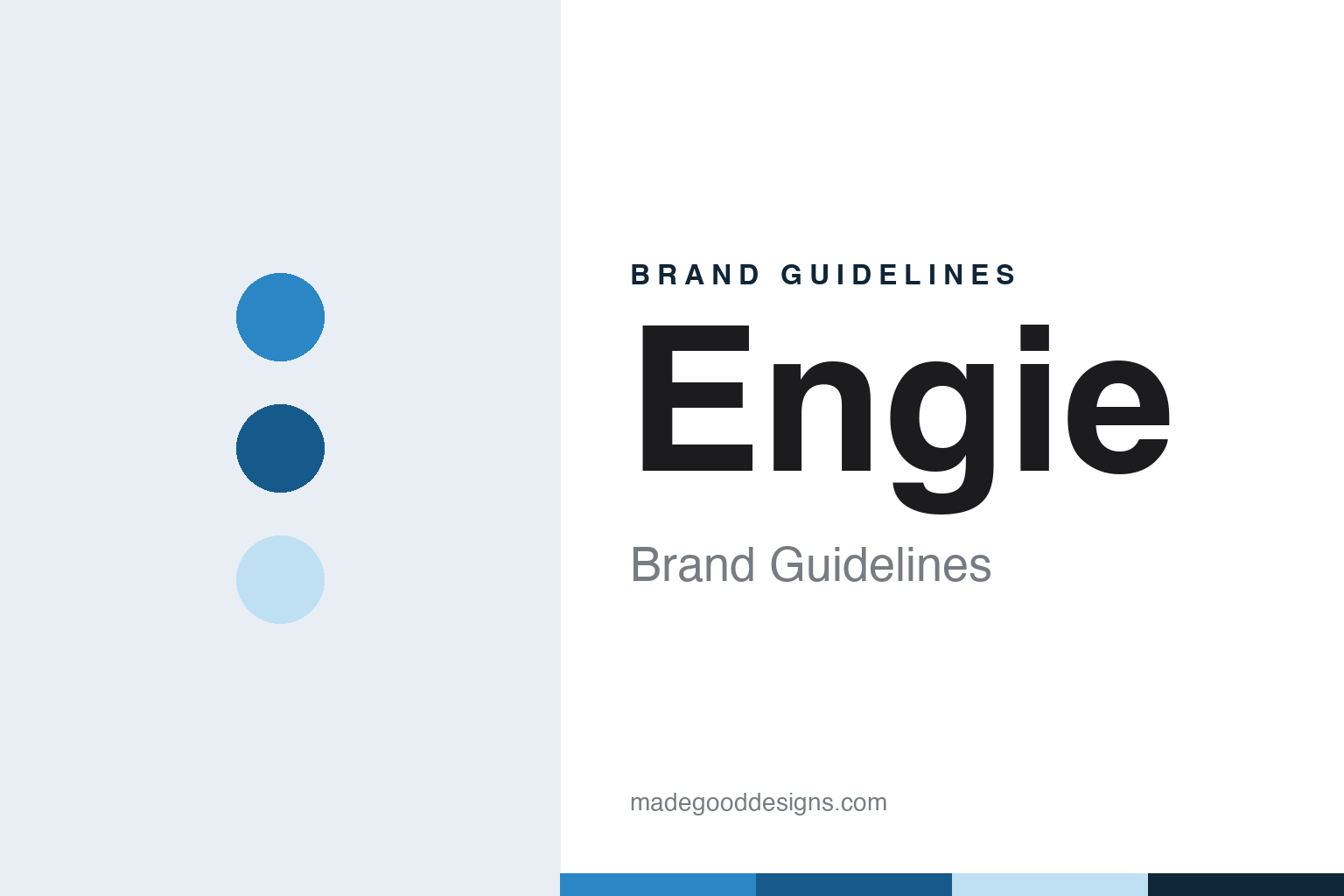
Engie Brand Guidelines
Gaz de France, Suez and a rising sun.
Aa
Two constants: an Engie sky and channel blue palette and a rounded sans register. Abstract homage — not an Engie asset; no logo, sun symbol or wordmark is reproduced.
A canal and a gas board
Two lines of descent, one 1858, one 1946.
Engie has two family trees. The older runs back to the Compagnie universelle du canal maritime de Suez, which French Wikipedia says Ferdinand de Lesseps set up on 15 December 1858 to dig and run the canal between the Mediterranean and the Red Sea; the canal opened in 1869. The construction years had a hard side. The historian Lucia Carminati, writing in The Maritime Executive in April 2021, says the company ran a system of forced labour and began conscripting thousands of Egyptian workers in 1862, alongside paid workers; that forced labour formally ended in 1864, when the new ruler Isma’il Pasha abolished it.
On 26 July 1956 Egypt nationalised the canal and transferred the company’s Egyptian assets to the Suez Canal Authority. French Wikipedia says the company, which received compensation, was renamed Compagnie financière de Suez in 1958 and turned to banking and investment. It was nationalised by France in 1982, privatised in 1987 and renamed Compagnie de Suez in 1990. Having become the main shareholder of the water and lighting company Lyonnaise des Eaux, founded in 1880, it merged with it in 1997; the group later sold its banking arms and was known as Suez.
The second tree is public. English Wikipedia says Gaz de France was created by the French government in 1946, alongside Électricité de France, when the country’s gas and electricity industries were nationalised. After Europe’s energy markets were opened up, it began selling electricity too, and part of its capital was floated on the Paris stock exchange in July 2005.
Colour
GDF Suez, 2008 to 2015.
The two lines met in a merger announced by the French government in February 2006. Because the state owned more than 80 per cent of Gaz de France, a law of 7 December 2006 was needed to allow its privatisation, English Wikipedia says. The companies agreed terms on 3 September 2007, with Gaz de France absorbing Suez, and GDF Suez came into being on 22 July 2008. The state’s holding in Gaz de France became just over 35 per cent of the new group. Suez’s water and waste businesses were spun off into a separately listed company, Suez Environnement, in which GDF Suez kept a stake.
The new group grew outside France. In August 2010 it announced a merger of its international power business with the British company International Power, taking 70 per cent, and it bought the remaining 30 per cent in July 2012. In Belgium its subsidiary Electrabel operates nuclear reactors, and its Tractebel engineering arm works on dams and power plants, French Wikipedia says. In July 2009 the European Commission fined GDF Suez and E.ON over arrangements concerning the MEGAL gas pipeline.
The state later reduced its stake. French Wikipedia says that after share sales in January and September 2017 it held 24.1 per cent of the capital, kept a special share giving it a veto over the most strategic decisions, and at the end of 2025 still held just under a quarter of the company, remaining its main shareholder. Engie is listed in Paris and Brussels and has its head office at La Défense, in Courbevoie.
Typography
How Europe’s utilities present themselves.
Many of Europe’s big electricity and gas groups began as something narrower: a regional hydro company, a national gas board, a coal-fired generator, a city lighting firm. Many of today’s names were assembled through mergers, nationalisations and privatisations, and their identities often had to stand for several older companies at once. A single short name and a simple symbol became the usual answer.
The pictures these groups choose tell the same story. Offshore wind farms standing in grey northern seas, hydro dams in mountain valleys, solar fields and transmission lines now carry more of the visual weight than power stations and chimneys. Colour often follows: greens and blues, sometimes with a warm accent for the sun, are common in the sector’s newer identities. Iberdrola’s three leaves, introduced in 2002 when it tied its brand to renewable energy, and Engie’s rising sun, adopted with the new name in 2015, are two examples.
Much of the brand now lives on screens rather than letterheads. Customers meet these companies through smart-home energy apps, online accounts and the electric-car charging points that carry their names on streets and motorways. Iberdrola, for example, redrew its logo in 2023 for digital use, with solid colours and a custom typeface shared by the companies it owns in other countries.
The sector also presents itself through long annual sustainability reports, sponsorship and industry gatherings such as Eurelectric’s Power Summit and the WindEurope annual event. This guide sets out what can be checked about each brand — where it came from, who owns it, and how its name and symbol changed — and marks clearly what rests only on the company’s own word.
Aa
A rounded sans — a short name under a rising-sun mark. (Specimen set in Nunito Sans, a sans STAND-IN; NOT the Engie logo or typeface.)
Engie
A rising sun and two syllables.
On 24 April 2015 GDF Suez announced that it was changing its name to Engie. In the company’s press release, the then chairman and chief executive Gérard Mestrallet called it “an easy name and one that is powerful,” chosen to suit the energy transition. The release says the new brand adopts the rising sun as its logo, “symbolizing a new day in the world of energy,” and takes its inspiration from the signature “By People for People.” The launch campaign ran on television, in print and online, and the release names Publicis Conseil as the agency. The trade site offshoreWIND.biz reported the change on 27 April 2015, alongside the group’s stated plan to double its renewable capacity in Europe. The international power business became Engie Energy International.
The name has since been carried into a reshaped group. English Wikipedia says Engie announced in 2015 that it would stop new investment in coal plants, reorganised in July 2021 into renewables, energy solutions, networks, and thermal and supply businesses, and agreed in November 2021 to sell its technical services arm, Equans, to Bouygues, a sale Engie said it completed on 4 October 2022. In August 2023 it bought the Houston battery storage company Broad Reach Power. After gas deliveries were disrupted in 2022, Engie began arbitration against Gazprom Export at the end of that year, citing contractual failures. In France the group also includes the gas distributor GrDF.
For a design guide, Engie shows how a merger name built from two acronyms can give way to a short invented word and a single symbol. Compare EDF Energy, the British arm of Gaz de France’s 1946 sister company, and Iberdrola, another European group built from older companies. For this guide we use a horizon blue, a deep channel blue and a pale morning sky with a sans, an unofficial interpretation; no product or logo is reproduced.
Explore & save
Keep Engie’s identity on hand — save it to a board in the Made Good inspiration library.
Engie identity set
Pin the Engie sky and channel blue palette and the rounded sans register to your own board.