Verbund Brand Guidelines
An Austrian hydro power company that faced the history of its first dam.
Aa
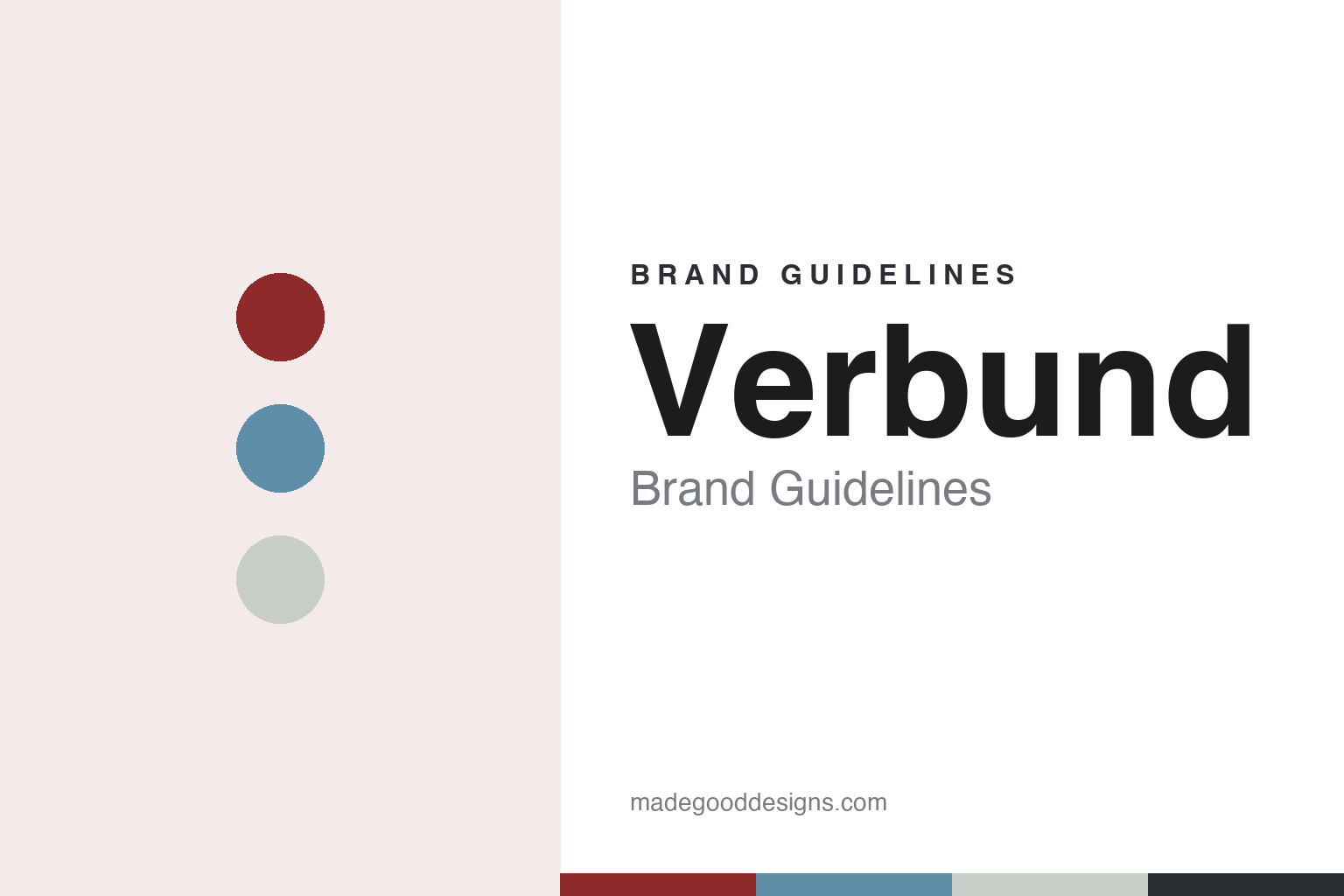
Two constants: an alpine red, glacier blue and concrete palette and an engineered grotesque register. Abstract homage — not a Verbund asset or mark; no logo, plant or product is reproduced.
Nationalised in 1947
A grid company, and an older building site.
Verbund was founded in 1947 as Österreichische Elektrizitätswirtschafts-AG, under Austria’s Second Nationalisation Act, according to English and German Wikipedia; the company’s own site gives the same year and name. German Wikipedia describes it as the successor to the Alpen-Elektrowerke and says the name comes from the Verbundnetz, the interconnected national grid it ran. Its first task after the war was to plan, build and operate large power stations and run that grid; special companies were set up to build the big hydro and thermal plants, with the Republic’s shares in them held by Verbund as trustee.
The most widely reported part of that inheritance is Kaprun, the hydro scheme in the Hohe Tauern mountains of Salzburg. Plans for using the water there went back to the late 1920s, Verbund said in 2003; German Wikipedia says the first concept was drawn up by AEG in Berlin in 1928. A few weeks after Austria was annexed by Germany in 1938, ground was broken: the Haus der Geschichte Österreich, the House of Austrian History, says Hermann Göring opened the building site in May 1938. German Wikipedia says the work was given to the Alpen-Elektrowerke, a VIAG subsidiary founded that year.
The labour was largely forced. In a September 2003 statement Verbund said that more than 6,300 civilian forced labourers and up to 4,000 prisoners of war were used at the site, and that Kaprun, “like other hydroelectric power plants in Austria,” went back largely to the Nazi wartime economy and the use of forced labourers, prisoners of war and concentration camp inmates. The House of Austrian History puts the figure at around 10,000 forced labourers between 1939 and 1945; German Wikipedia describes them as poorly equipped for high-mountain conditions and badly fed. Work slowed as materials ran short; from 1943 only an emergency programme continued, and the first generating set was started on 17 November 1944, Verbund said. Workers died on the site, and German Wikipedia says the project had practically stopped by the winter of 1942–43, when the forced labourers were moved to armaments work.
Verbund has addressed this record publicly. It said in 2003 that it had contributed to Austria’s reconciliation fund and had sponsored the historians Oliver Rathkolb and Florian Freund to study forced labour at the plants it now owns — Kaprun, Ybbs-Persenbeug on the Danube and the plants on the Drau and Enns. Their study, NS-Zwangsarbeit in der Elektrizitätswirtschaft der “Ostmark” 1938–1945, was published by Böhlau in Vienna, and on 4 September 2003 Verbund unveiled a commemorative plaque at Kaprun to the forced labourers and prisoners of war who died building it.
Colour
Kaprun, the Marshall Plan and the Danube.
After the war Kaprun became something else. From 1947 it was funded with Marshall Plan money, German Wikipedia says, and concreting of the Limberg dam began on 8 September 1948. The architect Edith Lassmann won the competition to design the crest of the Limberg dam and the upper-stage power house, and was put in charge of detailed planning and site management for the Limberg power house. The main scheme was completed in 1953 according to the House of Austrian History, while German Wikipedia dates its formal opening to 23 September 1955. For decades it served as a symbol of Austria’s post-war rebuilding — the “myth of Kaprun” — while its Nazi-era origins “were not spoken about for a long time,” the museum says. Elfriede Jelinek’s 2003 play Das Werk took up the forced labourers’ story.
By 1955, English and German Wikipedia say, Austria could again meet its electricity demand entirely from domestic sources, though fast growth meant imports were needed again from 1965. Verbund was at first wholly state-owned. In mid-1987 the nationalisation law was amended to allow a partial sale as long as 51 percent stayed with the state; at the same time Verbund took over the Republic’s shares in the special companies, among them Österreichische Donaukraftwerke and Tauernkraftwerke. In 1988 it listed on the Vienna Stock Exchange and 49 percent of the shares were sold.
Austria joined the European Union in 1995, and Verbund reorganised as a holding company with generation, trading, transmission and investment divisions ahead of the opening of the power market; it expanded abroad, starting with Germany in 1999. Between 1997 and 2000 eight of its Danube plants were leased to an American financial company and leased back in a cross-border deal, which was largely unwound in 2009, German Wikipedia says.
Verbund began selling electricity directly to Austrian customers in mid-2005 and moved into wind power from 2007. In mid-2009 it bought a chain of 13 run-of-river plants on the Inn in Bavaria from E.ON, adding eight more from E.ON later — in 2012 or 2013, as German Wikipedia gives both years. It left its Turkish joint venture EnerjiSA in 2012 as part of that exchange with E.ON. Its grid subsidiary, Austrian Power Grid, which runs Austria’s high-voltage network, was certified as an independent transmission operator on 2 March 2012.
Typography
Power companies and their public face.
Many of Europe’s big electricity and gas groups began as something narrower: a regional hydro company, a national gas board, a coal-fired generator, a city lighting firm. Many of today’s names were assembled through mergers, nationalisations and privatisations, and their identities often had to stand for several older companies at once. A single short name and a simple symbol became the usual answer.
The pictures these groups choose tell the same story. Offshore wind farms standing in grey northern seas, hydro dams in mountain valleys, solar fields and transmission lines now carry more of the visual weight than power stations and chimneys. Colour often follows: greens and blues, sometimes with a warm accent for the sun, are common in the sector’s newer identities. Iberdrola’s three leaves, introduced in 2002 when it tied its brand to renewable energy, and Engie’s rising sun, adopted with the new name in 2015, are two examples.
Much of the brand now lives on screens rather than letterheads. Customers meet these companies through smart-home energy apps, online accounts and the electric-car charging points that carry their names on streets and motorways. Iberdrola, for example, redrew its logo in 2023 for digital use, with solid colours and a custom typeface shared by the companies it owns in other countries.
The sector also presents itself through long annual sustainability reports, sponsorship and industry gatherings such as Eurelectric’s Power Summit and the WindEurope annual event. This guide sets out what can be checked about each brand — where it came from, who owns it, and how its name and symbol changed — and marks clearly what rests only on the company’s own word.
Aa
An engineered grotesque for a dam builder. (Specimen set in Archivo, a sans STAND-IN; NOT the Verbund logo.)
Verbund
“By our own power.”
Today Verbund AG is listed in the ATX, the Vienna Stock Exchange’s leading index. German Wikipedia gives its shareholders in 2025 as the Republic of Austria with 51 percent, a syndicate of the Lower Austrian utility EVN and Vienna’s municipal utility holding with more than 25 percent, the Tyrolean utility TIWAG with more than 5 percent, and less than 20 percent in free float. The company calls itself Austria’s leading energy company and one of the largest producers of hydro power in Europe, and says it generates most of its electricity from hydro, supplemented by wind, solar and thermal power. Its website carries the line “By our own power.”
Its coal era is over: German Wikipedia says coal firing at the Mellach district-heating plant ended in spring 2020. In March 2020 the supervisory board decided that Michael Strugl would succeed Wolfgang Anzengruber as chief executive at the start of 2021.
Verbund has a cultural side that suits a design guide. Since 2004 it has built the Sammlung Verbund, a collection of international contemporary art from the 1970s onward, and its power stations have been the subject of architecture books such as Architektur im Verbund, published by Springer in 2007. Through a tourism subsidiary it also promotes its plants and the valleys around them, including the Kaprun valley and the Maltatal, as places to visit.
For a design guide, Verbund shows how an engineering company can carry an honest account of its past alongside its reservoirs and power lines. Compare Statkraft, the Norwegian power company, and EnBW, from neighbouring Germany. For this guide we use an alpine red, a glacier blue and a concrete grey with a sans, an unofficial interpretation; no product or logo is reproduced.
Explore & save
Keep Verbund’s identity on hand — save it to a board in the Made Good inspiration library.
Verbund identity set
Pin the Verbund alpine red, glacier blue and concrete palette and the engineered grotesque register to your own board.