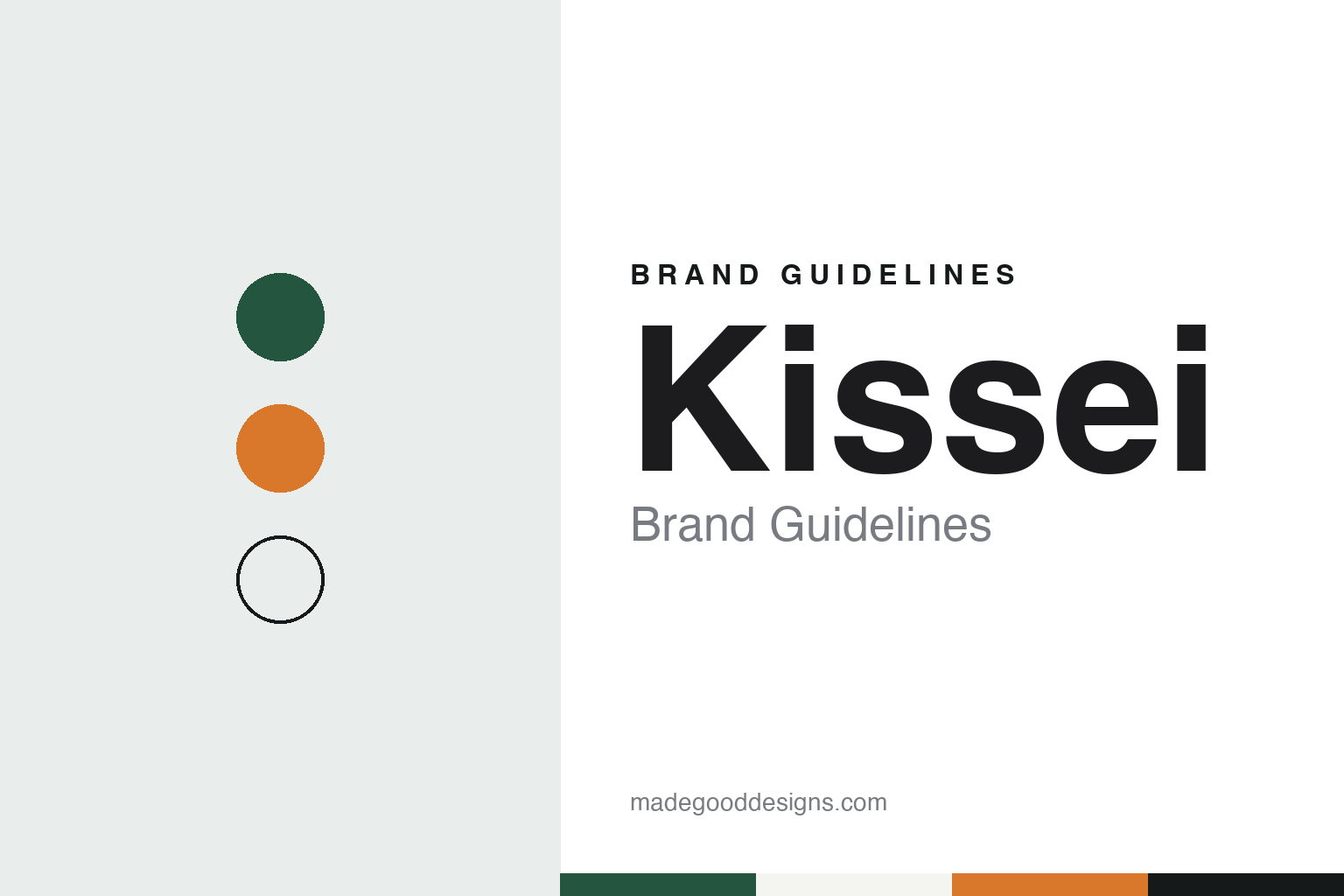
Kissei Brand Guidelines
The Matsumoto drug maker named after a nickname.
Aa
Two constants: an alpine green, slate and persimmon palette and a rounded Japanese gothic register. Abstract homage — not a Kissei product or mark; no carton, logo or water tower is reproduced.
Tachibana Seikagaku Kenkyusho
A post-war laboratory in the Nagano mountains.
Kissei Pharmaceutical began in Matsumoto, Nagano Prefecture, on 9 August 1946, a year after the end of the war. The company says it was set up as Tachibana Seikagaku Kenkyusho, the Tachibana biochemical research institute, to make medicines at a time when they, like most goods, were scarce, and that Nagano, long known as a source of crude herbal drugs, suited the work. Japanese Wikipedia gives the same founding date and records the name changes that followed.
The name is the first part of the story. In 1947 the business became Tachibana Seiyaku Kogyo, written with the two characters for “tachibana” and “sei.” The company says the intended reading of the new name was “Tachibana-sho,” but the nickname people already used, Kissei, another reading of the same characters, became the official one. In October 1964, when it moved its head office and factory to the Matsumoto site it still occupies, it switched to the katakana name Kissei Yakuhin Kogyo, Kissei Pharmaceutical.
The company tells the move with some ceremony. It says the new plant was fired up on 10 October 1964, the day of the opening ceremony of the Tokyo Olympics, and that a water tower more than 17 metres tall, painted with the Kissei name and visible from the nearby national highway and railway, became the symbol of the renamed firm. The tower no longer stores water, the company says, but it still stands in the same place as an emblem of the business.
The product that first made the name was Gascon, launched in December 1961. The company says it was used to clear gas and foamy mucus from the stomach during examinations with the gastrocamera, then coming into wide use, and that it lifted the company’s profile quickly; the company says it is still used today. Kissei’s first in-house discovery was Rizaben, launched in August 1982 for allergic conditions, with an eye-drop form following in 1995, according to the company’s timeline.
Colour
A circle held up by two letters.
Kissei is one of the few Japanese drug makers that spells out what its mark means. The company describes it as the company name enclosed in a circle, supported by two letters S. The circle, it says, stands for society, pictured as the earth, and for harmony among employees working towards an ideal; the two S shapes carry two founding principles, to contribute to society through pure, high-quality medicines and to serve society through the people of the company.
The company also makes a point of its packaging. It says it redesigned its prescription-drug cartons so that the information pharmacies need for stock control sits together in one panel, edged with perforations so that it can be torn off as a card, a format it calls the first of its kind in Japan. The design won the top Japan Star award at the 32nd Japan Packaging Contest in 2010, the company says, and a regional invention award in 2011.
On television the company keeps a quiet voice. Japanese Wikipedia says its corporate commercials share the theme of health, mostly told through scenes of nature, and close on the slogan “Ashita no kenko o mitsumeru,” roughly “looking to tomorrow’s health,” with a woman’s voice singing “Kissei, Yakuhin” as a sound logo. The company has sponsored programmes on the TV Asahi network, and between 1994 and 2011 the Nagano broadcaster Asahi Broadcasting Nagano made six “Kissei Special” documentaries on the nature and culture of the prefecture, the same source says.
Closer to home, Kissei has been the sleeve sponsor of the J.League club Matsumoto Yamaga since 2010, and since 1 July 2012 the Nagano Prefectural Matsumoto Culture Hall has carried the nickname Kissei Bunka Hall under a naming-rights agreement, Japanese Wikipedia says; the hall is the main venue of the Seiji Ozawa Matsumoto Festival.
Typography
How Japanese drug makers present themselves.
Japanese drug makers tend to present themselves through places and archives as much as through products. Research campuses carry much of the weight: Chugai began full operation of its Chugai Life Science Park Yokohama, in Kanagawa, in 2023, and earlier ran a research laboratory at Tsukuba, in Ibaraki, from 2001 to 2005; Otsuka Pharmaceutical opened an Osaka Research Center for Drug Discovery in 2022, according to the companies’ own timelines. Photographs of laboratories, glass façades and scientists at screens recur across their websites and reports.
History is the other recurring theme. Several of these companies trace their roots to the Meiji and Taisho eras, and their anniversary pages lean on archive photographs of early shopfronts, factories and founders, including the old medicine-trading streets of Doshomachi in Osaka. Chugai marked its 100th anniversary in March 2025 and the Otsuka group its centenary in 2021, and both publish detailed chronologies of how their names and symbols changed.
The visual language is mostly cool and clean. Blue and white dominate packaging and corporate marks: Chugai moved its corporate colour from green to blue in 2002, and Otsuka describes the large O of its group symbol in “Otsuka BLUE.” Alongside prescription medicines, many of these firms sell consumer products, such as health drinks, eye drops and nutrition bars, that put their names on pharmacy and convenience-store shelves; Otsuka’s Pocari Sweat, launched in 1980, is one example.
Trade shows complete the picture: booths at international partnering events such as BIO and at CPHI Japan show the companies to licensing partners and suppliers rather than to shoppers. This guide sets out what can be checked about each company — its founding, its owners, its war years and its symbols — and marks clearly what rests only on the company’s own word.
Aa
A rounded Japanese gothic — soft, regional and plain. (Specimen set in Zen Maru Gothic, a sans STAND-IN; NOT the Kissei logo.)
Kissei Pharmaceutical
A Matsumoto drug maker on the Prime market.
Kissei grew as a prescription-drug maker without leaving Nagano. It built a central research laboratory in Matsumoto in 1969, moved its research to a new centre in what is now Azumino, at the foot of the Northern Alps, in November 1990, and opened a factory at Shiojiri in 1994, the company says. It listed on the second section of the Tokyo Stock Exchange in December 1988 and on the first section in September 1991, which the company says made it the first Matsumoto-based firm there; since April 2022 its shares have traded on the Prime market. A food business started in 1990 and now sells special dietary foods such as the protein-adjusted Yume range.
Its own discoveries include the diabetes drug Glufast, launched in 2004, and Urief, a silodosin product for urinary symptoms linked to an enlarged prostate, launched in May 2006. The company says it developed Urief with Daiichi Pharmaceutical, co-markets it with Daiichi Sankyo and saw silodosin go on sale in the United States in 2009. English Wikipedia credits Kissei and ObsEva with developing linzagolix, which Kissei launched in Japan as Yselty, for uterine fibroids, in March 2026. In May 2026 the company applied for Japanese approval of olutasidenib, a leukaemia drug; that application was still pending at the time of writing.
The most serious recent episode concerns Tavneos (avacopan), a vasculitis drug developed by ChemoCentryx, which Kissei licensed for Japan in 2017 and launched in June 2022. The European Medicines Agency announced on 26 June 2026 that its human medicines committee had found the main study behind the drug was conducted in breach of good clinical practice, and recommended revoking the EU authorisation; the European Commission revoked it on 4 August 2026. In Japan, Kissei says it revised the package insert and issued a “blue letter” notice on liver problems on the health ministry’s instruction in May 2026, and that on 21 October 2026, after a ministry advisory panel found that the data submitted for approval may be unreliable, the ministry asked medical institutions not to start new patients on the drug for the time being.
For a design guide, Kissei shows how a regional drug maker can build an identity from a nickname, a circle whose meaning the company spells out and a water tower in its home town. Compare Daiichi Sankyo, its Urief partner, and Taisho Pharmaceutical, another Japanese drug maker with a long record of television advertising. For this guide we use alpine green, slate and persimmon on paper with a sans, an unofficial interpretation; no product or logo is reproduced.
Explore & save
Keep Kissei’s identity on hand — save it to a board in the Made Good inspiration library.
Kissei identity set
Pin the Kissei alpine green, slate and persimmon palette and the rounded Japanese gothic register to your own board.