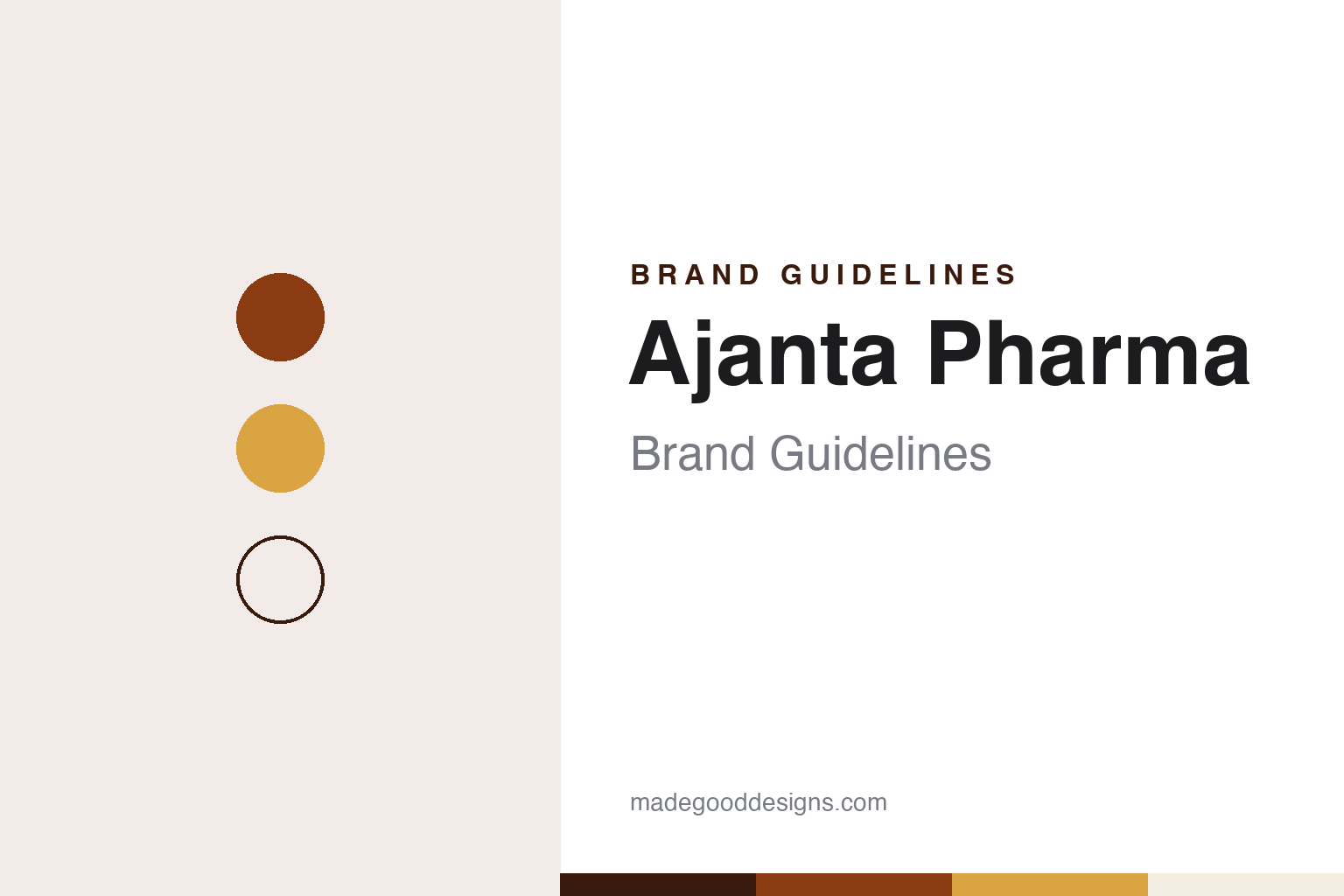
Ajanta Pharma Brand Guidelines
A Mumbai family drug maker that traded an energiser for specialty generics.
Aa
Two constants: a red-brown, gold and cream palette and a bookish serif register. Abstract homage — not an Ajanta Pharma product or mark; no pack, logo or label is reproduced.
Three brothers, 1973
A Mumbai family business and a famous energiser.
Ajanta Pharma was set up in Mumbai in 1973 by three brothers, Mannalal, Purushottam and Madhusudan Agrawal, Forbes India reported in July 2015.
For its first two decades Ajanta was a small, general maker of medicines, and its most visible product was not a prescription drug at all. In 1990 it launched 30-Plus, a herbal energiser capsule for men, according to a press release from the consumer-goods group Dabur. In the 1990s the actor Jeetendra appeared in its television advertising; Forbes India wrote in 2015 that it was the only television commercial in which he had ever endorsed a product. The capsule sold well, the magazine said, but its sales did not justify the cost of marketing it.
Ajanta let the brand go. On 3 May 2011 Dabur announced that it had entered into an agreement with Ajanta to acquire 30-Plus, describing it as part of a strategy to build its over-the-counter health-care business. The price was not disclosed.
By then the business had passed to a second generation. Forbes India reported that Ajanta had made losses for many years and was carrying heavy debt in the early 2000s, when Mannalal Agrawal’s sons Yogesh and Rajesh Agrawal joined; Rajesh told the magazine he came back from the United States in 2000. Yogesh became managing director and Rajesh joint managing director. In early 2003, the magazine reported, Yogesh persuaded the company’s lenders, including the State Bank of India and Exim Bank, to back a new plan, and the brothers wound down the old over-the-counter business and supply contracts with government health agencies.
Colour
Specialty generics and markets beyond India.
The new plan was narrow on purpose. Rajesh Agrawal told Forbes India in 2015 that Ajanta would make generic drugs in new formulations and dosages and build specialty brands, prescribed by specialists rather than general physicians, in four areas: ophthalmology, dermatology, cardiovascular medicine and pain management. English Wikipedia describes the same four areas as the focus of its branded-generic business in India today.
The magazine said that about 70% of Ajanta’s portfolio then consisted of products it had brought to India for the first time in a particular formulation or delivery form. Its examples were gatifloxacin eye drops, at a time when the drug was available only by mouth, and Met XL, a once-daily version of a cardiovascular medicine that had previously been taken two or three times a day. To sell them, the Agrawals turned the company’s field force into a specialty division that called only on specialist doctors.
Outside India, Ajanta’s growth came from emerging markets. From 2004, Forbes India reported, it expanded steadily into Africa and Asia, with antibiotics, anti-malarial and orthopaedic drugs, and by 2015 was selling in 35 countries, including Iraq, Nigeria, Cameroon and the Philippines. The magazine described Ajanta as the first Indian generic drug maker to secure World Health Organization pre-qualification for an anti-malarial, which allows agencies such as Unicef to buy it. It also reported that Ajanta built its own marketing teams in those countries instead of relying on distributors. English Wikipedia now puts the company’s reach at more than 30 countries across Africa, Southeast Asia, West Asia and the CIS, as well as the United States.
The United States came later. In 2015 Forbes India reported that Ajanta had filed 25 abbreviated new drug applications there and had secured its first approvals, including risperidone, which it had begun selling in 2014.
Typography
How Indian drug makers present themselves.
India’s drug makers are spread across several states, and some regions have become clusters. English Wikipedia’s article on the pharmaceutical industry in Gujarat calls Ahmedabad and Vadodara the state’s pharmaceutical hubs and records that the state government declared Gujarat a “pharma hub” in 2000; Torrent Pharma’s plants at Chhatral and Dahej are in the same state. Glenmark’s August 2026 factsheet lists formulation plants in Goa, Sikkim, Madhya Pradesh, Himachal Pradesh and Maharashtra, as well as in Argentina, the United States and the Czech Republic.
Many of the companies in this guide began as family firms and still carry their founders’ stories. Glenmark’s name, English Wikipedia says, was made from the names of its founder’s two sons; Torrent Pharma started in 1959 as Trinity Laboratories and belongs to a group that also runs power and gas businesses. Where a company’s history rests only on its own website, this guide says so.
The industry has its own meeting places. CPHI India, the Informa trade fair that bills itself as “the heart of South Asia’s pharma,” runs from 23 to 26 November 2026 at the IICC in Delhi, alongside the PMEC India machinery show at Greater Noida, according to its website. DCAT Week, which calls itself “the premier event for the global bio/pharmaceutical business ecosystem,” is next held in New York City from 15 to 18 March 2027.
This guide looks at how each company presents itself — in plant photographs, laboratory imagery, packs, founder portraits and corporate colours — and sets out what can be checked about each one: who founded it, who owns it and where it says its medicines are made, marking clearly what rests only on the company’s own word.
Aa
A bookish serif — warm, steady and a little old-fashioned, like the founders’ era. (Specimen set in Source Serif 4, a serif STAND-IN; NOT the Ajanta Pharma logo.)
Ajanta Pharma
Plants in Maharashtra and Gujarat, and two disputes.
Ajanta makes its medicines in India. In 2015 Forbes India listed four plants, three around Aurangabad in Maharashtra and one in Mauritius, and reported that one Aurangabad unit was approved by the US FDA and the UK’s Medicines and Healthcare products Regulatory Agency, with a new plant at Dahej in Gujarat commissioned and another at Savli planned. English Wikipedia now lists seven manufacturing facilities in India: six for finished formulations, including Dahej and Paithan, both approved by the US FDA, and a plant at Guwahati serving India and emerging markets, plus one making active ingredients mainly for its own use. The company’s main research centre is in Mumbai, the magazine said.
Two episodes are on the public record. In January 2017 the US FDA added an Ajanta-made sildenafil product, Kamagra, from the Paithan facility to its import alert 66-41 on unapproved drugs, Forbes India reported on 24 January 2017. Ajanta said the product had never been supplied to the US by the company and that there was no import alert on its facility or on any of its FDA-approved products. Separately, Bayer sued Ajanta in the Delhi High Court over patents on vardenafil; English Wikipedia says the court in January 2017 allowed Ajanta to make but not sell the product, and that the two companies reached an agreement after court-ordered mediation in February 2017.
Ajanta Pharma Limited is listed in India and has its headquarters in Mumbai; Forbes India described it in 2015 as a family company led by the founders’ second generation.
For a design guide, Ajanta Pharma shows a company that moved its identity from a mass-market advertising brand to quiet specialist prescription ranges. Compare Sun Pharma and Cipla, two other Mumbai drug makers. For this guide we use a red-brown, a saffron gold and a cream with a serif, an unofficial interpretation; no product or logo is reproduced.
Explore & save
Keep Ajanta Pharma’s identity on hand — save it to a board in the Made Good inspiration library.
Ajanta Pharma identity set
Pin the Ajanta Pharma red-brown, gold and cream palette and the bookish serif register to your own board.