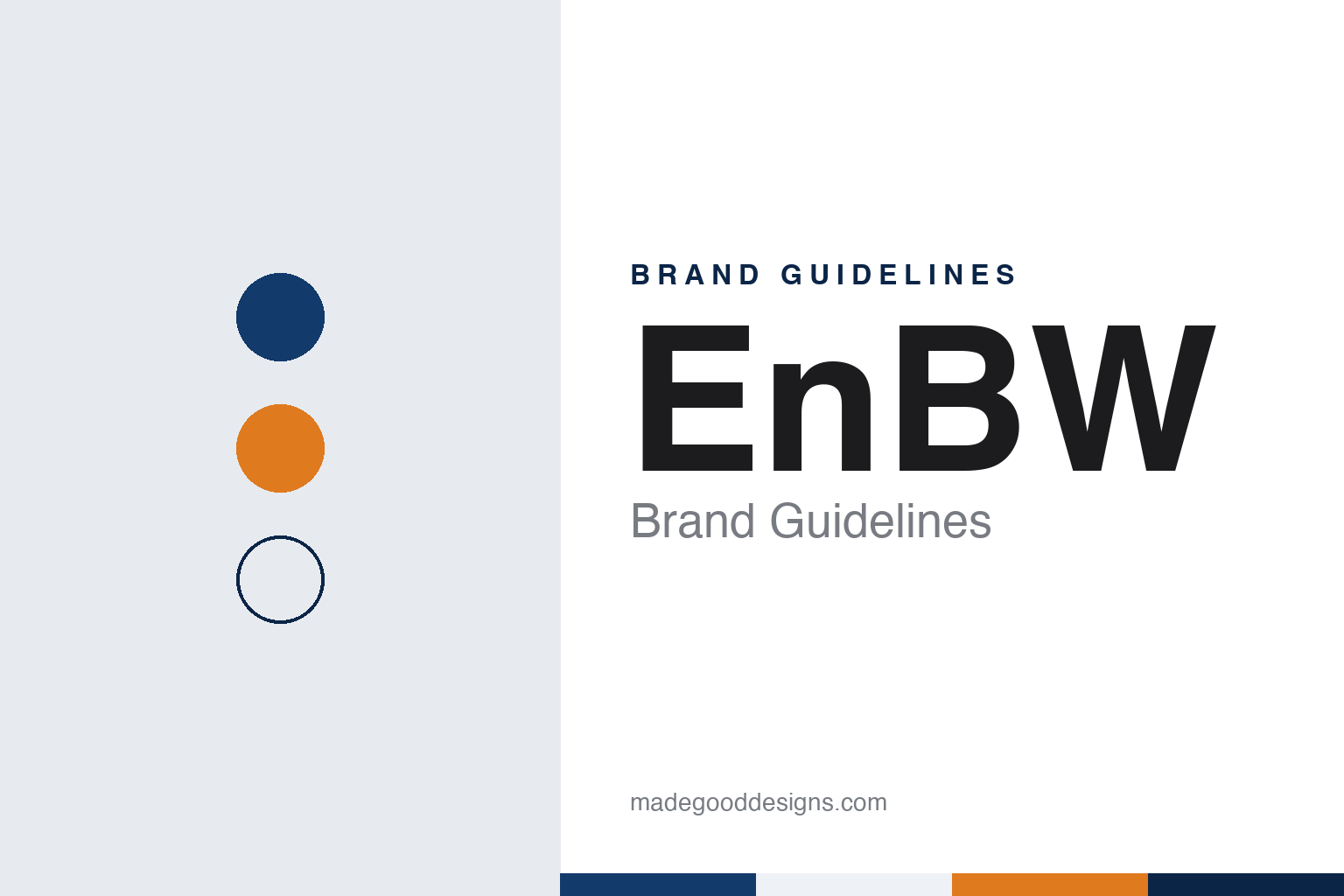
EnBW Brand Guidelines
The Karlsruhe group that merged two southern utilities and turned toward wind and grids.
Aa
Two constants: a deep blue and orange palette and a plain utility sans register. Abstract homage — not an EnBW asset or mark; no logo, wind farm or charging point is reproduced.
Two utilities, one name
Badenwerk, EVS and a four-letter abbreviation.
EnBW is a merger, not a foundation. EnBW Energie Baden-Württemberg AG came into being with effect from 1 January 1997, when the two big power companies of Germany’s south-west, Badenwerk AG of Karlsruhe and Energie-Versorgung Schwaben AG (EVS), joined together, English and German Wikipedia say. German Wikipedia traces the plan back to the late 1980s, when the region’s four large suppliers — Badenwerk, EVS, Neckarwerke and the Technische Werke der Stadt Stuttgart — set up a joint energy-research foundation in February 1989 as Europe moved towards open electricity markets. A first merger, planned for 1993 and cleared by the federal competition authority, was stopped by Badenwerk’s supervisory board.
The second attempt went through. The shareholders’ meetings of both companies approved the merger on 20 August 1997, backdated to the start of the year, and the new company was called Energie Baden-Württemberg AG, shortened to EBW. In January 1998, German Wikipedia says, the short name was changed from EBW to EnBW “for marketing reasons,” and a first advertising campaign under the new name followed. By July 1999 the two old regional companies had been folded into a single grid company and a shared service company, completing the merger in day-to-day operations. In October 2003 EnBW also merged with Neckarwerke Stuttgart.
The older of the two partners was public from the start. German Wikipedia says the parliament of the Republic of Baden decided on 1 July 1921 to found the Badische Landes-Elektrizitäts-Versorgungs AG, with all its capital held by the state; its core was the Murgwerk, a state hydropower station on the river Murg at Forbach built during the First World War. The company built up Baden’s high- and medium-voltage network, began linking its grid with Switzerland from 1926, and took the name Badenwerk AG in 1938. The sources used for this guide do not describe the record of Badenwerk or of EVS in the Nazi years, 1933–45, including whether forced labour was used. The duty to keep all of its capital in state hands was lifted in 1970, though the state remained its main shareholder.
Colour
Shareholders, a nuclear exit and a turn to wind.
EnBW’s ownership has moved between public and private hands and back. In January 2000 the state of Baden-Württemberg sold its 25.1 per cent stake to the French group Électricité de France (EDF), German Wikipedia’s EnBW article says; its Badenwerk article dates the sale to 1999. At the end of 2010 the state bought a 45 per cent stake back from EDF. In October 2011 the state’s constitutional court ruled that the previous government had acted unconstitutionally by bypassing the state parliament on the purchase; the state and EDF then took the price to arbitration at the International Chamber of Commerce in Paris, and in 2016 both claims were dismissed, German Wikipedia says.
Nuclear power shaped the group’s first years. German Wikipedia says that well over half of its profit in 2010 came from its nuclear stations. After the Fukushima disaster in March 2011, Germany’s government ordered a moratorium under which the Philippsburg 1 and Neckarwestheim 1 reactors were shut down; they lost their operating licences when the nuclear phase-out law was passed in August 2011. Neckarwestheim, Obrigheim and Philippsburg are all listed today as decommissioned.
The response was a change of direction. At the end of 2012 the new chief executive announced that the share of renewables in the group’s generation would rise from 12 to 40 per cent by 2020; German Wikipedia gives 40.1 per cent of installed capacity for 2021 and 46.9 per cent for 2023. Much of that came from the sea. EnBW Baltic 1, with 21 turbines, began operating in the Baltic in 2011, followed by Baltic 2, with 80 turbines, in early summer 2015. In the North Sea, Hohe See and Albatros, with 87 turbines and 609 megawatts between them, went into operation in early 2020, and construction of a third North Sea farm, He Dreiht, planned at 900 megawatts, officially began in May 2024, German Wikipedia says. On land, the group runs wind farms across Baden-Württemberg and other German states, in Sweden, and in France through Valeco, which it bought in June 2019.
Hydropower still links the group to its roots: the Rudolf-Fettweis-Werk at Forbach on the Murg, run-of-river stations on the Upper and High Rhine, the Iller and the Neckar, and pumped storage at Glems and in the Schluchsee scheme appear in German Wikipedia’s list of its plants. In March 2023 EnBW announced that it intended to stop using coal by 2028.
Typography
How utilities present themselves.
Many of Europe’s big electricity and gas groups began as something narrower: a regional hydro company, a national gas board, a coal-fired generator, a city lighting firm. Many of today’s names were assembled through mergers, nationalisations and privatisations, and their identities often had to stand for several older companies at once. A single short name and a simple symbol became the usual answer.
The pictures these groups choose tell the same story. Offshore wind farms standing in grey northern seas, hydro dams in mountain valleys, solar fields and transmission lines now carry more of the visual weight than power stations and chimneys. Colour often follows: greens and blues, sometimes with a warm accent for the sun, are common in the sector’s newer identities. Iberdrola’s three leaves, introduced in 2002 when it tied its brand to renewable energy, and Engie’s rising sun, adopted with the new name in 2015, are two examples.
Much of the brand now lives on screens rather than letterheads. Customers meet these companies through smart-home energy apps, online accounts and the electric-car charging points that carry their names on streets and motorways. Iberdrola, for example, redrew its logo in 2023 for digital use, with solid colours and a custom typeface shared by the companies it owns in other countries.
The sector also presents itself through long annual sustainability reports, sponsorship and industry gatherings such as Eurelectric’s Power Summit and the WindEurope annual event. This guide sets out what can be checked about each brand — where it came from, who owns it, and how its name and symbol changed — and marks clearly what rests only on the company’s own word.
Aa
A plain utility sans for a group that renamed itself for marketing reasons. (Specimen set in Source Sans 3, a sans STAND-IN; NOT the EnBW logo.)
EnBW
Owned by the state and its councils.
Today EnBW is still largely public. Its two main shareholders, English Wikipedia says, are NECKARPRI-Beteiligungsgesellschaft, wholly owned by the state of Baden-Württemberg, and Oberschwäbische Elektrizitätswerke (OEW), owned by local authorities, each with 46.75 per cent. The head office is in Karlsruhe, with central functions also in Stuttgart. The company says it has 5.5 million electricity and gas customers and is active in Austria, the Czech Republic, France, Switzerland, Turkey and the UK as well as Germany.
The group works under several names, which matters for its identity. Its grid company was renamed Netze BW in February 2014; German Wikipedia says energy law required the network business to set itself apart from EnBW in name and appearance, so that customers would not confuse grid and sales. The household brand Yello, based in Cologne, is part of the group, and in July 2020 the hydropower brand NaturEnergie+ was merged into it. The high-voltage grid company TransnetBW is another; in 2023 EnBW sold about a quarter of it to a consortium led by savings banks, and the state development bank KfW took a 24.95 per cent minority stake the same year, English Wikipedia says.
Charging is now a large part of the business. German Wikipedia says the group has worked on electric mobility since 2008; since March 2017 it has built charging points with Tank & Rast, which runs service areas on the German autobahn, and its EnBW mobility+ app finds and pays for charging across several countries. In March 2018 it bought the Leipzig home-battery maker SENEC, and in April 2024 it opened a fast-charging park in Lichtenau near Chemnitz with a timber roof and a children’s playground. The company calls its fast-charging network the EnBW HyperNet. In sport, it has long sponsored VfB Stuttgart and Karlsruher SC, and gives its name to the EnBW-Oberliga for young footballers.
For a design guide, EnBW shows how a merged regional utility built one name out of two and then spread it across wind farms, grids and charging bays. Compare Verbund, a neighbouring hydropower group in Austria, and E.ON Next, a German group’s household brand in Britain. For this guide we use a deep blue, an orange and a cool grey with a sans, an unofficial interpretation; no product or logo is reproduced.
Explore & save
Keep EnBW’s identity on hand — save it to a board in the Made Good inspiration library.
EnBW identity set
Pin the EnBW deep blue and orange palette and the plain utility sans register to your own board.