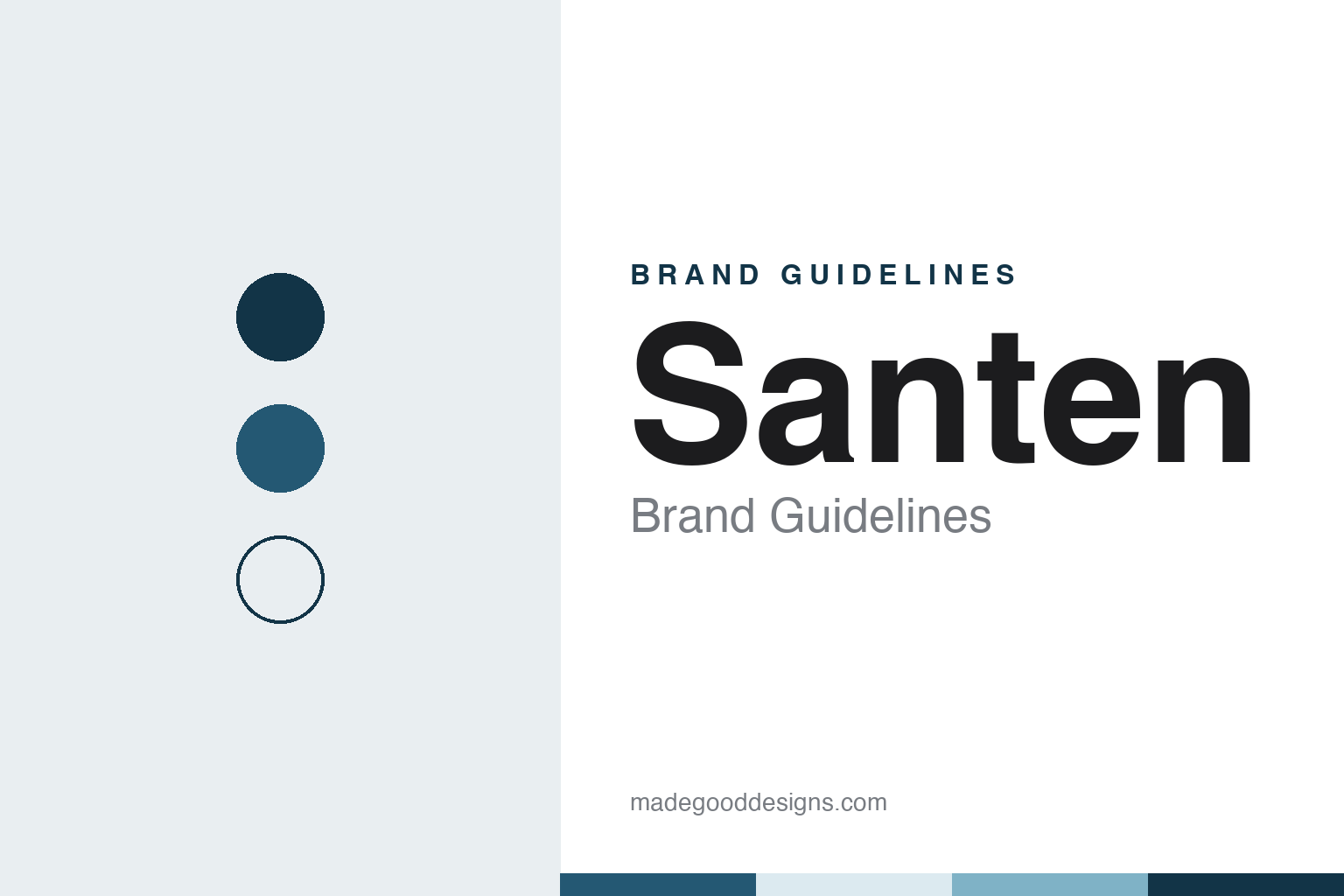
Santen Brand Guidelines
The Osaka eye-drop maker that began with a cold remedy in 1890.
Aa
Two constants: a deep lake blue and clear mist palette and a clean geometric sans register. Abstract homage — not a Santen product or mark; no bottle, logo or pack is reproduced.
Taguchi Santendo
A cold remedy in Kitahama, then a university eye drop.
Santen began in Osaka in 1890, when Kenkichi Taguchi opened a medicine business called Taguchi Santendo in Kitahama, according to the company’s annual securities report filed with Japan’s Financial Services Agency. Its first product was not an eye drop but a cold remedy, sold as Heburin-gan.
The turn came in 1899. The report says the company developed an eye medicine based on a prescription in general use at the hospital of Tokyo Imperial University and sold it under the trademark Daigaku Megusuri — “university eye drops” — and that the business grew sharply as a result. Japanese Wikipedia says Daigaku eye drops are still on sale more than 125 years later.
The name has a scholarly source. Japanese Wikipedia says “Santen” was taken from the Doctrine of the Mean, one of the Confucian Four Books, from a passage about taking part alongside heaven and earth, and that the company’s philosophy of “participating in the workings of heaven” comes from the same line. It also notes, as a coincidence, that santé means health in French.
Growth brought a new structure. In 1914 a limited partnership, Santendo, was formed with Taguchi and Tadayuki Mita as its main investors, the report says, and in July 1925 Santendo Co., Ltd. was established, taking over the partnership’s business with Mita as president.
The war years appear in the record as moves rather than products. In 1935 the company opened its Yodogawa plant, later called the Osaka plant, in what is now Higashiyodogawa ward. In 1944 it moved its head office from Kitahama into the grounds of that plant, and in March 1945 it changed its name to Santendo Seiyaku — adding the word for pharmaceuticals “to show its business clearly,” the securities report says. Japanese Wikipedia says cold remedies remained its main line until the war and that afterwards it concentrated on eye medicines. The sources used for this guide do not say whether forced or conscripted labour was used at the company during the war.
Colour
Plastic bottles, prescription drops and an eye-only company.
The modern name arrived in June 1958, when the company became Santen Seiyaku — Santen Pharmaceutical — as it began selling prescription medicines, according to the securities report. Japanese Wikipedia says that in 1962 it launched Super Sante, the first eye drops sold in a plastic container in Japan; until then eye drops had come in glass bottles that broke easily. The shares were listed in Osaka in 1963 and in Tokyo in 1964.
Expansion abroad began in the 1990s. Santen set up Santen Inc. in Napa, California, in 1993; in 1997 it founded Santen Oy in Tampere, Finland, and bought the Finnish eye-medicine maker Star. It went on to buy Advanced Vision Science, an American maker of eye-care devices, in 2001, and the French ophthalmic company Novagali Pharma in 2011, later renamed Santen S.A.S. In July 2014 it acquired a portfolio of ophthalmic medicines and related rights from Merck & Co., the securities report says.
The decisive narrowing came in August 2015, when Santen transferred its anti-rheumatic medicines business to Ayumi Pharmaceutical. Japanese Wikipedia says that this left Santen a drug maker specialised in ophthalmology, and that in Japan it holds the largest share of prescription eye drops and the second-largest share of over-the-counter eye drops, behind Rohto.
On the shop shelf the brand is Sante, the name on most of its consumer eye drops, which Japanese Wikipedia says is a registered trademark the company defends. Its packaging has drawn designers: Japanese Wikipedia says the perfume-bottle-like bottle and box of Sante Beauteye, launched in May 2013, were designed by Tokujin Yoshioka, and it records limited Sante FX editions made with the animated film Evangelion: 3.0 in 2012.
One episode tested the shelf brand. In June 2000 the company received a threat claiming that its consumer eye drops had been tampered with; it withdrew the products from stores and, between September and December 2000, returned them to sale in a plastic outer wrapping, Japanese Wikipedia says.
Typography
Design and documentation.
Japanese drug makers tend to present themselves through places and archives as much as through products. Research campuses carry much of the weight: Chugai began full operation of its Chugai Life Science Park Yokohama, in Kanagawa, in 2023, and earlier ran a research laboratory at Tsukuba, in Ibaraki, from 2001 to 2005; Otsuka Pharmaceutical opened an Osaka Research Center for Drug Discovery in 2022, according to the companies’ own timelines. Photographs of laboratories, glass façades and scientists at screens recur across their websites and reports.
History is the other recurring theme. Several of these companies trace their roots to the Meiji and Taisho eras, and their anniversary pages lean on archive photographs of early shopfronts, factories and founders, including the old medicine-trading streets of Doshomachi in Osaka. Chugai marked its 100th anniversary in March 2025 and the Otsuka group its centenary in 2021, and both publish detailed chronologies of how their names and symbols changed.
The visual language is mostly cool and clean. Blue and white dominate packaging and corporate marks: Chugai moved its corporate colour from green to blue in 2002, and Otsuka describes the large O of its group symbol in “Otsuka BLUE.” Alongside prescription medicines, many of these firms sell consumer products, such as health drinks, eye drops and nutrition bars, that put their names on pharmacy and convenience-store shelves; Otsuka’s Pocari Sweat, launched in 1980, is one example.
Trade shows complete the picture: booths at international partnering events such as BIO and at CPHI Japan show the companies to licensing partners and suppliers rather than to shoppers. This guide sets out what can be checked about each company — its founding, its owners, its war years and its symbols — and marks clearly what rests only on the company’s own word.
Aa
A clean geometric sans for a clinical brand. (Specimen set in Manrope, a sans STAND-IN; NOT the Santen logo.)
Santen
One name, one field, Osaka roots.
The corporate identity was simplified in July 2020. Japanese Wikipedia says that on 7 July 2020 the company unified its corporate brand name as “Santen” and replaced its slogan “A Clear Vision for Life” with “Imagine Your Happiness”, with versions in Japanese and Chinese.
Santen is still an Osaka company. It moved its head-office functions from Higashiyodogawa to Kita ward in June 2013 — to the Grand Front Osaka development, Japanese Wikipedia says — and moved its registered head office there in January 2020; the old head office and Osaka plant site was sold in 2018, according to the securities report. Its shares have traded on the Prime Market of the Tokyo Stock Exchange since April 2022.
Where its products are made is set out in its filings. The company opened the Noto plant in Ishikawa prefecture in January 1985 and the Shiga plant, now the Shiga Product Supply Center, in July 1996, adding a third building there in June 2023; it set up Santen Pharmaceutical (China) in Suzhou in 2005, and English Wikipedia lists Suzhou among its plants. The Finnish plant at Tampere was transferred to Next Pharma in September 2019, the securities report says. Research is based at the Nara Research and Development Center in Ikoma, opened in 1996.
Recent years have brought both new ventures and retreats. In 2020 Santen formed a joint venture with Verily Life Sciences, Twenty Twenty Therapeutics, and bought Eyevance Pharmaceuticals in the United States; in July 2023 it transferred some prescription products in the Americas to Harrow, and in March 2025 the Verily joint venture was wound up, according to the securities report.
For a design guide, Santen shows how a company can narrow its whole identity to one organ and one category, from a university eye drop of 1899 to a single global name. Compare Takeda, another Osaka drug maker with Meiji-era roots, and Sumitomo Pharma. For this guide we use a deep lake blue, a night teal and a clear mist with a sans, an unofficial interpretation; no product or logo is reproduced.
Explore & save
Keep Santen’s identity on hand — save it to a board in the Made Good inspiration library.
Santen identity set
Pin the Santen deep lake blue and clear mist palette and the clean geometric sans register to your own board.