Statkraft Brand Guidelines
The Norwegian state’s waterfalls, turned into a company.
Aa
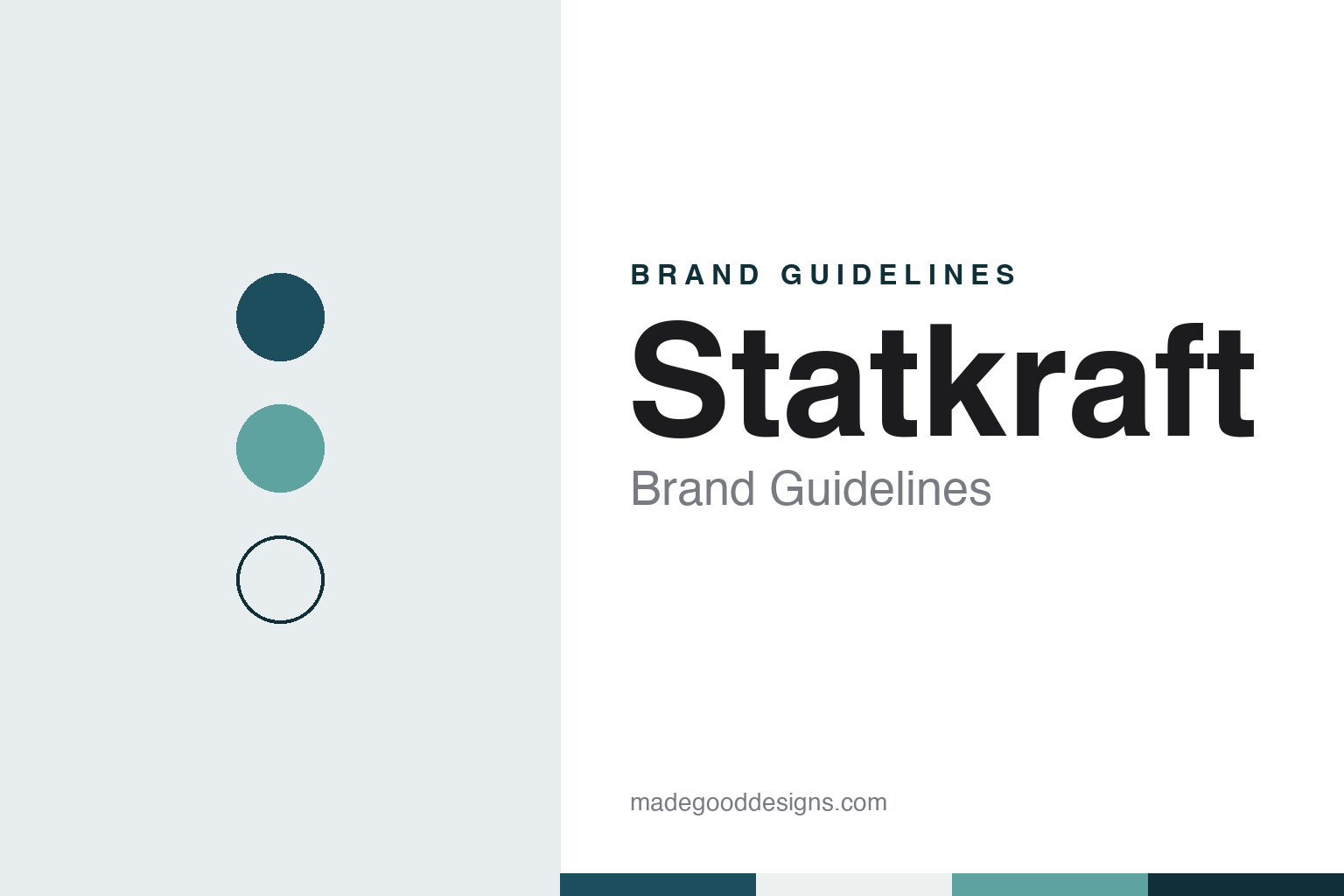
Two constants: a fjord teal and glacier green palette and a Nordic grotesque register. Abstract homage — not a Statkraft asset or mark; no logo, dam or power station is reproduced.
A waterfall in 1895
The state buys its first falls.
Statkraft’s story starts with a waterfall. In 1895 the Norwegian state bought its first power site, Paulenfossen on the Otra river system in the south of the country, Norwegian Wikipedia says; the company itself says it has developed “ever since 1895.” Between 1907 and 1920 the state spent heavily on waterfall rights and became northern Europe’s largest owner of hydropower, according to Norwegian Wikipedia, in the years when Norway was becoming an industrial country built on cheap electricity.
For most of the twentieth century there was no company called Statkraft. The state’s plants and lines were run by its waterways administration — first the canal authority, Kanalvesenet, and from 1921 the body that became today’s Norwegian Water Resources and Energy Directorate, NVE, the encyclopedia Store norske leksikon says. It describes the state’s building of power stations and lines as an important tool in the electrification and industrialisation of Norway.
The German occupation of 1940–45 touched sites that Statkraft owns today. Store norske leksikon says that in December 1940 the German occupation authorities started work on the Aura scheme in Sunndal to power an aluminium plant at Sunndalsøra; work stopped again in spring 1942, and after the war the rights passed to the state. At Glomfjord in Nordland, it says, the Germans began enlarging the power station to raise aluminium output for Nordag, a company meant to supply light metal to German armaments production, until Allied saboteurs blew up the pipes and two generating sets on 21 September 1942, in the raid known in English as Operation Musketoon. The sources used for this guide do not say how the state’s own power plants were run during the occupation or whether forced labour was used at them.
The great state build-out came after the war. In the 1950s the state built large stations across the country, among them Aura, put into service between 1953 and 1956, the Røssåga plants in Nordland and Tokke in Telemark. The last of the giant schemes, Ulla-Førre in Rogaland, was finished in 1988; its Kvilldal station is Norway’s largest hydropower station by installed capacity, Store norske leksikon says.
Colour
From a directorate to a company.
Statkraft was carved out in two steps. In 1986 the building and running of the state’s power stations and lines was split off from NVE as a separate state enterprise, Statskraftverkene. After Norway’s energy law was changed in 1991, that body was divided on 1 January 1992 into two independent state enterprises: Statkraft SF, which would compete in the power market, and Statnett SF, which took over the national grid and links abroad, Store norske leksikon and Norwegian Wikipedia say.
Ownership stayed with the state as the form changed. Norwegian Wikipedia dates the move of ownership from the Ministry of Petroleum and Energy to the Ministry of Trade and Industry to 1 January 2002, while Store norske leksikon links it to 2004, when Statkraft became a limited company, Statkraft AS, still wholly owned by the state; Norwegian Wikipedia says the state enterprise Statkraft SF owns the company. In the 1990s and 2000s it bought into several regional power companies in Norway; in 2002 it bought all the power stations of Trondheim Energi Kraft, and in 2005 it bought 19 Swedish and 4 Finnish stations from E.ON Sweden, formerly Sydkraft, Store norske leksikon says.
The largest step abroad was an exchange with E.ON. English Wikipedia says the two signed a letter of intent in 2007; Norwegian Wikipedia says the swap was carried out in 2009, giving Statkraft hydropower plants, district-heating plants and gas-fired stations in Germany, Sweden and the UK, together with shares in E.ON AG, in return for its shares in E.ON Sverige. Norwegian Wikipedia calls it the largest deal any Norwegian company had made abroad up to then.
Statkraft also moved beyond water. Norway’s first wind farm, at Smøla in Møre og Romsdal, opened in 2002. On 11 March 2010 Statkraft opened its first solar park, Casale, at Aprilia south of Rome, which it no longer owns. From 2009 to 2014 it ran a salt-power prototype at Tofte on the Oslofjord, testing osmotic power from the meeting of fresh and salt water, Norwegian Wikipedia says. Later purchases include the solar developer Solarcentury in November 2020 and the Spanish wind and solar company Enerfin, agreed in November 2023 and completed in May 2024, according to Store norske leksikon and English Wikipedia.
Typography
How utilities present themselves.
Many of Europe’s big electricity and gas groups began as something narrower: a regional hydro company, a national gas board, a coal-fired generator, a city lighting firm. Many of today’s names were assembled through mergers, nationalisations and privatisations, and their identities often had to stand for several older companies at once. A single short name and a simple symbol became the usual answer.
The pictures these groups choose tell the same story. Offshore wind farms standing in grey northern seas, hydro dams in mountain valleys, solar fields and transmission lines now carry more of the visual weight than power stations and chimneys. Colour often follows: greens and blues, sometimes with a warm accent for the sun, are common in the sector’s newer identities. Iberdrola’s three leaves, introduced in 2002 when it tied its brand to renewable energy, and Engie’s rising sun, adopted with the new name in 2015, are two examples.
Much of the brand now lives on screens rather than letterheads. Customers meet these companies through smart-home energy apps, online accounts and the electric-car charging points that carry their names on streets and motorways. Iberdrola, for example, redrew its logo in 2023 for digital use, with solid colours and a custom typeface shared by the companies it owns in other countries.
The sector also presents itself through long annual sustainability reports, sponsorship and industry gatherings such as Eurelectric’s Power Summit and the WindEurope annual event. This guide sets out what can be checked about each brand — where it came from, who owns it, and how its name and symbol changed — and marks clearly what rests only on the company’s own word.
Aa
A Nordic grotesque for a company named for the state’s power. (Specimen set in Barlow, a sans STAND-IN; NOT the Statkraft logo.)
Statkraft
Still owned by the state.
Today Statkraft AS has its head office at Lilleaker in Oslo and answers to the Ministry of Trade, Industry and Fisheries, Store norske leksikon says. In Norway it ran 347 hydropower stations in 2025, which produced a little over 40 per cent of the country’s hydropower, and its Norwegian stations are controlled from operating centres at Gaupne, Korgen and Dalen. The company describes itself as “Europe’s largest renewable energy producer”; it also produces wind, solar and gas-fired power, and trades energy across Europe, South America and Asia. Several of its stations, among them Glomfjord, Nore, Nea, Alta and Svartisen, are listed as cultural monuments of Norwegian power production; Glomfjord’s station building of 1920 was designed by the architect Olaf Nordhagen.
Wind has also brought Statkraft into court. It is the largest owner of Fosen Vind, Store norske leksikon says. In October 2021 Norway’s Supreme Court, sitting as a grand chamber, ruled unanimously that the licence decisions for the Roan and Storheia wind farms on the Fosen peninsula were invalid, because the development breached the right of Sámi reindeer herders to practise their culture under Article 27 of the UN Covenant on Civil and Political Rights. The turbines kept running, and protests followed in 2023. Mediation led to an agreement between Fosen Vind and the Sør-Fosen sijte in December 2023, and between Roan Vind and the Nord-Fosen siida in March 2024, covering compensation and replacement winter grazing land; the first agreement also gives the Sør-Fosen sijte a veto over continued operation after the current 25-year licence period, Store norske leksikon says.
The group keeps changing shape. Its district-heating business in Trondheim and Stjørdal was sold to Lunera Energi from 1 December 2025, and in 2026 it was given approval to build 85 turbines at Hästliden in Sweden, the third part of the Markbygden project, Store norske leksikon says.
For a design guide, Statkraft shows how a state utility can carry more than a century of waterfalls into a modern company without changing owner. Compare Vattenfall, Sweden’s state power company with its own waterfall roots, and Ørsted, a Danish group that renamed itself around wind. For this guide we use a fjord teal, a glacier green and a granite grey with a sans, an unofficial interpretation; no product or logo is reproduced.
Explore & save
Keep Statkraft’s identity on hand — save it to a board in the Made Good inspiration library.
Statkraft identity set
Pin the Statkraft fjord teal and glacier green palette and the Nordic grotesque register to your own board.