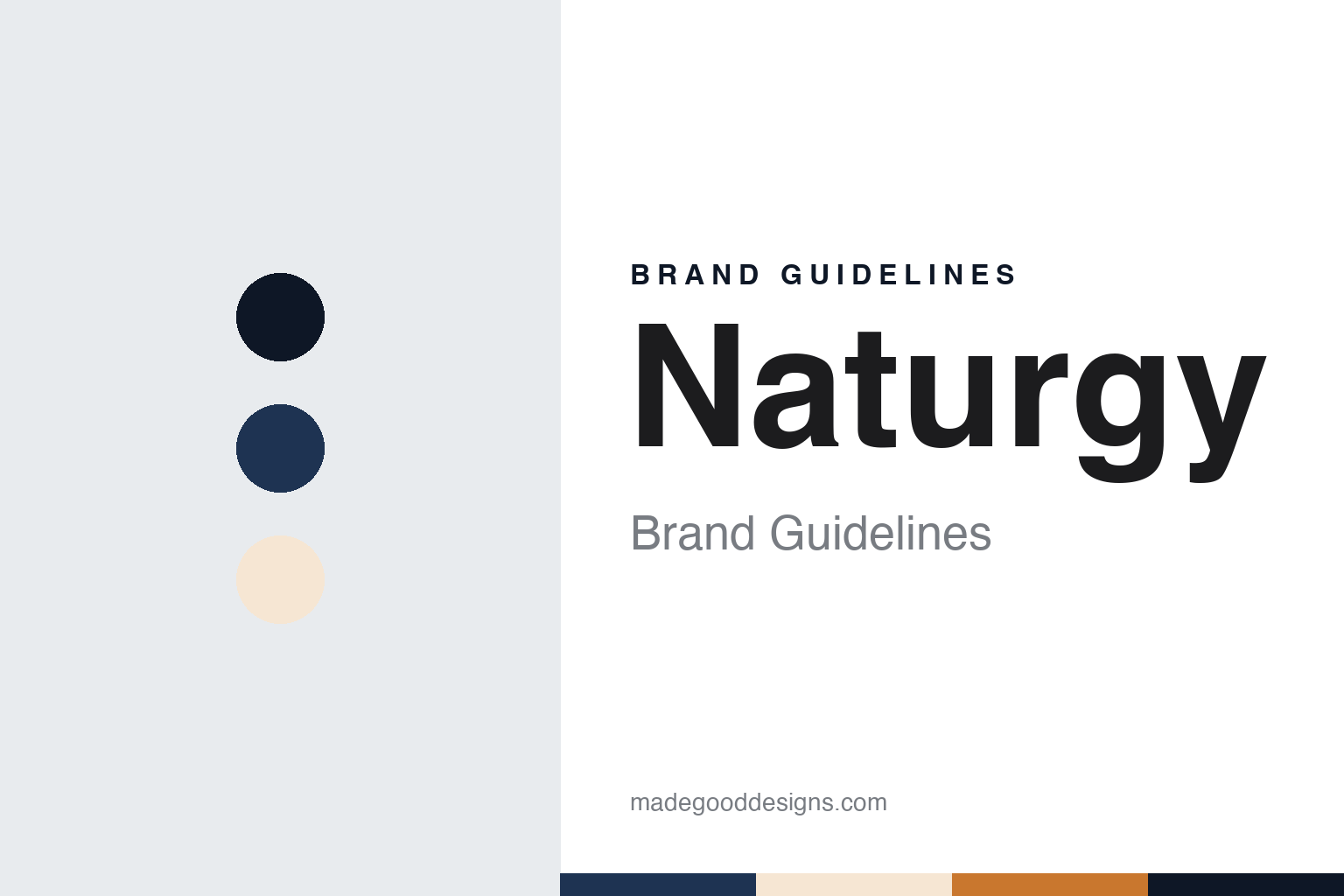
Naturgy Brand Guidelines
Barcelona gas lamps of 1843, Unión Fenosa and a butterfly.
Aa
Two constants: a Naturgy navy and amber palette and a Friendly sans register. Abstract homage — not a Naturgy product or mark; no butterfly, logo or sign is reproduced.
Barcelona gaslight
Street lamps, a gas works and a power station.
Naturgy is a 2018 name for a business whose roots go back to 1843. Spanish Wikipedia traces it to the Sociedad Catalana para el Alumbrado por Gas, founded in Barcelona that year to light the city with gas. In 1841 the French technician Charles Lebon and the financier Pedro Gil y Babot had won the auction for Barcelona’s public gas lighting, and in 1842 work began in the La Barceloneta district on what Spanish Wikipedia calls Spain’s first manufactured-gas works, which made gas from coal. The company’s shares traded from 1846, when the Barcelona stock exchange began, and it later ran gas works in Seville and Ferrol.
Electricity came at the end of the century. In 1896, with a French multinational, the company built the Vilanova thermal power station in Barcelona, followed by other thermal plants and hydro schemes in the Pyrenees of Huesca. In 1912 it took the name Catalana de Gas y Electricidad, bringing all its electricity assets into the parent company, Spanish Wikipedia says. The sources used for this guide do not describe the company during the Spanish Civil War and the early Franco years.
In 1965 the company promoted the founding of Gas Natural, S.A., together with Esso and several Spanish banks, to import liquefied natural gas from Libya. The regasification plant in Barcelona opened in 1969, which Spanish Wikipedia calls the start of natural gas supply in Spain. The parent company shortened its name to Catalana de Gas in 1987.
The electricity side of today’s group has a Madrid root. Spanish Wikipedia dates it to Unión Eléctrica Madrileña, formed in 1912 by merging a cluster of small companies that supplied part of the capital; Unión Fenosa later came out of the merger of Unión Eléctrica with Fuerzas Eléctricas del Noroeste.
Colour
Gas Natural, then Gas Natural Fenosa.
The modern company took shape in 1991, when Catalana de Gas, Gas Madrid and the piped-gas distribution assets of the Repsol group merged as Gas Natural SDG, Spanish Wikipedia says. It went abroad from 1992, starting with part of the Buenos Aires gas network, and in the late 1990s bought distributors in Brazil, Colombia and Mexico. In 1996 the Maghreb–Europe gas pipeline, linking the Iberian peninsula with Algeria’s Hassi R’Mel field, came into service, and in 2002 Gas Natural started its first combined-cycle power plant, at San Roque.
It then set out to become an electricity company too. A bid for Endesa launched in 2005 was abandoned in 2007. In 2008 Gas Natural agreed to buy a majority stake in Unión Fenosa; Spain’s competition authority cleared the deal with conditions in 2009, and after a public takeover bid Gas Natural held 95.22 percent of the electricity company. In June 2009 shareholders approved the absorption of Unión Fenosa, and in 2010 the combined group presented the brand Gas Natural Fenosa, Spanish Wikipedia says.
In October 2017 the company moved its registered office from Barcelona to Madrid, during the political crisis in Catalonia, the marketing magazine Reason Why reported. Its Barcelona building, the Mare Nostrum tower in La Barceloneta, was designed by Enric Miralles and Benedetta Tagliabue’s practice EMBT and completed in 2005, English Wikipedia says.
The rename followed on 27 June 2018. The executive chairman, Francisco Reynés, announced at the annual general meeting, alongside a 2018–2022 strategic plan, that Gas Natural Fenosa would become Naturgy, Reason Why reported that day. He linked the change to Repsol’s exit from the shareholder base and to the group’s expansion, saying the company needed a short name that showed its international aspirations and identified it as an energy company. The new logo, the magazine noted, kept the butterfly that had accompanied the previous version. The legal name became Naturgy Energy Group, S.A.; pv magazine reported the rename on 28 June 2018.
Typography
How utilities present themselves.
Many of Europe’s big electricity and gas groups began as something narrower: a regional hydro company, a national gas board, a coal-fired generator, a city lighting firm. Many of today’s names were assembled through mergers, nationalisations and privatisations, and their identities often had to stand for several older companies at once. A single short name and a simple symbol became the usual answer.
The pictures these groups choose tell the same story. Offshore wind farms standing in grey northern seas, hydro dams in mountain valleys, solar fields and transmission lines now carry more of the visual weight than power stations and chimneys. Colour often follows: greens and blues, sometimes with a warm accent for the sun, are common in the sector’s newer identities. Iberdrola’s three leaves, introduced in 2002 when it tied its brand to renewable energy, and Engie’s rising sun, adopted with the new name in 2015, are two examples.
Much of the brand now lives on screens rather than letterheads. Customers meet these companies through smart-home energy apps, online accounts and the electric-car charging points that carry their names on streets and motorways. Iberdrola, for example, redrew its logo in 2023 for digital use, with solid colours and a custom typeface shared by the companies it owns in other countries.
The sector also presents itself through long annual sustainability reports, sponsorship and industry gatherings such as Eurelectric’s Power Summit and the WindEurope annual event. This guide sets out what can be checked about each brand — where it came from, who owns it, and how its name and symbol changed — and marks clearly what rests only on the company’s own word.
Aa
A friendly sans — a short name and a butterfly. (Specimen set in Inter Tight, a sans STAND-IN; NOT the Naturgy logo.)
Naturgy
One group, several names.
Naturgy does not trade under one name everywhere. Spanish Wikipedia says its Spanish gas networks are run by Nedgia, and its electricity network by UFD, the former Unión Fenosa Distribución, which took that brand in 2018. Regulated tariffs are sold by a separate company, Comercializadora Regulada Gas & Power, because rules transposed from a European directive require regulated and free-market suppliers to use distinct names and brands, so that customers do not confuse them. On the free market it sells electricity, gas, self-consumption and electric-mobility services as Naturgy.
Its generation has changed too. Spanish Wikipedia says the group ended coal-fired generation in Spain in June 2020, closing the Narcea, Anllares, La Robla and Meirama plants, and gives its installed renewable capacity at the end of 2025 as 8,085 megawatts. It also lists stakes in the Almaraz and Trillo nuclear plants. According to Spanish Wikipedia, the brand came third in the brand category of Spain’s Premios Nacionales de Marketing in 2019 and first in 2022.
Its owners have shifted. Europa Press reported on 3 March 2026 that the fund GIP, part of BlackRock, had completed its exit from Naturgy, and that CriteriaCaixa, the holding company of the “la Caixa” Foundation, had raised its stake to 28.5 percent, making it the largest shareholder, ahead of the Australian fund IFM. Naturgy’s shares are listed on the Spanish exchanges and form part of the Ibex 35 index.
For a design guide, Naturgy shows how a company with more than 180 years of names can keep one symbol through a rename. Compare Iberdrola, another Spanish electricity group, and Endesa, the Madrid utility Gas Natural once bid for. For this guide we use a harbour navy and an amber with a sans, an unofficial interpretation; no product or logo is reproduced.
Explore & save
Keep Naturgy’s identity on hand — save it to a board in the Made Good inspiration library.
Naturgy identity set
Pin the Naturgy navy and amber palette and the Friendly sans register to your own board.


