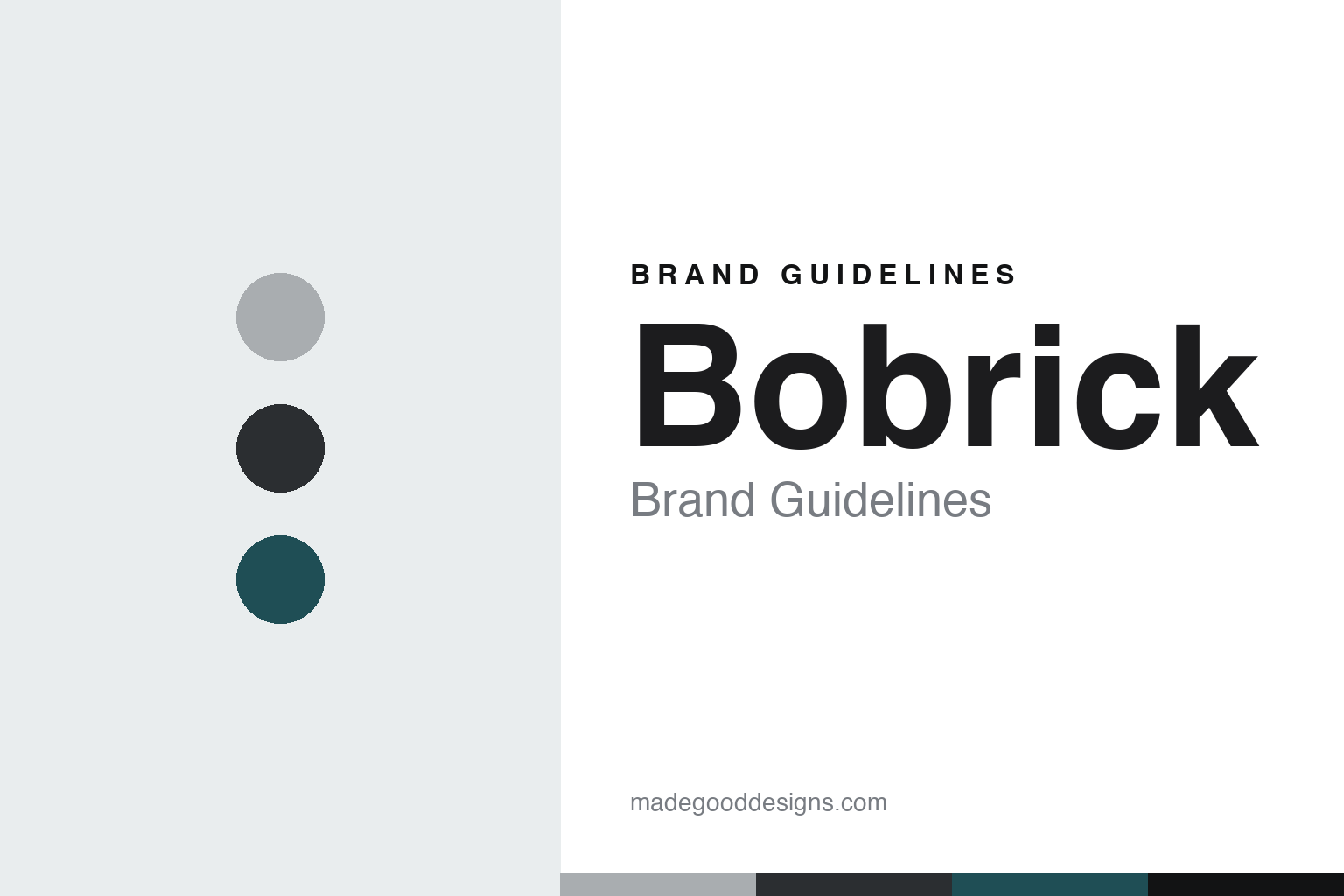
Bobrick Brand Guidelines
Stainless washroom hardware from a family company in North Hollywood.
Aa
Two constants: a satin steel, graphite and teal palette and an architectural sans register. Abstract homage — not a Bobrick product or mark; no dispenser, cubicle or logo is reproduced.
Bobrick Chemical Company
A 1906 start and a 1946 purchase.
Bobrick Washroom Equipment makes the stainless-steel dispensers, grab bars, mirrors and toilet partitions found in commercial washrooms. The company says it was founded in 1906 by Gabriel Alexander Bobrick as the Bobrick Chemical Company. It is headquartered in North Hollywood, California, and says it has been “shaping the industry for over a century.”
The family that runs it today arrived four decades after the founding. A leadership announcement carried by Aviation Pros on 3 November 2020 said William S. Louchheim Sr. bought Bobrick in 1946, and that the company had “remained privately held and family owned throughout.” His grandson Mark Louchheim had been president since 1991; in 2020 he became chairman and chief executive, and Matthew Louchheim, previously vice president of corporate development and general manager of the toilet-partition business, became president — the fourth generation of Louchheims to lead the company, the announcement said.
The same announcement said Bobrick had moved into new corporate offices in North Hollywood in 2015, expanded into new market segments and built new North American manufacturing capacity. The company’s own careers pages still stress the family side: “Although we’re global, we’re family owned,” it says.
In 2026 Bobrick marked what its president called its 120th anniversary by opening a global showroom at the New York Design Center, designed with the architecture firm Gensler, BSM reported in May 2026. The showroom was planned as a gallery and teaching space, with events and continuing-education programmes for architects and designers.
Colour
Accessories, partitions and a group of brands.
Bobrick’s range falls into two broad families. The first is washroom accessories: soap dispensers, paper towel dispensers, combined towel and waste units, waste receptacles, mirrors, hand dryers, grab bars and toilet tissue dispensers, grouped on its website into series such as TrimLineSeries, ConturaSeries and ClassicSeries. The second is toilet partitions and cubicles, sold under names such as DuraLineSeries, SierraSeries and the higher-end PRIVADA cubicles.
Much of the group was built by acquisition. The 2020 announcement credited Mark Louchheim with three purchases: Koala Kare Products in 2004, GAMCO Commercial Restroom Accessories in 2006 and the British cubicle maker Thrislington Cubicles in 2018. Bobrick describes Koala Kare as a maker of baby changing stations and commercial childcare products, and Gamco as a division specialising in stainless-steel washroom accessories.
Thrislington came with a design reputation of its own. On 1 February 2018 Deeside.com reported that the Sandycroft company, near Deeside in north Wales, had been bought by the California firm for an undisclosed sum. It described a business turning out commercial products since the 1960s, with multiple design awards and installations at Google’s Dublin headquarters, Ferrari World in Abu Dhabi and the Broad museum in Los Angeles. Bobrick said then that Thrislington products would go on being made at its UK plant with the existing management, and that the business would run as a separate division.
The company now gives its footprint as seven manufacturing facilities across the United States, Canada and the United Kingdom, with offices and plants in North America and Europe, and says it serves customers in more than 100 markets. Its about page lists five locations in the United States, one in Canada and two in Europe, and says some of the world’s most renowned companies and institutions rely on Bobrick “to reinforce their brand” and to reduce long-term operating costs. Its website also lists Koala Kare adult changing stations alongside the baby changing stations.
Typography
The washroom trade.
Washroom hygiene is a design field most people meet without noticing. The hand dryer by the airport gate, the towel dispenser in an office corridor and the soap unit above a stadium basin are chosen not by the people who use them but by architects, facility managers and cleaning contractors. The makers of these products speak first to that professional buyer, and their brands are built to read clearly in a specification sheet or a trade catalogue as much as on a wall.
Much of the work is systems design. A paper towel or soap brand usually sells a dispenser together with the refill made to fit it, so the visible object on the wall carries the name while the paper, foam or gel inside is what is bought again and again. Hand dryer makers sell the opposite way: one machine, mounted once, with filters, covers and accessories around it. Both approaches lean on a small number of named ranges rather than long product lists.
Materials do much of the talking. Stainless steel fittings, white and grey plastics and plain labelling recur across catalogues, for products that may end up in very different washrooms, from a hospital to a hotel lobby. Colour tends to appear in small accents, on a cover, a light or a refill pack, rather than across the whole object.
The category also presents itself in person. Trade fairs such as Interclean and the ISSA Show, where cleaning and facility-management suppliers gather, give makers a place to launch dispensers, dryers and digital refill services, and some fairs run innovation awards of their own. The guides in this series look at how individual makers handle those shared conventions.
Aa
A plain architectural sans for specification sheets. (Specimen set in IBM Plex Sans, a sans STAND-IN; NOT the Bobrick logo.)
Fino and the showroom
Stainless steel, specified by series.
The clearest statement of Bobrick’s current design direction is the Fino Collection. Launched in August 2021, according to a company release carried by gb&d, it was developed jointly with Thrislington: a hand dryer, a paper towel dispenser and a waste receptacle that share one width and what the release called “cubist simplicity,” made in satin-finish stainless steel with seamless construction and concealed hardware, plus matching cubicle accessories and grab bars. The release said Fino came in standard stainless steel and in brass, copper and black PVD coatings, or powder-coated to a specified colour, and that every Fino accessory was made in the UK with a five-year guarantee.
The New York showroom puts the group’s brands side by side. BSM reported that it brings together what Matthew Louchheim called the company’s “three powerhouse brands” — Bobrick, Koala Kare and Thrislington — with Fino accessories and Thrislington, Privada and Evolve partitions on show, and an installation about the company’s history of more than a century.
Bobrick’s website is organised around series names, design resources, technical data and building-code documents, and the company calls itself “an industry leader in well-designed, value-oriented washroom accessories and toilet partitions.” It also runs a blog, the Bobrick Academy, with design resources and articles on washroom design trends, and offers finishes such as matte black alongside stainless steel on its accessory collections.
For a design guide, Bobrick shows how a family-owned maker can present stainless washroom hardware as something architects choose by series and finish. Compare Excel Dryer and World Dryer, two other American washroom names. For this guide we use a satin steel grey, graphite and a teal ink with a sans, an unofficial interpretation; no product or logo is reproduced.
Explore & save
Keep Bobrick’s identity on hand — save it to a board in the Made Good inspiration library.
Bobrick identity set
Pin the satin steel, graphite and teal palette and the architectural sans register to your own board.


