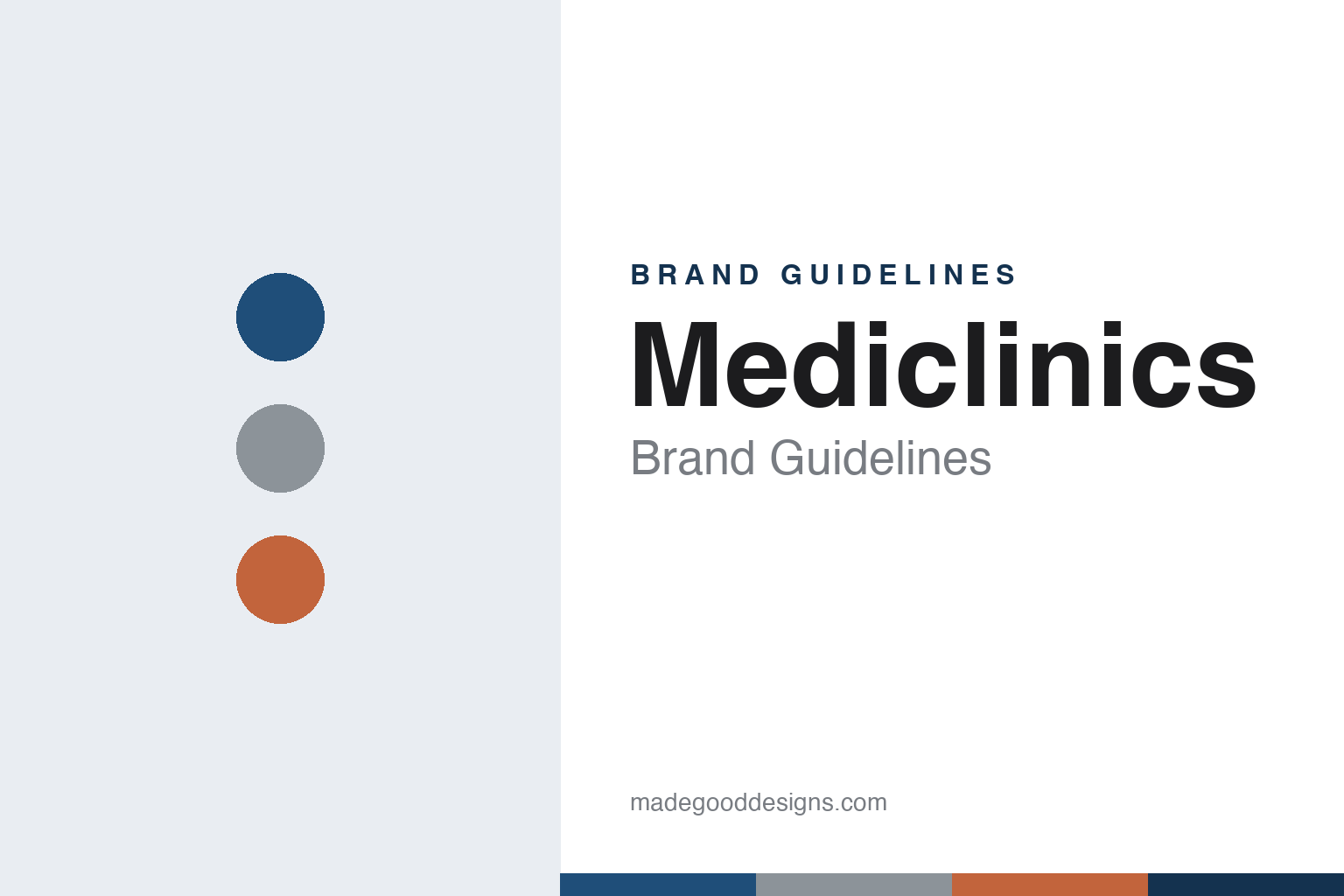
Mediclinics Brand Guidelines
The family-run Barcelona maker of hand dryers and washroom accessories.
Aa
Two constants: a blue, steel and terracotta palette and a geometric sans register. Abstract homage — not a Mediclinics product or mark; no dryer, logo or nameplate is reproduced.
A Barcelona distributor
From bathroom equipment to hand dryers.
Mediclinics is a Barcelona maker of hand dryers and washroom accessories for public and commercial buildings. The company dates itself to 1974: its own timeline lists that year as the start of its commercial activity, and a November 2024 Designboom feature marking the firm’s fiftieth anniversary says it was founded that year in Barcelona as a local distributor of bathroom equipment. Designboom describes Mediclinics as a family-run firm; the operating company is Mediclinics S.A., based in Barcelona.
Manufacturing came eleven years later. Both the company and Designboom date its first hand dryer, the Saniflow E-85, to 1985, and the Saniflow name has stayed with the firm: the company’s timeline records the first steps of Saniflow Corp. in the United States in 2003. Designboom puts the start of the company’s international expansion in 1989, beginning with Europe; Mediclinics now says it sells in more than 100 countries, through a network of distributors across Spain and in most of its export markets.
In 2006, by the company’s account, it opened a new logistics centre and assembly plant in Barcelona, and it says its products are shipped to those markets from its Barcelona logistics and production centre. Mediclinics also says it works with the Universitat Politècnica de Catalunya (UPC) on research and development, and it names GS, CB, EMC, CE and UL among the certifications its products carry, with a management system certified to ISO 9001.
Colour
Hands in, hands through.
The range grew in steps that the company lists year by year. The Dualflow Plus of 2012 introduced what Mediclinics calls “hands-in” drying, in which the hands go down into the unit; dryers with brushless motors followed in 2019, and in 2020 the All-in-One units combined washing and drying at the basin. Baby-changing stations arrived in 2016 under the Babymedi name, with a recessed kit added in 2022, and in 2025 the company introduced BTM, a wash-and-dry system set behind the mirror. Its catalogue also covers soap and paper dispensers, grab bars, signage and stainless-steel sanitaryware.
The dryers themselves are sold in families that differ in casing and motor. On the company’s website the Dualflow Plus comes in an ABS casing, the Speedflow Plus in a steel one, and the Machflow Plus with either a brushed or a brushless motor. Beyond dryers, the site lists hair dryers, drinking fountains, emergency eye-wash stations and showers, and mobility aids alongside grab bars. Designboom’s 2024 feature summed up the range as automatic hand dryers, wash-and-dry stations, soap and paper-towel dispensers, baby-changing stations and multi-purpose cabinets, and illustrated the firm’s history with the Prima, which it called one of the first automatic hand dryers Mediclinics launched.
The model that drew design juries is the U-Flow, which the company dates to 2023. Its U-shaped, “hands-through” opening lets the user pass their hands through the dryer rather than into a slot. Designboom reported in November 2024 that the U-Flow had won an iF Design Award 2024, and in March 2025 that it had been selected from 10,800 iF entries and had gone on to a Good Design Award in the bathroom and accessories category, the programme presented by the Chicago Athenaeum: Museum of Architecture and Design and the European Centre for Architecture Art Design and Urban Studies.
Colour has become part of the pitch. In October 2026 the Spanish trade title Interempresas reported that Mediclinics lets buyers choose the colour of both the front panel and the drying zone of the U-Flow, and that it offers an online configurator so that architects and clients can try combinations before specifying the dryer. Interempresas framed the option as a way to match the dryer to a corporate identity or to the materials of a washroom, or to let it stand out. The company’s Spanish website sums the idea up in a short line, “Cada color, un diseño”: each colour, a design.
Typography
Washroom equipment as design.
Washroom hygiene is a design field most people meet without noticing. The hand dryer by the airport gate, the towel dispenser in an office corridor and the soap unit above a stadium basin are chosen not by the people who use them but by architects, facility managers and cleaning contractors. The makers of these products speak first to that professional buyer, and their brands are built to read clearly in a specification sheet or a trade catalogue as much as on a wall.
Much of the work is systems design. A paper towel or soap brand usually sells a dispenser together with the refill made to fit it, so the visible object on the wall carries the name while the paper, foam or gel inside is what is bought again and again. Hand dryer makers sell the opposite way: one machine, mounted once, with filters, covers and accessories around it. Both approaches lean on a small number of named ranges rather than long product lists.
Materials do much of the talking. Stainless steel fittings, white and grey plastics and plain labelling recur across catalogues, for products that may end up in very different washrooms, from a hospital to a hotel lobby. Colour tends to appear in small accents, on a cover, a light or a refill pack, rather than across the whole object.
The category also presents itself in person. Trade fairs such as Interclean and the ISSA Show, where cleaning and facility-management suppliers gather, give makers a place to launch dispensers, dryers and digital refill services, and some fairs run innovation awards of their own. The guides in this series look at how individual makers handle those shared conventions.
Aa
A clean geometric sans for a catalogue of named dryers. (Specimen set in Manrope, a sans STAND-IN; NOT the Mediclinics logo.)
Mediclinics
Manufacturers since 1974.
On the page, Mediclinics presents itself plainly. Its Spanish site calls the company “Fabricantes desde 1974,” manufacturers since 1974, and organises the catalogue by use: hand dryers, behind-the-mirror units, wash-and-dry units, baby-changing stations, dispensers and accessories. The dryer names share a suffix, as in Machflow, Dualflow, Speedflow and U-Flow, and are shown with a registered-trademark sign. A Contract line is aimed at the most demanding projects, and the site runs in Spanish, English, Italian and German, with a separate version for the United States.
The name invites confusion. Mediclinics, the Barcelona washroom company, is unrelated to Mediclinic, the hospital group, and its American arm, set up in 2003, carries the Saniflow name rather than the parent’s. Designboom described Mediclinics as family-run in both 2024 and 2025, and the company marked fifty years of trading in 2024.
For a design guide, Mediclinics shows how a maker of utilitarian washroom equipment can build a product family through a consistent naming system and treat colour as part of the specification. Compare the Excel Dryer brand guidelines and the World Dryer brand guidelines. For this guide we use a deep Mediterranean blue, a cool steel grey and a warm terracotta with a clean geometric sans, an unofficial interpretation; no product or logo is reproduced.
Explore & save
Keep Mediclinics’s identity on hand — save it to a board in the Made Good inspiration library.
Mediclinics identity set
Pin the Mediclinics blue, steel and terracotta palette and the geometric sans register to your own board.


