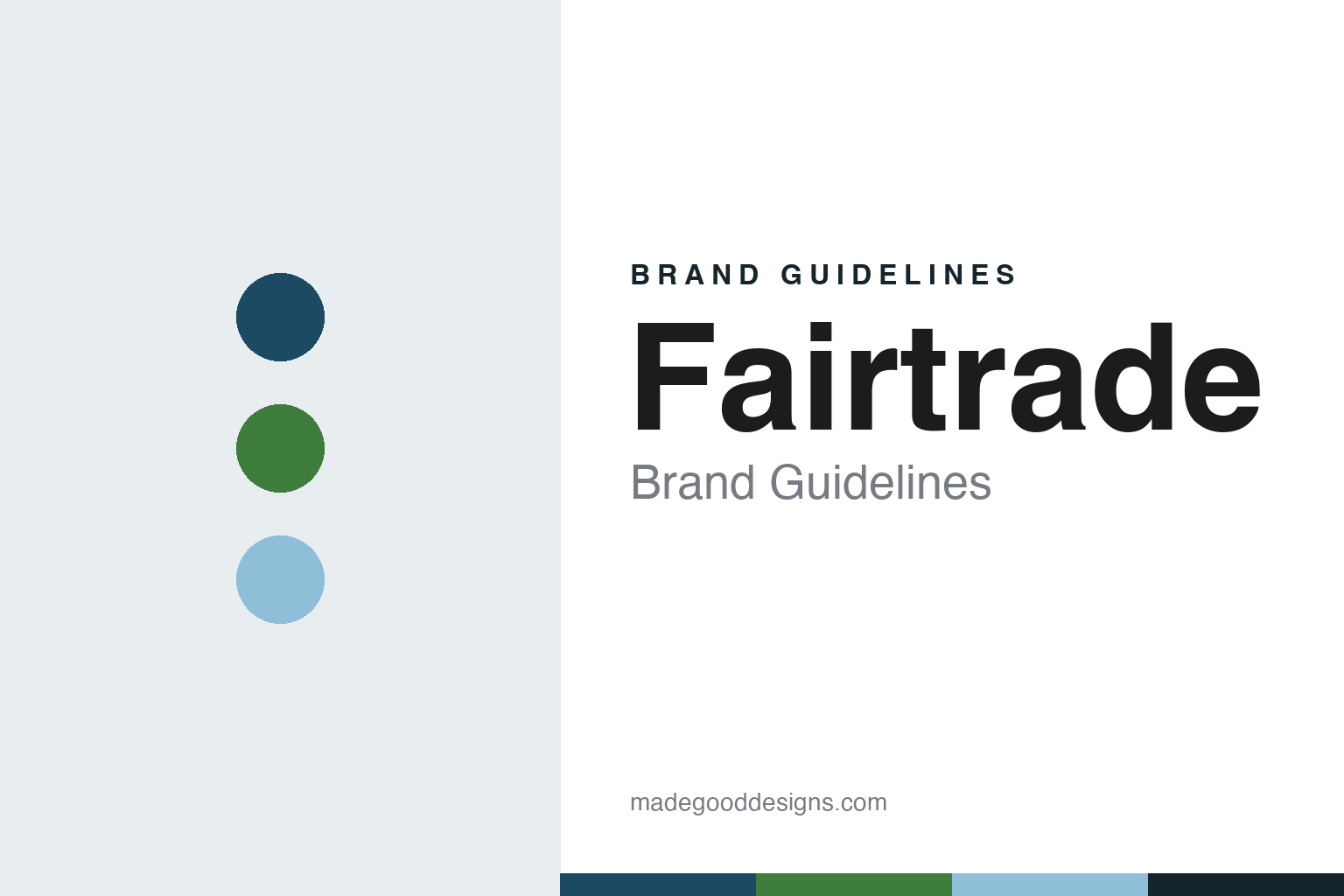
Fairtrade Brand Guidelines
A Dutch coffee label that became one registered mark for many countries.
Aa
Two constants: a sky, leaf and ink palette and a plain humanist sans register. Abstract homage — not a Fairtrade product or mark; no logo, seal or pack is reproduced.
Max Havelaar
A coffee cooperative, a Dutch charity and a name from a novel.
The FAIRTRADE Mark began as a Dutch coffee label. The Max Havelaar Foundation was founded in the Netherlands in May 1988, according to the fair-trade timeline on the Canon van Nederland site, and the first coffee carrying its label reached supermarkets on 15 November 1988. The first incentive, that account says, was contact between the Dutch development organisation Solidaridad and the Mexican coffee cooperative UCIRI. It quotes Isaías Martínez Morales of UCIRI: “We don’t need help; we are not beggars. If you would pay us a reasonable price for our coffee, we can do without help from now on.” English Wikipedia credits the launch to Nico Roozen, Frans van der Hoff and Solidaridad, and says the first coffee was imported by Van Weely and roasted by Neuteboom.
The name came from Max Havelaar, the novel by Multatuli, the pen name of Eduard Douwes Dekker, about poor labour and living conditions on plantations in colonial Indonesia. What was new, the Canon account says, was the label itself. Written trade criteria meant that any trader or roaster who followed them could join, and that the coffee could leave the small world shops for supermarkets. Prince Claus, husband of Queen Beatrix, helped draw public attention, and the same account says 65% of Dutch consumers knew the certificate by the start of 1989.
The idea spread, and the name did not stay the same. English Wikipedia lists “Max Havelaar” labels in Belgium, Switzerland, Denmark, Norway and France, “Transfair” in Germany, Austria, Luxembourg, Italy, the United States, Canada and Japan, “Fairtrade Mark” in the UK and Ireland, “Rättvisemärkt” in Sweden and “Reilu Kauppa” in Finland. Each began with its own standards and monitoring. A working group called TransMax started bringing them together in 1994, and in 1997 they formed Fairtrade Labelling Organizations International. In January 2004 the body divided in two, Wikipedia says: one side kept standards and producer support, while FLOCERT took on checking compliance.
Fairtrade International describes itself today as a non-profit, multi-stakeholder association of 22 member organisations, three producer networks and 19 national Fairtrade organisations, with about 90 staff at its central offices in Bonn, Germany. It says it owns the mark and that the mark appears on more than 30,000 products. Its General Assembly, it says, combines 50 percent producer representation with 50 percent national-organisation representation.
Colour
A producer with one arm raised, between sky and leaf.
The current design dates from 2002. The FAIRTRADE Mark Guidelines (Issue 2, Spring 2018), a public 82-page manual marked “use compulsory,” say the mark was created that year “to replace the variety of different national marks used by Fairtrade Organizations.” English Wikipedia gives the aims as better visibility on supermarket shelves and simpler cross-border trade. The manual records two revisions: January 2011, to refine the design and improve legibility on pack, and Spring 2018, when the registered-trademark symbol moved inside the mark.
The manual explains the drawing in its own words. It describes “the blue sky of potential” connected to “the fresh green of new growth” by the symbol of a producer “with an arm raised in celebration of human endeavour and empowerment.” It names the two colours Leaf Green and Sky Blue, and it protects them: a newly developed brand must not use tones equal or too close to them on packaging, and a brand already using close greens and blues must take the black and white version of the mark.
The size rules are specific. Clear space around the mark equals half its width, reduced to a quarter on small packs, tags or labels. As a guide, the mark should not print smaller than 7 mm wide, and the size guide runs up to 21 mm on A4-sized packs and 66 mm on A1 posters. It goes on the front of the pack, in a lower corner or centred, less prominent than the brand, at least 5 mm from an edge or seam. It must not be smaller than any other certification mark on the same pack. France and Switzerland keep a trace of the origin: a version with a Max Havelaar strapline may be used only for products sold primarily in those two countries by companies based there.
The family has grown. Fairtrade’s website explains a plain mark for single ingredients that are physically traceable; a version with an arrow, sending readers to the back of the pack, for products with several ingredients or mass-balance sourcing; separate Cotton and Gold marks; a Textile Production Mark; and the Fairtrade Sourced Ingredient mark, which it dates to March 2019, for products where one ingredient is bought on Fairtrade terms. The website says the mark means ingredients have met the Fairtrade standards. Use requires a signed licence contract and prior written approval, and packs must carry the Fairtrade claim, with a producer FLO ID or a national reference code required in some cases. Fruit with a rough surface, such as pineapples, must carry a hang tag or collar tag.
Typography
Small marks, strict rules.
A certification mark does a different job from a company logo. It does not sell one maker’s goods; it sits on other companies’ packs, often in a corner, and asks shoppers to trust a set of rules they will rarely read. That makes these schemes unusual design subjects. The visible part is tiny, while the system behind it fills manuals, licence contracts and audit reports.
The manuals are often public, and they are unusually exact. The FAIRTRADE Mark Guidelines set a clear space, a size guide from posters down to labels and hang tags, and a minimum printed width. The Rainforest Alliance’s seal guidelines set a minimum size so that a QR code still scans, and forbid printing the seal across a fold. Fairtrade gives legibility as its reason and the Rainforest Alliance gives scanning, and in both cases the same mark has to work on a large pack, a label or a hang tag, printed by many different companies.
Around the mark sit smaller pieces of evidence. Schemes may ask for a claim beside the mark, a licence or producer number on the pack, or a web address that leads back to the standard. Fairtrade’s guidelines, for example, call for a producer FLO ID or a national reference code in some cases. Behind them sit audits and certificates: the Rainforest Alliance says only those who meet a standard after an audit may display its seal.
This group of guides looks at how these schemes present themselves: who founded them, who owns the mark, what each scheme says it certifies, and what its logo rules ask of the brands that use it. Where critics have challenged a scheme, the guide says so, and what the mark means is given in the scheme’s own terms.
Aa
A plain humanist sans for a register of labels and claims. (Specimen set in Work Sans, a sans STAND-IN; NOT the Fairtrade logo.)
Two Fair Trades
A mark tested by splits, studies and supermarket shelves.
The system has had public disputes, several of them about labels. On 15 September 2011, Fairtrade International and Fair Trade USA, formerly TransFair USA, issued a joint statement saying they shared beliefs but saw different ways of reaching their goals, and Fair Trade USA left the system at the end of that year. Laura Raynolds and Douglas Murray of Colorado State University’s Center for Fair and Alternative Trade said in October 2011 that the primary reason appeared to be Fair Trade USA’s decision to certify plantation-scale coffee. English Wikipedia describes a separate Fair Trade Certified mark in North America, and lists Fairtrade America among Fairtrade’s members.
Research has been contested too. In May 2014, academics at London’s School of Oriental and African Studies published a four-year study, funded by the UK’s Department for International Development, of coffee, tea and flower farms in Ethiopia and Uganda. SciDev.Net reported that workers at both Fairtrade-affiliated and other farms were “desperately deprived,” and that in some cases those at affiliated farms were worse paid. It also reported that the Fairtrade Foundation, the UK member, said it had found flaws in the study and that progress was being made for poor agricultural labourers.
Big customers have also moved the mark on pack. In November 2016 ConfectioneryNews reported that Mondelēz had named Fairtrade as global partner of its Cocoa Life programme, and that Cadbury products in the UK and Ireland would carry a small Fairtrade Foundation logo on the back and a larger Cocoa Life logo on the front. FoodNavigator reported in June 2017 that the change was under way, with the backing of the scheme. Sainsbury’s took a different route. The same report said its in-house “fairly traded” programme had drawn a rebuke from the Foundation’s chief executive, Michael Gidney, who said the approach “falls short of our key standards.” In February 2022 The Grocer reported that Sainsbury’s had dropped the label, introduced in 2017 on its Gold and Red Label teas, after criticism from charities including Oxfam and Christian Aid.
For a design guide, Fairtrade shows how a small drawing and a long rule book can stand in for a promise that shoppers cannot check for themselves. Compare Divine Chocolate, a Fairtrade chocolate brand, and Rainforest Alliance, a seal with its own rule book. For this guide we use deep sky, leaf and ink with a sans, an unofficial interpretation; no product or logo is reproduced.
Explore & save
Keep Fairtrade’s identity on hand — save it to a board in the Made Good inspiration library.
Fairtrade identity set
Pin the Fairtrade sky, leaf and ink palette and the plain humanist sans register to your own board.


