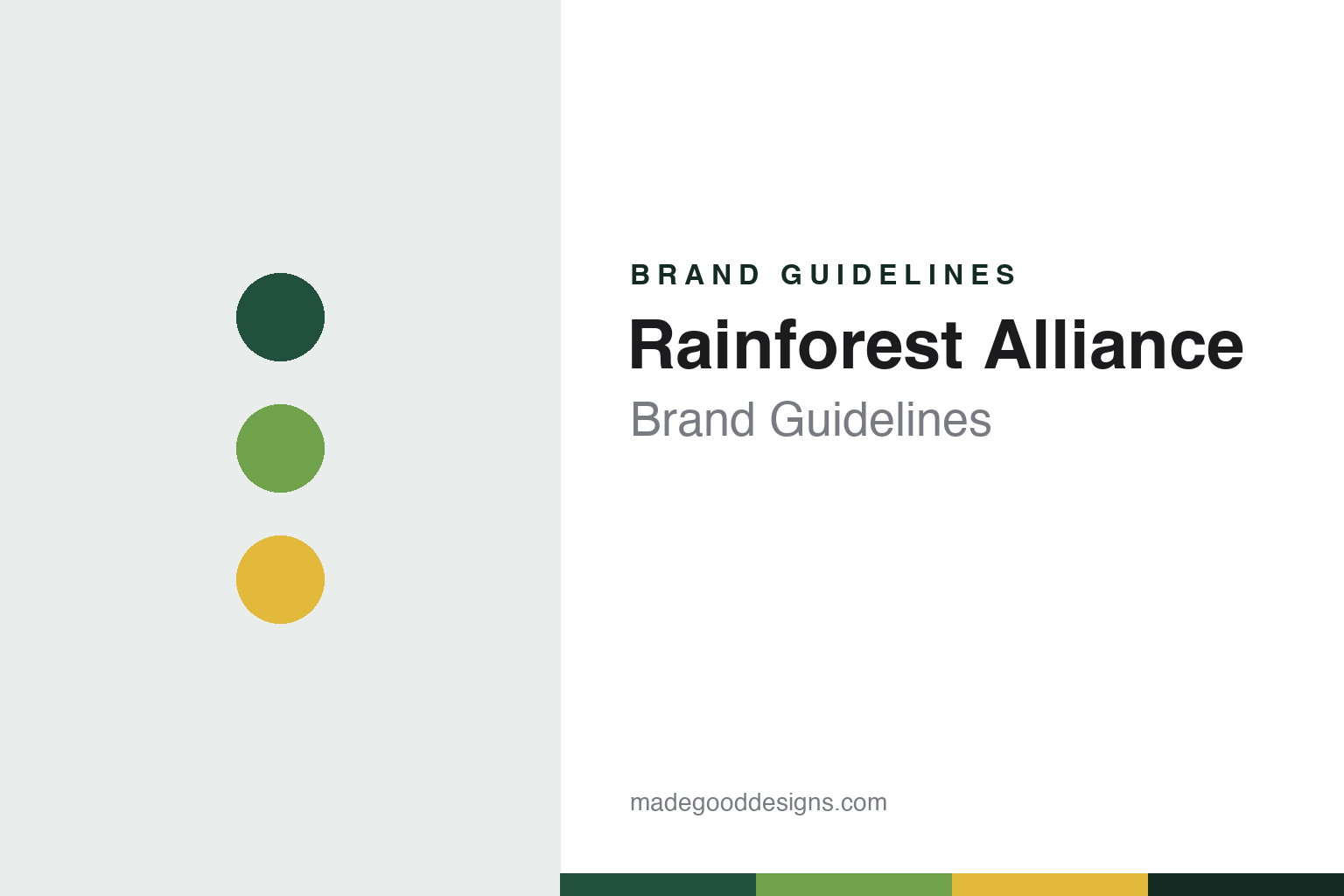
Rainforest Alliance Brand Guidelines
A frog on a seal, and the rules that keep it scannable.
Aa
Two constants: a canopy, moss and gold palette and a geometric sans register. Abstract homage — not a Rainforest Alliance product or mark; no seal, logo or frog is reproduced.
A Frog in Costa Rica
A banner, a mascot and a merger with a coffee label.
The Rainforest Alliance was founded in 1987 by Daniel Katz, an American environmental activist who, according to English Wikipedia, chairs its board. The organisation’s own website calls him both founder and co-founder, and says he raised its first “Save the Rainforest” banner nearly 40 years ago. Wikipedia places its headquarters in New York City and says it has staff in more than 20 countries and operations in more than 70.
The frog came early. The organisation says its founders chose the red-eyed tree frog as its mascot in the late 1980s because it is common in Costa Rica, where the group first began working on forests and on how food is grown. It adds that frogs are bio-indicators, meaning that healthy frog populations point to healthy ecosystems. Its consumer slogan is “Follow the Frog.”
The organisation once ran forestry and tourism certification as well. Wikipedia says that on 1 October 2018 it moved its forestry certification business, with staff and clients, to Preferred by Nature, formerly NEPCon, a non-profit in Copenhagen, which also took on management of its tourism standards. Its seal remained on certified tourism businesses under that arrangement, Wikipedia says.
The biggest change came from the Netherlands. UTZ started in 2002 as Utz Kapeh, “good coffee” in the Mayan language Quiché, English Wikipedia says, founded by the Belgian-Guatemalan coffee grower Nick Bocklandt and the Dutch roaster Ward de Groote, with Solidaridad as a co-initiator. It became UTZ Certified in March 2007 and plain UTZ in January 2016. A Rainforest Alliance press release dated 6 June 2017 announced the plan to merge, with UTZ’s Han de Groot to become chief executive, and the merger was legally completed in January 2018 under the Rainforest Alliance name. The two standards ran in parallel until the 2020 Sustainable Agriculture Standard replaced them. In May 2021 the organisation announced Santiago Gowland, formerly of The Nature Conservancy, as chief executive.
Colour
A redrawn frog, a QR code and a 2.7 cm floor.
After the merger two labels remained on shelves, and the organisation introduced a third. A support deck for companies dated May 2020 calls the seal part of a new brand identity following the merger. It describes company consultations and consumer tests in the UK, the US, Germany and Japan. Companies asked for simplicity, for a sense that the seal covered more than the environment, and for the existing recognition not to be lost. The answer, the deck says, was “a sleeker, more dynamic and flexible frog,” with the words “People & Nature” added and a version without a frog promised for certain markets. Artwork was available from 1 June 2020 and products could launch with it from 1 September. The website says the legacy seal and the UTZ label are slowly being phased out.
The organisation says the seal means the product, or a specified ingredient, was produced by “farmers, foresters, and/or companies working together to create a world where people and nature thrive in harmony.” Auditors check farms and companies against the chosen standard, it says, and only then may they display the seal. English Wikipedia says the current standard generally requires 90 percent certified content, or the equivalent through mass balance, with lower thresholds for herbs and palm oil that must be stated on the label.
The Sustainable Agriculture Seal Guidelines, in an edition updated in March 2026, are a detailed public manual. The seal comes in a vertical and a horizontal form, in green or black, with or without white, and a reversed white version for special cases only. It carries a QR code, and that code sets the size: the vertical seal must not go below 2.7 cm wide, nor the horizontal below 2.7 cm tall, and it must grow on banners and posters so it can still be scanned. The 2020 deck gave a minimum size of 15 mm. Where space is too tight, a version without the code carries a web address instead.
Other rules are just as exact. Clear space equals three times the height of the R in “Rainforest,” which the manual says gives a circle 1.41 times the size of the seal. The seal must never cross a fold line or wrap a corner, and the frog must never be pulled out on its own. The crop name beneath it must be set in Poppins SemiBold, in title case, centred. The organisation’s logo is a separate mark in a dark forest green, for off-pack partnerships only, with a 3 cm print minimum and 100 pixels on screen. A second seal followed: on 8 September 2025 the organisation announced a Regenerative Agriculture Standard for coffee, with products to carry a distinct seal, which has its own guidelines, updated in May 2026.
Typography
Small marks, strict rules.
A certification mark does a different job from a company logo. It does not sell one maker’s goods; it sits on other companies’ packs, often in a corner, and asks shoppers to trust a set of rules they will rarely read. That makes these schemes unusual design subjects. The visible part is tiny, while the system behind it fills manuals, licence contracts and audit reports.
The manuals are often public, and they are unusually exact. The FAIRTRADE Mark Guidelines set a clear space, a size guide from posters down to labels and hang tags, and a minimum printed width. The Rainforest Alliance’s seal guidelines set a minimum size so that a QR code still scans, and forbid printing the seal across a fold. Fairtrade gives legibility as its reason and the Rainforest Alliance gives scanning, and in both cases the same mark has to work on a large pack, a label or a hang tag, printed by many different companies.
Around the mark sit smaller pieces of evidence. Schemes may ask for a claim beside the mark, a licence or producer number on the pack, or a web address that leads back to the standard. Fairtrade’s guidelines, for example, call for a producer FLO ID or a national reference code in some cases. Behind them sit audits and certificates: the Rainforest Alliance says only those who meet a standard after an audit may display its seal.
This group of guides looks at how these schemes present themselves: who founded them, who owns the mark, what each scheme says it certifies, and what its logo rules ask of the brands that use it. Where critics have challenged a scheme, the guide says so, and what the mark means is given in the scheme’s own terms.
Aa
A geometric sans, the family the seal guidelines name for crop labels. (Specimen set in Poppins, a sans STAND-IN; NOT the Rainforest Alliance logo.)
Under Audit
Unions, lawsuits and growers have all challenged the seal.
The seal has drawn sustained criticism, much of it about Latin American fruit plantations. English Wikipedia records objections that the scheme, unlike Fairtrade, does not guarantee a minimum price, and it quotes The Economist taking the opposite view of that design. The 2020 programme added a Sustainability Differential, a cash payment to certified producers over the market price, and Sustainability Investments from buyers. Wikipedia also says the organisation was criticised in the mid-2000s for allowing the seal on products with a minimum of 30 percent certified content.
Labour rights have been the sharpest issue. In June 2019 the British campaign group Banana Link reported that unions representing banana and pineapple plantation workers in Costa Rica had broken off dialogue with the organisation, saying it had certified companies despite persecution of trade unions. In May 2020 the Guardian published allegations about certified pineapple plantations in Costa Rica; English Wikipedia summarises them as claims that some certified growers exploited workers, used illegal agrochemicals and hid undocumented workers from auditors. The Rainforest Alliance replied in a statement dated 29 May 2020 that it took such matters very seriously, could not investigate because no specific farm had been named, and had decertified four pineapple farms in Costa Rica the year before.
Two US cases have also been brought. Wikipedia says the nonprofit Water and Sanitation Health sued in 2014, alleging unfair marketing over Chiquita suppliers in Guatemala; the organisation denied the allegations, and the suit was dismissed in August 2016. A similar case by Corporate Accountability Lab was dismissed in 2023. Growers pushed back from another side. In July 2020 banana associations from Ecuador, Costa Rica, Colombia and Guatemala wrote an open letter challenging the new standard and how it was decided, and roundtables that year did not settle the matter, Wikipedia says.
For a design guide, the Rainforest Alliance shows how a mascot can carry a technical promise, and how a QR code can set the size of a logo. Compare Fairtrade, which shares a link through Solidaridad, a co-initiator of UTZ, and the Forest Stewardship Council, whose label the 2020 deck says may appear alongside the seal on forestry products. For this guide we use canopy green, moss and a gold with a sans, an unofficial interpretation; no product or logo is reproduced.
Explore & save
Keep Rainforest Alliance’s identity on hand — save it to a board in the Made Good inspiration library.
Rainforest Alliance identity set
Pin the Rainforest Alliance canopy, moss and gold palette and the geometric sans register to your own board.