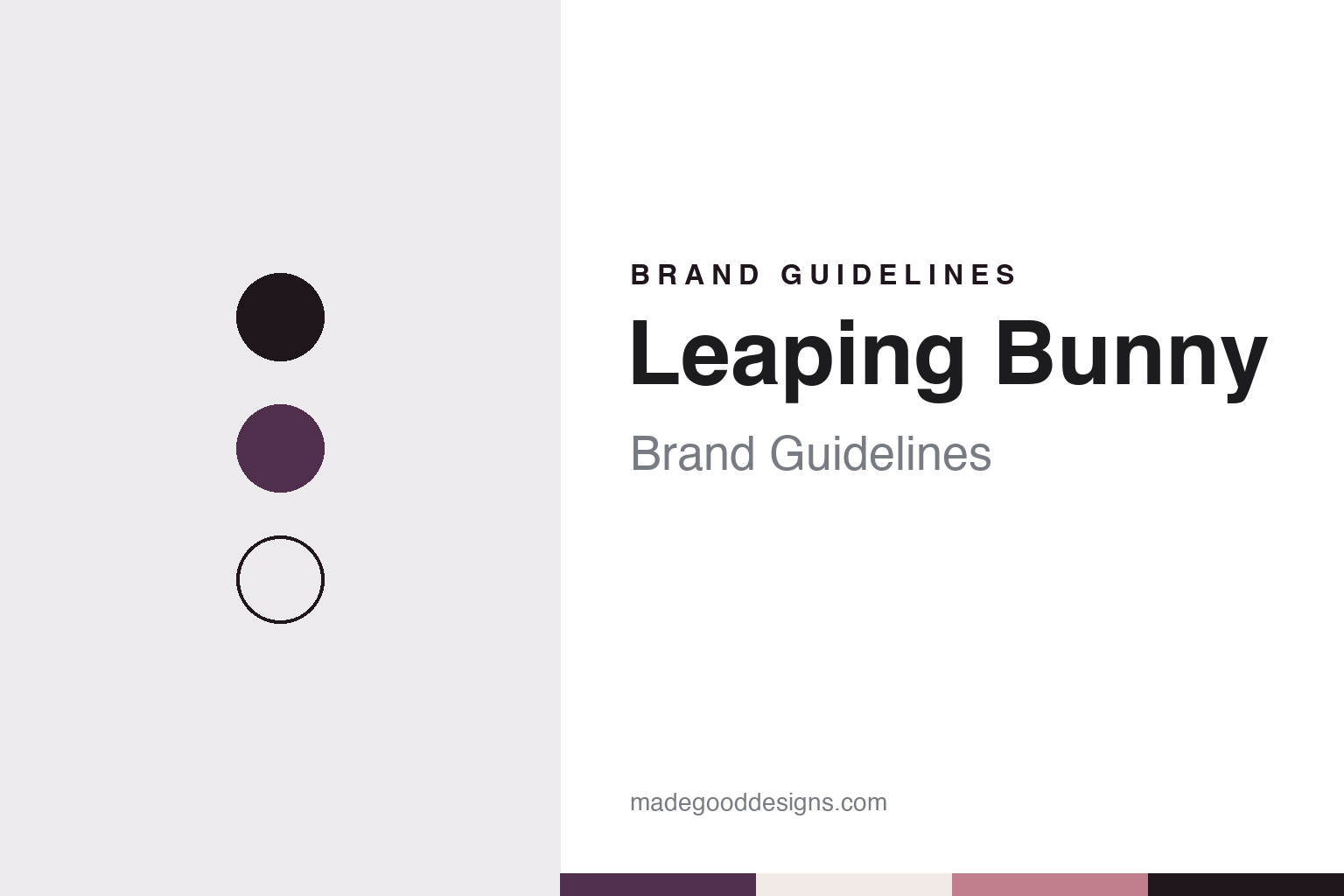
Leaping Bunny Brand Guidelines
The 1996 cruelty-free rabbit and the two bodies behind it.
Aa
Two constants: an aubergine, oat and dusty rose palette and a warm campaigning serif register. Abstract homage — not a Leaping Bunny or Cruelty Free International mark; no rabbit, logo or stamp is reproduced.
One Rabbit
Too many bunnies, then a single standard.
Leaping Bunny is younger than the groups behind it, some of them by more than a century. The American Anti-Vivisection Society dates from 1883, in Philadelphia, and the New England Anti-Vivisection Society from 1895. In Britain, Frances Power Cobbe left the society she had established, after a dispute over whether to seek restriction or abolition, and founded the body that became the British Union for the Abolition of Vivisection at Bristol on 14 June 1898, according to the Hull History Centre’s catalogue of its records. Cruelty Free International, its successor, says it was first The British Union and became known as the BUAV in 1949; the Hull catalogue and English Wikipedia use the BUAV name from the start.
That older movement did not go quiet during the war. The Hull catalogue says the Conference of Anti-Vivisection Societies first met on 20 November 1942, when five societies attended at the BUAV’s invitation. Cosmetics became a central cause later. The BUAV launched its Choose Cruelty Free campaign in March 1988, calling on shoppers to avoid cosmetic and household products tested on animals, and a European Cosmetics campaign in 1991. Cruelty Free International said in 2026 that it began approving cruelty-free brands forty years earlier.
The mark grew out of a labelling problem. The Leaping Bunny Program says that “cruelty-free” had become a popular way for brands to set themselves apart, and that companies were designing their own bunny logos and making claims without animal protection groups taking part. In 1996, it says, several groups from the US and Canada formed the Coalition for Consumer Information on Cosmetics, or CCIC, to promote one standard and one logo.
A 2007 case study written at the University of California, San Diego, names eight founding groups: the American Anti-Vivisection Society, American Humane Association, Animal Protection Institute, Beauty Without Cruelty USA, Doris Day Animal League, Humane Society of the United States, New England Anti-Vivisection Society and Animal Alliance of Canada. It also says that European groups, including the BUAV, later added their support. Sources differ on the logo’s date. The case study says it made its debut in 1998; Cruelty Free International says that in 1996 it began working with partner groups and the logo was introduced.
The Guardian described the British version in January 2008 as the Humane Cosmetics Standard, “aka” the Leaping Bunny, awarded by the BUAV.
Colour
A pledge, a date and a licence.
The mark stands for a written standard, not a slogan. CCIC’s Corporate Standard of Compassion for Animals covers cosmetics, personal care and household products. A company pledges not to conduct, commission or be party to animal testing of products, formulations or ingredients, and not to buy from suppliers that did so after its fixed cut-off date, a date each company chooses. Suppliers and manufacturers must sign declarations, and those go into a supplier monitoring system.
The cut-off date is the key idea. The programme says that virtually every ingredient has been tested on animals at some point, so what it certifies is the absence of new testing. It says that companies must recommit each year and stay open to independent audits. The list does not cover what ingredients are made of, the programme says, so it is not a vegan list.
Certification and the logo are separate. The programme says applying and being listed cost nothing for companies based in the US or Canada, while companies that want the logo on packs pay a one-time licensing fee based on gross annual sales. That gap has long been visible. The 2007 San Diego case study said only 40 percent of signatories had licensed the logo, and it named visibility as the mark’s greatest challenge. It also recorded the first audits in 2001, when SGS checked six companies, including Seventh Generation and Dr. Bronner’s, and all passed.
Ownership is a recurring question. The programme’s FAQ addresses the fact that some certified brands belong to parent companies that are not certified. It says those brands must run as stand-alone subsidiaries with their own supply chains, and that it tells shoppers about the parent in its guides so they can decide for themselves.
Administration has moved over time. The programme says the American Anti-Vivisection Society has chaired CCIC and managed Leaping Bunny since 2007. Its site now lists the coalition as that society, Animal Alliance of Canada, the National Anti-Vivisection Society, Rise for Animals, which is the former New England society, and Humane World for Animals, as the Humane Society of the United States has been called since February 2025. The site says it lists more than 2,300 certified companies. Brands based elsewhere are referred to Cruelty Free International.
That British body has its own history. English Wikipedia says that in 2012 the BUAV and the New England society set up Cruelty Free International to campaign against cosmetics testing, and that in 2015 the BUAV merged into it. The organisation dates the change to 1 June 2015. English Wikipedia also says the BUAV won one of four issues in a High Court challenge to the Home Office over its investigation of primate experiments at Cambridge, a ruling later overturned on appeal. In April 2025 the Hungarian trade title Trademagazin reported that all AVON products had received the Leaping Bunny from Cruelty Free International, after the Avon Care and Anew ranges in July 2023.
Typography
Marks, numbers and rules.
A certification mark does a different job from a company logo. It does not sell one maker’s goods; it sits on other companies’ packs, often in a corner, and asks shoppers to trust a set of rules they will rarely read. That makes these schemes unusual design subjects. The visible part is tiny, while the system behind it fills manuals, licence contracts and audit reports.
The manuals are often public, and they are unusually exact. The FAIRTRADE Mark Guidelines set a clear space, a size guide from posters down to labels and hang tags, and a minimum printed width. The Rainforest Alliance’s seal guidelines set a minimum size so that a QR code still scans, and forbid printing the seal across a fold. Fairtrade gives legibility as its reason and the Rainforest Alliance gives scanning, and in both cases the same mark has to work on a large pack, a label or a hang tag, printed by many different companies.
Around the mark sit smaller pieces of evidence. Schemes may ask for a claim beside the mark, a licence or producer number on the pack, or a web address that leads back to the standard. Fairtrade’s guidelines, for example, call for a producer FLO ID or a national reference code in some cases. Behind them sit audits and certificates: the Rainforest Alliance says only those who meet a standard after an audit may display its seal.
This group of guides looks at how these schemes present themselves: who founded them, who owns the mark, what each scheme says it certifies, and what its logo rules ask of the brands that use it. Where critics have challenged a scheme, the guide says so, and what the mark means is given in the scheme’s own terms.
Aa
A warm campaigning serif — chosen for a mark that came out of campaigning groups. (Specimen set in Fraunces, a serif STAND-IN; NOT the Leaping Bunny logo.)
Leaping Bunny
One rabbit, two programmes.
Leaping Bunny’s value has always been recognition. The programme calls it the only internationally recognised symbol of its kind, and says it appears on packaging, advertising and websites. Its FAQ says the logo is recognised in the United States, Canada, the United Kingdom and much of the European Union. Licensees may use it on products, websites and social media once approved, and Cruelty Free International says its brand logos and images may be used only with prior written consent.
The rabbit also drew imitators, and that is one reason given for its most recent change. On 16 March 2026 Cruelty Free International announced “a new name and bold new logo” for its global scheme, now the Cruelty Free International Approval Programme. It said it had seen “a proliferation of rabbit symbols” and cruelty-free claims without independent third-party assurance, confusing consumers and brands, and that the new logo would help people identify brands it had approved. It said its approval criteria were unchanged, and that during the transition brands might show either the new logo or the Leaping Bunny with its name underneath.
Not every brand is following. Charlotte Tilbury’s help page says Cruelty Free International has retired the Leaping Bunny logo in the UK and that, because the new identity will not be available consistently across its markets, it has chosen not to adopt it, while keeping its stated policy unchanged.
The result is a mark in two states. Cruelty Free International’s programme pages now speak of its own logo and stamp of approval. The North American site, copyright the American Anti-Vivisection Society in 2026, still runs the Leaping Bunny Program, the shopping guide and the logo licence under its own standard.
For a design guide, Leaping Bunny shows how a symbol that unites a crowded field can itself become crowded by look-alikes. Compare OEKO-TEX, a label with a strict line between logo and label, and Seventh Generation, an early audited company. For this guide we use aubergine, oat and a dusty rose with a serif, an unofficial interpretation; no product or logo is reproduced.
Explore & save
Keep Leaping Bunny’s identity on hand — save it to a board in the Made Good inspiration library.
Leaping Bunny identity set
Pin the Leaping Bunny aubergine, oat and dusty rose palette and the warm campaigning serif register to your own board.