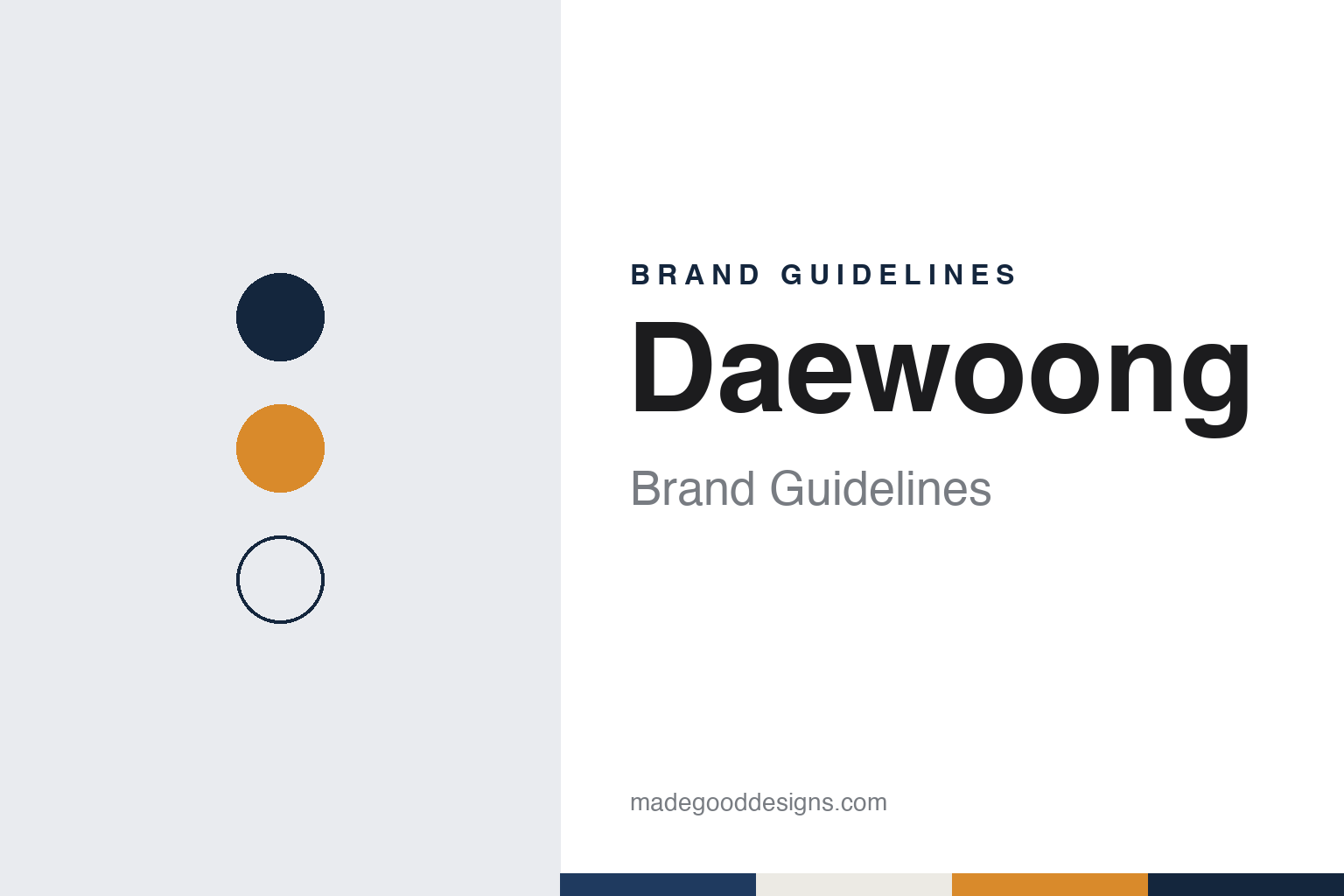
Daewoong Brand Guidelines
The Seoul drug maker named for a great bear.
Aa
Two constants: a navy, amber and grey palette and a clean Korean sans register. Abstract homage — not a Daewoong product or mark; no pack, logo or capsule is reproduced.
Chosun Ganyu
A liver-oil works in a newly liberated Korea.
Daewoong Pharmaceutical traces its start to 1945, the year Japanese colonial rule in Korea ended. Korean Wikipedia says that in that year Ji Dal-sam took over Kawai, a Japanese-owned pharmaceutical works, and set up Chosun Ganyu Pharmaceutical Industrial — ganyu is the Korean word for liver oil — as the forerunner of today’s company. English Wikipedia dates the Kawai business to 1942 and gives 1945 as the year the Korean company was incorporated; the reports used for this guide do not say what the Japanese-owned works made in the war years before 1945.
The early years were interrupted. Korean Wikipedia records that the company won a vice-president’s prize at an exhibition of Korean-made goods in 1949, that its drug production stopped in 1950 because of the Korean War, and that it received a manufacturing licence from the health ministry in 1954. In 1961 it took the name Daehan Vitamin Industrial.
The turning point came in 1966, when Yoon Young-hwan became chief executive; English Wikipedia says he bought the business, which was then in financial difficulty. In 1972 a plant opened in Seongnam and the head office moved to Seoul, and in 1973 the company listed its shares, the fourth Korean drug maker to do so, according to Korean Wikipedia. A research institute followed in 1974, the same year as the soft-capsule version of Ursa, the liver remedy still in its range today. In 1978 the company became Daewoong Pharmaceutical. Korean Wikipedia gives the name in hanja as 大熊製藥; the first two characters mean “great bear,” and the last two “pharmaceutical.”
Colour
Ursa, Bearse and a toxin.
Daewoong grew as a maker of everyday medicines as well as prescription drugs. Korean Wikipedia’s company timeline lists the multivitamin Gemron in 1979, the antacid Miranta in 1982 and the digestive-enzyme tablet Bearse in 1987, and names the vitamin brand Impactamin among its current consumer products, alongside Ursa. Partnerships brought in outside names: in 1982 it set up Daewoong Lilly, a joint venture that Korean Wikipedia says is now Lilly Korea, and in 1988 it began selling the Polident denture cleanser under an agreement with its developer. The same timeline says Ursa was named an official supplier to the 1986 Asian Games and the 1988 Seoul Olympics.
Biotechnology came next. Korean Wikipedia credits the company with an epidermal growth factor product developed in 2001 with Korean technology, and lists two newer prescription medicines: Fexuclue, a medicine for gastro-oesophageal reflux launched in 2022, and Envlo, an SGLT2 inhibitor for diabetes launched the same year, which Korean Wikipedia describes as Korea’s first drug of that class and the country’s 36th domestically developed new drug. In 2016, it adds, the US Food and Drug Administration approved the company’s meropenem antibiotic injection.
The product that now shapes the company is Nabota, a botulinum toxin. English Wikipedia says that by 2026 the aesthetics business centred on Nabota had become Daewoong’s largest, and that the company was moving into fillers and skin boosters. In the United States, Nabota is sold by the partner company Evolus; The Asia Business Daily reported in August 2024 that it had received approval from the US Food and Drug Administration by 2019.
Typography
Research campuses and long packaging lines.
Korean and Chinese drug makers tend to introduce themselves through places as much as products. Their annual reports and websites lead with research campuses: new buildings in Shanghai and Suzhou, and the technology district of Pangyo, south of Seoul. Chia Tai Tianqing, for example, says it moved its global research headquarters to Shanghai in 2023, and Hengrui says it opened research offices in Princeton and Basel in 2020.
The pictures inside those reports follow a familiar pattern. White-coated scientists work at screens and fume hoods; long packaging lines carry tablets and vials; and the older companies keep a place for their beginnings, with founders and first factories shown in archive photographs. Several of the businesses in this group began as municipal or state factories decades before they became listed research companies.
Trade fairs are the other stage. The companies take booths at the BIO International Convention in the United States and at the large pharmaceutical fairs in China, where licensing talks with international partners are now a regular part of the business. Hengrui’s July 2025 licensing agreement with GSK is one recent example. In this guide, such deals are named without sums, and any deal not confirmed as completed is described as pending.
The visual identities themselves are mostly corporate and restrained: usually a wordmark in red, blue or green, with photography doing most of the work. Few of these companies publish brand guidelines or official colour values, so the palettes in this guide are our own unofficial interpretations, chosen to sit alongside the companies’ public materials without copying them.
Aa
A clean Korean sans for a name meaning “great bear.” (Specimen set in Gothic A1, a sans STAND-IN; NOT the Daewoong logo.)
Daewoong
A great bear and a long dispute.
Nabota also drew Daewoong into a long legal dispute. In 2017 the rival toxin maker Medytox sued Daewoong in Korea, claiming that the strain and manufacturing process behind Nabota had been taken from Medytox; Daewoong has contested the claim throughout. In 2019 Medytox and Allergan filed a complaint with the US International Trade Commission against Daewoong and Evolus. At the end of 2020 the ITC barred imports of Nabota into the United States for 21 months, and in February 2021 Medytox and Allergan reached a settlement with Evolus that ended the ITC case, The Asia Business Daily reported.
In Korea, the Seoul Central District Prosecutors’ Office closed its investigation in February 2022, saying it had found no evidence of a leak. On 10 February 2023, however, the Seoul Central District Court ruled largely in Medytox’s favour in the civil case, ordering Daewoong to hand over the strain, to dispose of finished products, to stop using the related manufacturing technology and to pay damages. Daewoong appealed on 15 February, and the next day the court suspended enforcement until the appeal is decided, so Nabota production and sales continued. The appeal opened at the Seoul High Court in September 2024, and The Asia Business Daily reported that criminal investigations prompted by Medytox’s complaints had resumed. In September 2026 the broadcaster MTN reported that Medytox had raised its damages claim and that both sides’ appeals were still before the court.
The company today is part of a wider group. Its website lists it alongside Daewoong Co., Ltd., HanAll — the former Hanall Pharmaceutical, which Korean Wikipedia says Daewoong acquired in 2015 — and other group companies, and names Chang-jae Lee and Seongsoo Park as chief executives. The head office is in Gangnam, Seoul. Korean Wikipedia lists its main plant at Hyangnam in Hwaseong, a cGMP-standard plant at Osong in North Chungcheong completed in 2017 and a life-sciences research centre in Yongin, and records the Daewoong-Infion plant in Surabaya, Indonesia, completed in 2016. English Wikipedia says a new toxin plant in Hwaseong is due to be completed in 2027.
For a design guide, Daewoong shows how a name meaning “great bear” can stretch from a pharmacy-shelf liver capsule to an export toxin brand. Compare Yuhan and Hanmi, two other Seoul drug makers. For this guide we use a deep navy, a warm amber and a soft grey with a sans, an unofficial interpretation; no product or logo is reproduced.
Explore & save
Keep Daewoong’s identity on hand — save it to a board in the Made Good inspiration library.
Daewoong identity set
Pin the Daewoong navy, amber and grey palette and the clean Korean sans register to your own board.