Rohde & Schwarz Brand Guidelines
The Munich laboratory that became a family-owned measurement group.
Aa
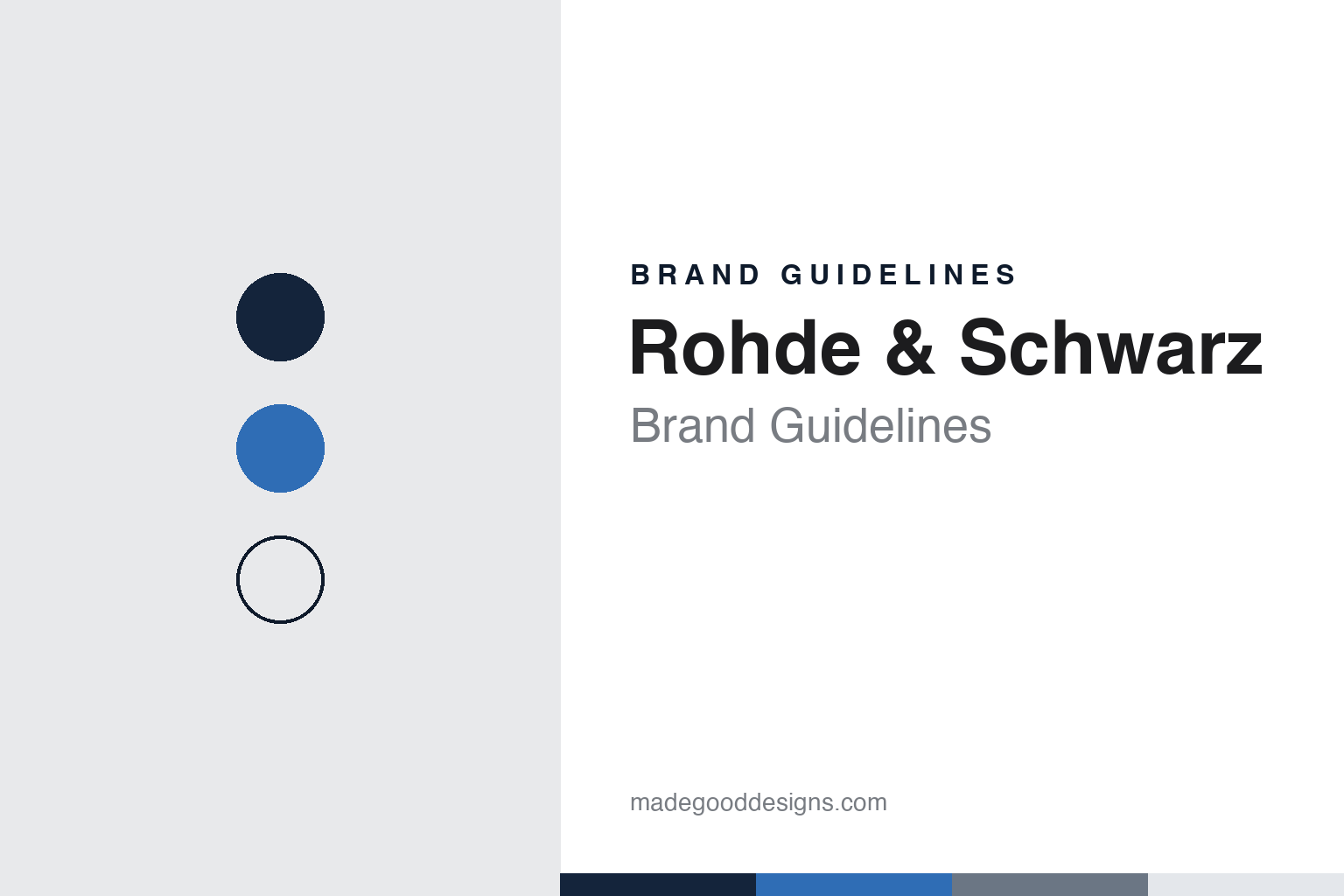
Two constants: a deep navy, signal blue and grey palette and an engineering sans register. Abstract homage — not a Rohde & Schwarz product or mark; no instrument, logo or nameplate is reproduced.
PTE
Two Jena physicists and a Munich flat.
Rohde & Schwarz began as a laboratory run by two physicists. Lothar Rohde and Hermann Schwarz met while studying physics in Jena and built their first measuring instrument in 1932, according to English and German Wikipedia. The International Directory of Company Histories says their first potential client was Hescho, a maker of industrial ceramics that needed to show how its materials behaved at high frequencies.
In the summer of 1933 the pair set up a laboratory in a flat on Thierschstraße in Munich. German Wikipedia says the firm started business in August and was entered in the Munich commercial register on 17 November 1933 as the Physikalisch-Technisches Entwicklungslabor Dr. L. Rohde & Dr. H. Schwarz, or PTE; the company today gives 17 November as its founding date. Its first export order came in 1934 from an English insulation maker, which ordered an instrument for measuring losses in ceramic discs.
The laboratory grew quickly. In 1937 it moved into a former bread factory on Tassiloplatz, near Munich’s Ostbahnhof, with 35 staff and 24 instruments in its range, German Wikipedia says; the Directory gives about 40 staff that year. In 1938 PTE built a portable quartz clock weighing 36 kilograms, which the company calls the world’s first.
The war years. Growth after 1939 came from military demand. The Directory says PTE had about 100 staff when the Second World War began and became a supplier of measuring instruments to the German war industry, especially in radio and communications, with 260 staff by 1941. English Wikipedia says the Wehrmacht’s sustained demand for radio equipment brought orders as the economy was militarised, and that the company’s high-frequency measuring equipment advanced the development of Wehrmacht radar and radio systems. German Wikipedia says a first large Wehrmacht order, for radio-monitoring receivers, moved the firm to industrial production in 1942. The sources used for this guide do not say whether the firm used forced labourers during the war. A subsidiary, Messgerätebau GmbH, was set up for the Allgäu in 1941 and produced first in Kempten and, from 1944, in a former knitting factory in Memmingen; the Directory names a radio-observation receiver called “Samos” among its products. Several of the company’s buildings were partly destroyed by bombing in 1942 and 1943, and in 1945 the company employed about 600 people and its subsidiary about 200, the Directory says.
Colour
From FM transmitters to oscilloscopes.
In mid-1945 the American military government allowed the company to resume work, and a US order to service radio equipment at the air base in Erding, near Munich, kept it going, English Wikipedia and the Directory say. Wikipedia dates the Rohde & Schwarz name to 1945; the Directory places the change at the start of the war.
Broadcasting came next. On 18 January 1949 Radio München, forerunner of the Bavarian broadcaster Bayerischer Rundfunk, ordered an FM transmitter; the company says Europe’s first VHF station went on air on 28 February 1949. It dates its Zg diagraph, which it calls the world’s first vector network analyser, to series production in 1950. The Directory names the West German post office, broadcasters, air-traffic authorities and the new Bundeswehr as its main customers in the 1950s.
The measuring range widened decade by decade. The company lists the SMPU of 1974, which it describes as the first microprocessor-controlled radio test set; its first spectrum analyser, the FSA, in 1986; a GSM system simulator delivered in April 1992; and the CMU200 and CMW500 mobile-radio testers of 1999 and 2007. In 2010 it entered the oscilloscope market with the R&S RTO, which English Wikipedia says was the first oscilloscope with a digital trigger, followed by the FSW spectrum analyser in 2011 and the MXO 4 series in September 2022.
Acquisitions filled gaps. HAMEG, a German oscilloscope maker, joined the group — in 2005 according to German Wikipedia and in 2012 according to English Wikipedia — and its products were sold under the Rohde & Schwarz name from 2016, English Wikipedia says. The company describes Zurich Instruments, bought in 2021, as its entry into quantum technology, and bought ZES Zimmer, a maker of power-measurement instruments in Oberursel, in July 2025.
The group is wider than test and measurement. Its own pages list divisions for aerospace and defence and for critical infrastructure and networks, and Wikipedia describes broadcast transmitters, air-traffic-control radio, encryption products and radio-monitoring systems among its businesses.
Typography
How the category presents itself.
Test and measurement companies sell instruments that most people never see, and their marketing is built around the screen. Product pages and brochures tend to lead with an oscilloscope display: a dark background, a fine grid of divisions and bright traces in yellow, cyan, magenta and green, each colour standing for a separate channel. The trace is the product’s face, so photographs are often cropped tight on the display rather than on the case around it.
The second familiar image is the laboratory. Signal and spectrum analysers, generators and power supplies appear stacked in racks or lined up on a bench, cables looping between front panels of knobs, soft keys and connectors. Engineers are shown probing a circuit board with a fine tip, reading a waveform while the device under test sits under a lamp or a magnifier. The tone is calm and technical, with product names and model numbers set in plain sans type.
Further along the chain, the pictures move into the factory. Semiconductor test makers show automated chip testers and handlers in clean production areas, staff in protective suits, and wafer probe cards photographed under magnification, where rows of needle-like contacts meet the pads of a chip. Network and wireless test companies favour antennas, fibre spools, base stations and phones in shielded boxes.
The category also meets its customers in person. Trade shows such as electronica in Munich, DesignCon in Santa Clara and Mobile World Congress in Barcelona are where new instruments are launched and demonstrated live, so stand design, demo screens and printed data sheets carry much of each brand’s visual identity. This guide sets out what can be checked about each company — who founded it, who owns it and where its products are made — and marks clearly what rests on the company’s own word.
Aa
An engineering sans for a name built from two surnames. (Specimen set in Archivo, a sans STAND-IN; NOT the Rohde & Schwarz logo.)
Rohde & Schwarz
Private, Bavarian and largely made in-house.
Rohde & Schwarz has stayed in private hands. The Directory describes it as owned by the Rohde and Schwarz families, and the company today calls itself “privately owned” and Munich-based. Friedrich Schwarz, Hermann Schwarz’s son, joined the founders in running the business, and the company dates his place on the executive board to 1971. Its headquarters is on Mühldorfstraße in Munich, where the company says its main building went up in 1960 and 1961.
Where it is made. English and German Wikipedia say most of its equipment is made in its own plants at Memmingen in the Allgäu and Teisnach in the Bavarian Forest, and at Vimperk in the Czech Republic, with smaller plants in Singapore and Malaysia for final assembly and dispatch of selected products. Teisnach opened in 1969, German Wikipedia says. At Vimperk the company began working with the local Tesla factory in 1991 and bought it in 2001, its first manufacturing plant outside Germany; English Wikipedia says that plant makes the whole oscilloscope range. The company says it has “always covered a significant share of its value chain in-house.”
Identity. The name is the founders’ two surnames joined by an ampersand, and product names carry an R&S prefix, as in R&S RTO and R&S MXO 4. The palette and type below are our own interpretation.
For a design guide, Rohde & Schwarz shows how a founders’ laboratory became a large group that still carries both founders’ names. Compare Tektronix, which the Directory says agreed in 1993 to market Rohde & Schwarz instruments in North America, and Keysight. For this guide we use a deep navy, a signal blue and cool greys with a sans, an unofficial interpretation; no product or logo is reproduced.
Explore & save
Keep Rohde & Schwarz’s identity on hand — save it to a board in the Made Good inspiration library.
Rohde & Schwarz identity set
Pin the Rohde & Schwarz deep navy, signal blue and grey palette and the engineering sans register to your own board.