Ushio Brand Guidelines
A Tokyo company that treated light as energy as well as illumination.
Aa
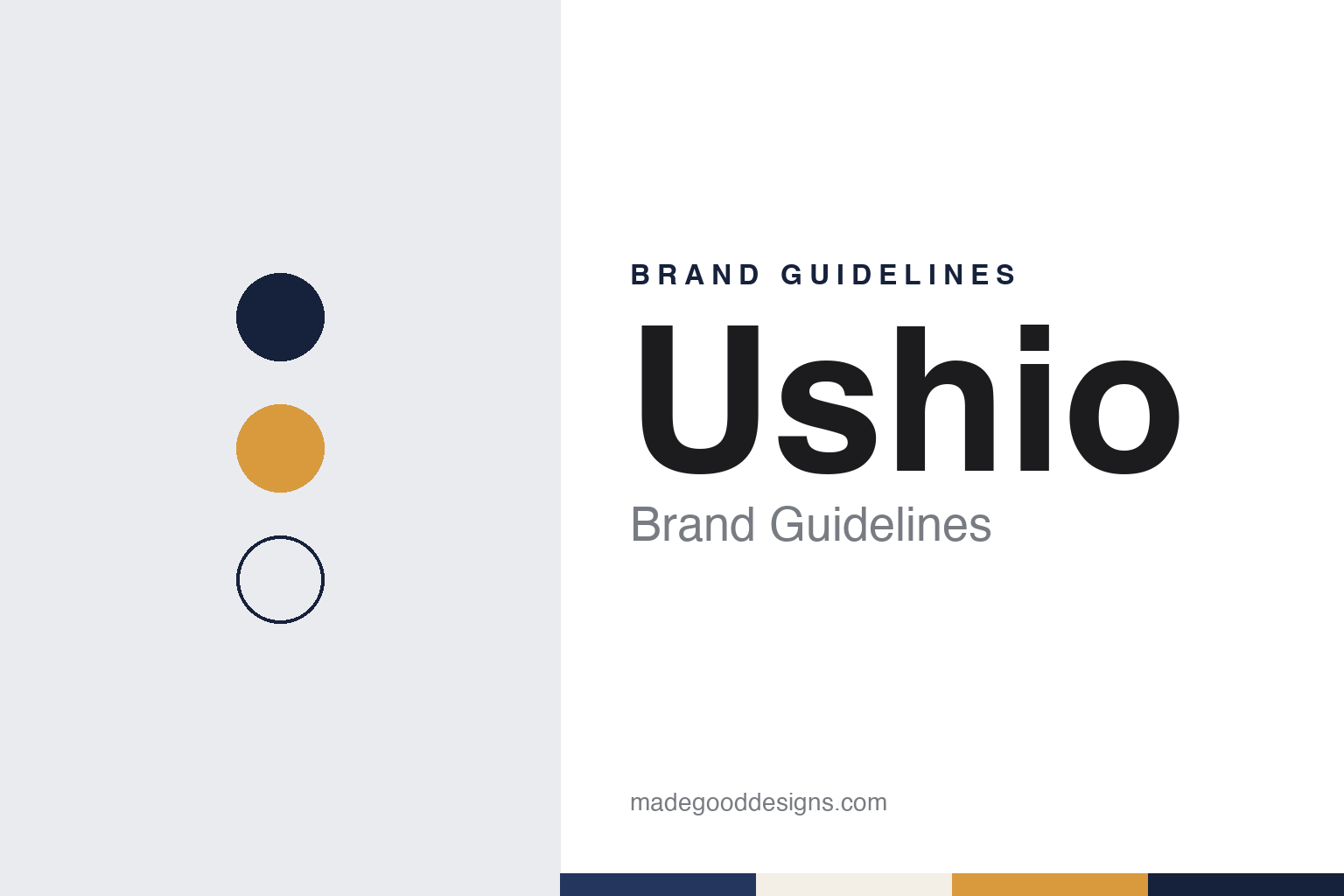
Two constants: an indigo, xenon-white and amber palette and a Japanese gothic sans register. Abstract homage — not an Ushio product or mark; no lamp, logo or nameplate is reproduced.
Light as energy
A spin-off from a family business, run by a 33-year-old.
Ushio Inc. dates its founding to March 1964. The company’s own account of its founder, Jiro Ushio, says he had joined the family business, Ushio Industries (Ushio Kogyo), in 1959, and that its electrical division was spun off to form Ushio Inc.; Japanese Wikipedia describes the new company as the industrial light-source division of Ushio Kogyo becoming independent. The founder was 33 at the time, the company says, and its 268 employees had an average age of 23.
At a time when light was used only for illumination, the company says, it set out to apply light “not only as illumination, but as a form of energy.” In 1965 it drew up “Four Basic Principles,” which it says remain the base of its management philosophy; the fourth was to “show the world the true value of a medium-sized enterprise.”
The first products were lamps. Ushio’s history page lists xenon long-arc and short-arc lamps for illumination in 1964, including rooftop advertising lighting on the Keio department store in Tokyo, which the company calls a world first. In 1966 came what Ushio describes as Japan’s first halogen lamp, along with a xenon short-arc lamp for cinema projectors designed to run horizontally rather than vertically, and its first solar simulator, delivered to the Institute of Space and Astronautical Science at the University of Tokyo.
The move from lamps into equipment began early. In 1968 the company opened a division in Yokohama and launched the “Unimask 101” IC lithography system; Ushio says it was the first in the world to put the projection method into practical use, and calls it the origin of its present UX series of lithography equipment. Ushio America followed in 1967 as a lamp sales base in the United States. The company listed on the second section of the Tokyo Stock Exchange in 1970, the same year it opened its Harima Division at Himeji in Hyogo Prefecture, and moved to the first sections in Tokyo and Osaka in 1980; it left the Osaka exchange in January 2010.
Colour
Searchlights, solar simulators and a projector maker.
Some of Ushio’s early work was very public. The company says a xenon short-arc searchlight was installed in the Tower of the Sun at Expo ’70 in Osaka, and that in 1975 it delivered a large solar simulator, fitted with 19 water-cooled xenon short-arc lamps, to the National Space Development Agency of Japan, now JAXA, for testing satellites. In 1971 it moved its head office to the Otemachi business district in Tokyo.
Other products went into manufacturing: halogen heaters for semiconductor production in 1982; the “Photolex” optical cleaning system in 1983, which the company describes as the world’s first to dry-clean organic residue from semiconductor surfaces using ultraviolet light; and, in 1993, what Ushio calls the first productization of dielectric barrier discharge excimer lamps, first aimed at cleaning in the LCD industry. In 1998 it introduced “NSH” lamps for DLP data projectors.
The company expanded abroad after the 1985 Plaza Accord. Ushio says it began building factories in Hong Kong, the United States, the Netherlands and Taiwan soon afterwards, and in 1990 it bought the German lamp maker BLV Licht- und Vakuumtechnik, now Ushio Germany.
Ushio also moved into projection. In 1992 Ushio acquired the projector division of the American firm Christie Electric Corp., forming Christie, Inc., and in 1999 it bought the imaging equipment division of Electrohome Ltd. of Canada, forming Christie Digital Systems, which makes digital cinema projectors. Japanese Wikipedia dates Ushio’s entry into digital cinema to the 1992 purchase.
Some ventures were later sold or closed. Ushio set up Gigaphoton in 2000 to make excimer lasers for lithography and transferred all of its shares to Komatsu in 2011; it took a stake in XTREME technologies, a German developer of light sources for EUV lithography, in 2005, made it wholly owned in 2008 and liquidated it in December 2017. It bought the semiconductor-laser developer Necsel in stages in 2009 and 2010, and made the exposure-equipment maker Adtec Engineering a wholly owned subsidiary in 2014.
Typography
How photonics makers present themselves.
Photonics companies sell things most people never see. Their lasers sit inside machine tools, their transceivers inside data-centre racks, and their detectors inside instruments, telescopes and physics experiments. So the way they present themselves leans on a small set of images that make light visible: a laser beam crossing a dark optical table, the glowing end of a fibre, a row of pluggable transceiver modules lined up for a switch, or a photomultiplier tube and a sensor chip photographed under studio light against black.
The catalogue matters as much as the advertisement. Many makers of optics and components publish long product catalogues of lenses, mirrors, mounts, filters, tubes and diodes, each part with a drawing, a part number and a page of specifications. That catalogue habit gives much of the sector a shared look: clean technical photography, plenty of white or black space, careful diagrams and an engineering sans or a restrained serif, with colour used sparingly, often for a single accent.
The trade shows are where the industry gathers in person. Photonics West, LASER World of PHOTONICS and OFC, the optical fibre communication conference, are among the events where companies show new lasers, modules and detectors, and their stands and press releases often borrow the same visual language of beams, fibres and glowing chips. Company histories also lean on science: makers of detectors and light sources often point to the research projects and observatories that have used their parts.
This guide sets out what can be checked about each brand — who founded it, who owns it, what it has bought or sold and what it makes — and marks clearly what rests only on the company’s own word. Pending deals are described as pending, with the date they were announced.
Aa
A Japanese gothic sans for a Tokyo light-source maker. (Specimen set in Zen Kaku Gothic New, a sans STAND-IN; NOT the Ushio logo.)
Ushio
A light-source group reshaping itself for 2030.
Ushio Inc. is listed on the Prime Market of the Tokyo Stock Exchange, Japanese Wikipedia says. In July 2025 it moved its head office from Marunouchi to the Sumitomo Fudosan Tokyo Mita Garden Tower in Minato ward, following a notice the company issued in May 2025. Its president and chief executive is Takabumi Asahi; in April 2026 the trade magazine Digital AV Magazine reported that Michael Phipps had succeeded him as chief executive of Christie Digital, and that Asahi continued as chief executive of the Ushio group. The company gave its group headcount as 5,898 as of March 31, 2026, with 1,475 at Ushio Inc. itself.
Under a strategy called “Revive Vision 2030,” set out in 2024, Ushio has been reshaping its portfolio. In July 2025 it agreed to acquire the industrial and entertainment lamps business of the ams-OSRAM group, mainly lamps for semiconductor manufacturing equipment, and it said on March 3, 2026 that the acquisition was complete. On April 14, 2026 it agreed to transfer its semiconductor laser device business to Kyocera; the transfer is scheduled for April 1, 2027, and had not been completed at the time of writing. In February 2026 the company also announced an investment in the chipmaker Rapidus.
On manufacturing, Japanese Wikipedia lists domestic sites at Himeji, Yokohama and Gotemba, and the company’s history records lamp production bases set up in the Philippines in 1996 and in Suzhou, China, in 2004, and the Polish lamp maker Natrium, bought in 2005 and now Ushio Poland. Its product range today runs from lamps and LED light sources to the UX series of projection aligners for wafers and packaging substrates, for which it opened orders on new models in December 2025 and June 2026, the latter equipped with LED light sources.
For a design guide, Ushio shows how a component maker can build an identity around light itself, from searchlights and solar simulators to lamps built into manufacturing equipment. Compare Hamamatsu Photonics, another Japanese photonics maker, and Excelitas. For this guide we use indigo, xenon white and halogen amber with a sans, an unofficial interpretation; no product or logo is reproduced.
Explore & save
Keep Ushio’s identity on hand — save it to a board in the Made Good inspiration library.
Ushio identity set
Pin the Ushio indigo, xenon white and halogen amber palette and the Japanese gothic sans register to your own board.