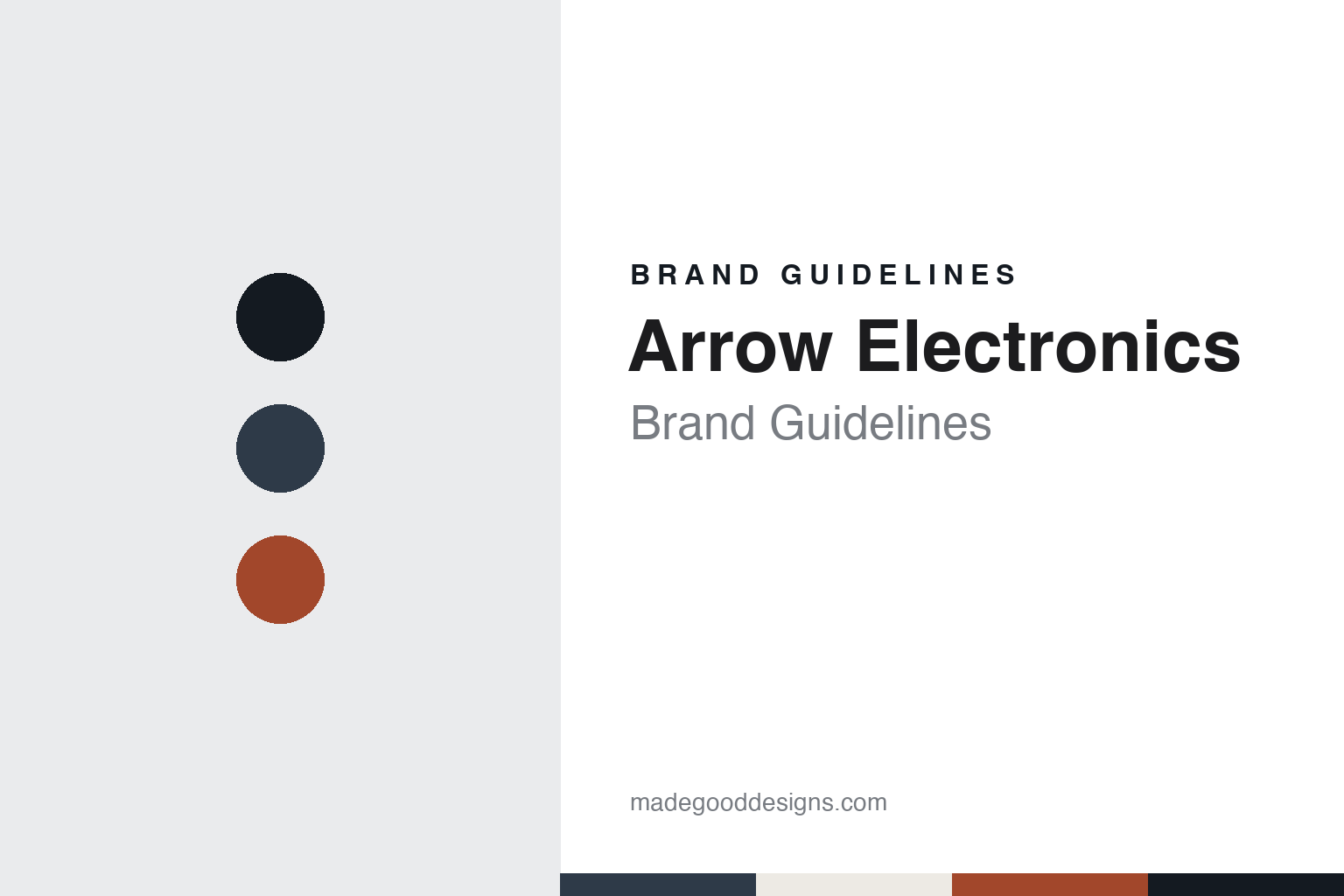
Arrow Electronics Brand Guidelines
A 1935 Radio Row store grown into a global distributor.
Aa
Two constants: a slate, brick and warm grey palette and an engineering sans register. Abstract homage — not an Arrow Electronics product or mark; no logo or packaging is reproduced.
Arrow Radio
A shop on Cortlandt Street.
Arrow Electronics began as a shop. In 1935 a store called Arrow Radio opened on Cortlandt Street in lower Manhattan, on the stretch known as Radio Row, English Wikipedia says; it was established by Maurice “Murray” Goldberg and sold used radios and radio parts to retail customers. Other businesses nearby belonged to Charles Avnet and to Seymour Schweber, whose company Arrow later merged with.
By the 1940s the store was selling new radios made by RCA, GE and Philco, with surplus parts sold over the counter in a department at the back. Arrow then sought franchises to sell new parts; RCA and Cornell Dubilier were the first manufacturers to grant one, and the business was incorporated as Arrow Electronics, Inc. in 1946. In the early 1950s it began selling parts to industrial customers through a small field sales team, opened a second store and sales office in Mineola on Long Island in 1956, and listed its shares on the American Stock Exchange in 1961, by which time the industrial side made up more than half its sales, Wikipedia says. During the 1960s the headquarters moved to Farmingdale, also on Long Island.
The decisive change came in 1968. An investor group led by Glenn, Green & Waddell — a partnership of three recent Harvard Business School graduates, B. Duke Glenn Jr., Roger E. Green and John C. Waddell — bought control of Arrow, seeing room to consolidate a fragmented trade. In the 1970s Arrow won semiconductor franchises, starting with Texas Instruments in 1970, opened sales offices in more than 20 American cities and closed its retail business. Wikipedia credits it with introducing the distribution trade’s first integrated online, real-time computer system for checking stock and taking orders remotely. Arrow listed on the New York Stock Exchange in 1979 and that year bought Cramer Electronics, its first major acquisition in the industry.
Colour
Fifty acquisitions and a joint venture.
On 4 December 1980 a fire at the Stouffer’s Inn killed 13 members of Arrow’s senior management, Glenn and Green among them, English Wikipedia records. John Waddell took over the leadership, and in 1982 he recruited Stephen P. Kaufman, a former partner at McKinsey & Company, to run the electronics distribution division. Kaufman became chief executive in 1986 and chairman in 1994.
Under Kaufman, Arrow grew by buying other distributors — more than 50 of them, Wikipedia says. In the United States the names included Kierulff, bought in 1988, Schweber, Zeus, Anthem, Bell and Wyle; abroad they included Spoerle in Germany, Silverstar in Italy and CAL in Hong Kong and China. Arrow also moved into distributing commercial computer products, starting with the purchase of Gates/FA Distributing, and in 1998 it set up Marubun/Arrow, a 50/50 joint venture with Japan’s Marubun Corporation intended to support each partner’s operations in Asia and North America.
The buying continued under later chief executives. Kaufman stepped down as chief executive in 2000 and retired as chairman in 2002, when he was succeeded by Daniel W. Duval, a board member of 15 years. William E. Mitchell, formerly president of Solectron’s global services division, joined as chief executive in 2003, became chairman in 2006 and completed 17 acquisitions in six years, Wikipedia says. Michael J. Long, who had joined Arrow in 1991 through its merger with Schweber Electronics and had been president and chief operating officer since March 2008, was named to succeed him, the trade site Evertiq reported in March 2009; Mitchell was to stay on as executive chairman until the end of that year, and Long became chairman in 2010. Under Long the company moved its headquarters to Centennial, Colorado, in 2011, and bought into electronics publishing: United Technical Publishing from Hearst in 2015, and in 2016 a portfolio from UBM that included EE Times and EDN, according to Wikipedia.
Typography
How distributors present themselves.
Electronic-component distributors sit between the companies that make chips, passives and connectors and the engineers who design them into products. For much of the twentieth century their public face was paper: thick printed catalogues, reissued at intervals and kept on the shelf beside the workbench, listing thousands of parts by type, value and package. Many of these businesses began as shops selling radio parts over the counter, and the catalogue carried that counter into offices and factories.
Today the catalogue has largely given way to the search box. Distributor websites lead with a part-number search, filters for specifications and stock levels, and datasheets a click away; the printed book survives, where it survives at all, as a reference rather than the main way to order. Photographs in these companies’ own material tend to show the warehouse behind the website: long aisles of reels, trays and anti-static bins, picking stations and parcels on conveyors, often paired with promises of same-day shipping on orders placed before a cut-off time.
The audience has widened too. Alongside franchised lines from chip makers, distributors now sell development boards, evaluation kits and maker-friendly modules to students, hobbyists and start-ups as well as to large manufacturers, and many run online communities and training material for engineers. Franchised distributors and catalogue houses present themselves differently: the first stress their relationships with manufacturers and their design support, the second their range and speed.
Much of the trade still meets in person. Engineers and buyers walk the stands at shows such as electronica in Munich, Embedded World in Nuremberg and CES in Las Vegas, where distributors take booths beside the manufacturers whose parts they sell. This guide sets out what can be checked about each company — who founded it, who owns it now and how it has changed — and marks clearly what rests only on the company’s own word.
Aa
An engineering sans for a parts trade. (Specimen set in IBM Plex Sans, a sans STAND-IN; NOT the Arrow Electronics logo.)
Arrow Electronics
From a parts counter to a racing livery.
Sean J. Kerins, who had led Arrow’s enterprise computing business, succeeded Long as president and chief executive in June 2022. He left in September 2025: on 16 September the board named William F. Austen, one of its directors, interim president and chief executive and began a search for a permanent successor, Simply Wall St reported on 23 September 2025, adding that the company said the departure was unrelated to its financial statements.
Arrow’s name now reaches well beyond the trade. It has sponsored the FIRST Robotics Competition for high-school teams since 2012. In 2019 it became title sponsor of the Schmidt Peterson IndyCar team and signed a sponsorship deal with McLaren Racing; the IndyCar entry has raced as the Arrow McLaren team since the 2023 season, and the title sponsorship is due to end after the 2028 season, English Wikipedia says. Its business covers electronic components and enterprise computing products, with distribution and services for equipment makers, resellers, managed service providers and contract manufacturers.
For a design guide, Arrow Electronics shows how a parts counter on Radio Row became a name carried on racing cars. Compare Avnet, whose founder also traded on Radio Row, and Future Electronics, another North American component distributor. For this guide we use a slate, a brick red and a warm grey with a sans, an unofficial interpretation; no product or logo is reproduced.
Explore & save
Keep Arrow Electronics’s identity on hand — save it to a board in the Made Good inspiration library.
Arrow Electronics identity set
Pin the Arrow Electronics slate, brick and warm grey palette and the engineering sans register to your own board.