DigiKey Brand Guidelines
A ham-radio kit from northern Minnesota that became a parts catalogue for engineers.
Aa
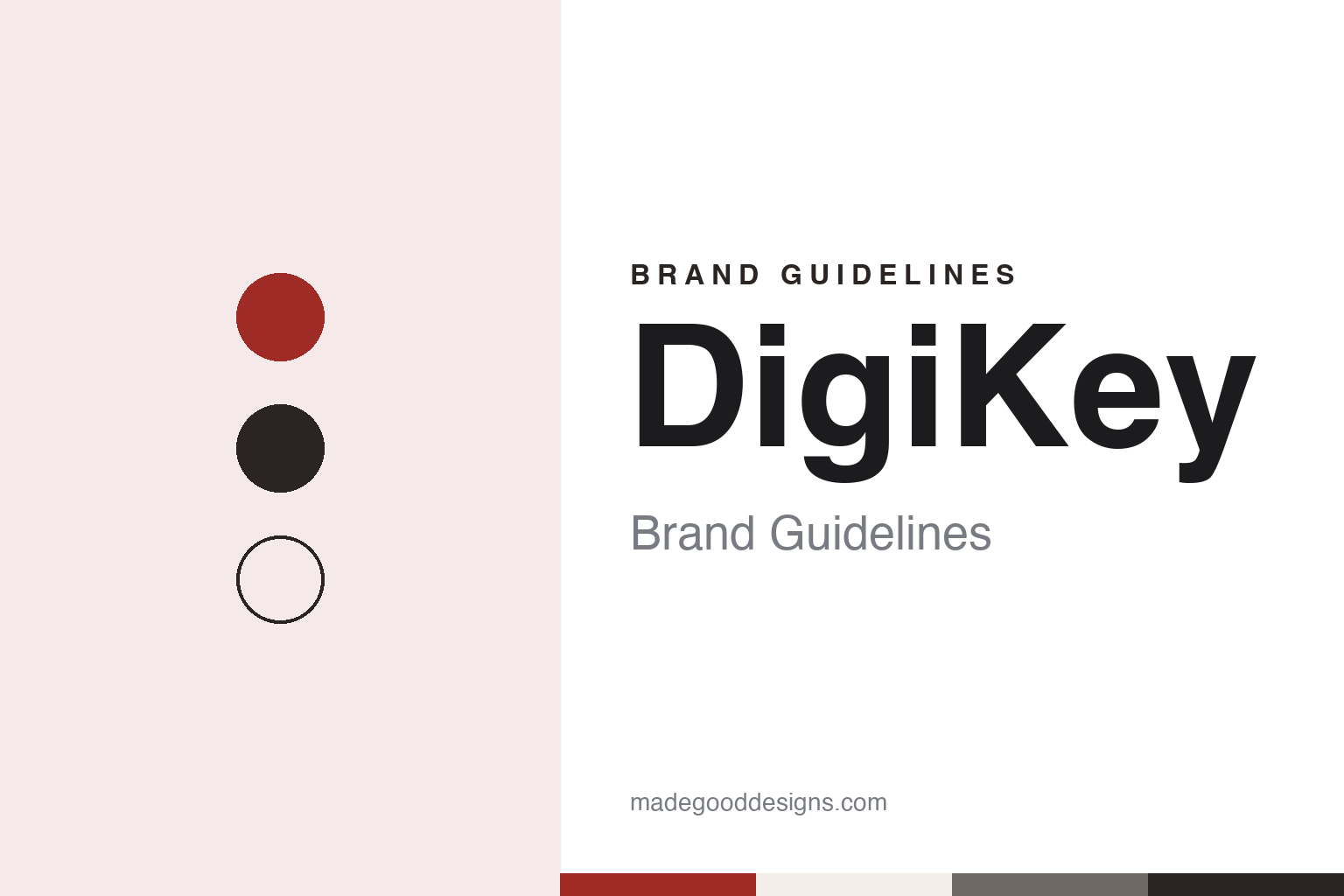
Two constants: a brick red, charcoal and paper palette and an engineered sans register. Abstract homage — not a DigiKey product or mark; no logo, part or packaging is reproduced.
The Digi-Keyer
A Morse-code kit that outsold itself in spare parts.
DigiKey began in 1972 in Thief River Falls, a small city in north-western Minnesota, and its name comes from a hobby product rather than a business plan. English Wikipedia says the founder, Ronald Stordahl, studied electrical engineering at the University of Minnesota, returned to his home town and took up amateur radio in the early 1970s. He built a keyer, a device that sends evenly timed Morse code, and sold it as a kit to other radio amateurs as the “Digi-Keyer Kit”; schematics for the keyer had appeared in the amateur-radio journal QST in April 1968, the same article says.
The kit itself did not sell especially well. According to English Wikipedia, Stordahl had bought more components than he needed, and he began selling the spare parts by mail order. That side line became the business: a distributor willing to sell parts in any quantity, however small, to hobbyists as well as companies.
The company stayed where it started. Mark Larson joined in 1976 as general manager and became president in 1985, English Wikipedia says, and led the move from a hobbyist customer base to a wider engineering market; by 1984 the business had moved into a large building next door to the snowmobile maker Arctic Cat. Wikipedia describes the company as privately owned by Stordahl, and records that Dave Doherty, previously head of operations, became president on 1 June 2015, when Larson moved to the board.
A detail from the parts themselves hints at the house style: DigiKey’s own part numbers, the stock-keeping codes printed on every bag and reel label, typically end in the suffix “-ND”, according to English Wikipedia.
Colour
From a thick catalogue to an online store.
For most of its history DigiKey was a catalogue house: engineers and hobbyists picked parts from printed pages and ordered by phone or post. The shift online started early. English Wikipedia says the company launched its website in 1996, and in the same year opened its first international domain, for Canada; local sites later spread to more than forty countries.
The paper catalogue ended in 2011. In May that year Electronic Design reported that Digi-Key had “ceased production of its print catalog” and would offer its products only online, presenting the change as an environmental decision and as part of a move towards a fully integrated online distributor. Its TechZone magazine went online-only from the June 2011 lighting issue, and customers could still download the catalogue as a PDF or browse an interactive version. The report quoted Larson, then president and chief operating officer, on giving customers real-time pricing, lead times and specifications.
The warehouse grew alongside the website. English Wikipedia says that by 2017 DigiKey worked from a single site in Thief River Falls, and that in March 2018 it announced a building of about one million square feet for receiving, shipping and storage; the building officially opened on 17 August 2022. In May 2023 eeNews Europe reported that the company had more than 2.7 million products in stock at its Minnesota headquarters and was expanding a third-party marketplace and fulfilment service, a move the magazine compared to Amazon’s model.
Wikipedia also notes two smaller markers of the company’s self-image: in November 2022 DigiKey was granted a design patent for a tray to carry and store electronic components, and in summer 2023 it held its 50th-anniversary celebration, delayed from the previous year by the COVID-19 pandemic.
Typography
How distributors present themselves.
Electronic-component distributors sit between the companies that make chips, passives and connectors and the engineers who design them into products. For much of the twentieth century their public face was paper: thick printed catalogues, reissued at intervals and kept on the shelf beside the workbench, listing thousands of parts by type, value and package. Many of these businesses began as shops selling radio parts over the counter, and the catalogue carried that counter into offices and factories.
Today the catalogue has largely given way to the search box. Distributor websites lead with a part-number search, filters for specifications and stock levels, and datasheets a click away; the printed book survives, where it survives at all, as a reference rather than the main way to order. Photographs in these companies’ own material tend to show the warehouse behind the website: long aisles of reels, trays and anti-static bins, picking stations and parcels on conveyors, often paired with promises of same-day shipping on orders placed before a cut-off time.
The audience has widened too. Alongside franchised lines from chip makers, distributors now sell development boards, evaluation kits and maker-friendly modules to students, hobbyists and start-ups as well as to large manufacturers, and many run online communities and training material for engineers. Franchised distributors and catalogue houses present themselves differently: the first stress their relationships with manufacturers and their design support, the second their range and speed.
Much of the trade still meets in person. Engineers and buyers walk the stands at shows such as electronica in Munich, Embedded World in Nuremberg and CES in Las Vegas, where distributors take booths beside the manufacturers whose parts they sell. This guide sets out what can be checked about each company — who founded it, who owns it now and how it has changed — and marks clearly what rests only on the company’s own word.
Aa
An engineered sans for a parts catalogue. (Specimen set in IBM Plex Sans, a sans STAND-IN; NOT the DigiKey logo or brand typeface.)
DigiKey
A hyphen dropped for the 50th anniversary.
For five decades the company wrote its name Digi-Key, with a hyphen that echoed the original kit. That changed in May 2023. The Spanish trade magazine Redeweb reported on 19 May 2023 that DigiKey had introduced an update to its brand system covering the logo, colour palette, typeface, tagline, tone of voice and a simplified name, and that the work was done with the brand consultancy Lippincott. eeNews Europe reported the same week that the new look was shown at the EDS Leadership Summit in Las Vegas, would roll out through 2023, and was tied to the company’s 50th anniversary.
Both reports quote the company’s own description: an “evolution” of its historic look meant to keep an “engineered feel” in a more modern form, with the simplified name intended to reflect a wider portfolio of technical products and digital services. Dave Doherty, the president, said in the announcement that the company’s focus for fifty years had been “accelerating progress for every engineer, designer and builder.” A Lippincott partner, Tim Cunningham, said the work combined the company’s legacy with its plans for growth. The Australian trade site Electronics Online carried the announcement on 1 June 2023 and described the new name as a simplified one in the same terms.
The rebrand left the substance in place: the company is still in Thief River Falls, still privately held according to English Wikipedia, and still built around a catalogue of parts sold in any quantity. What changed was the presentation: a hyphenated catalogue name became a single word, in a brand system the company said reflected a “digital-first perspective,” as Electronics Online reported.
For a design guide, DigiKey shows how a mail-order parts house can keep its origin story in its name while rebuilding its look for a digital storefront. Compare Mouser Electronics, another American catalogue distributor that began with hobbyists, and RS Group, the British catalogue house that renamed itself in 2022. For this guide we use a brick red, charcoal and warm paper with a sans, an unofficial interpretation; no product or logo is reproduced.
Explore & save
Keep DigiKey’s identity on hand — save it to a board in the Made Good inspiration library.
DigiKey identity set
Pin the DigiKey brick red, charcoal and paper palette and the engineered sans register to your own board.