Mineral Resources Brand Guidelines
The Perth pit-to-ship contractor that became a lithium miner.
Aa
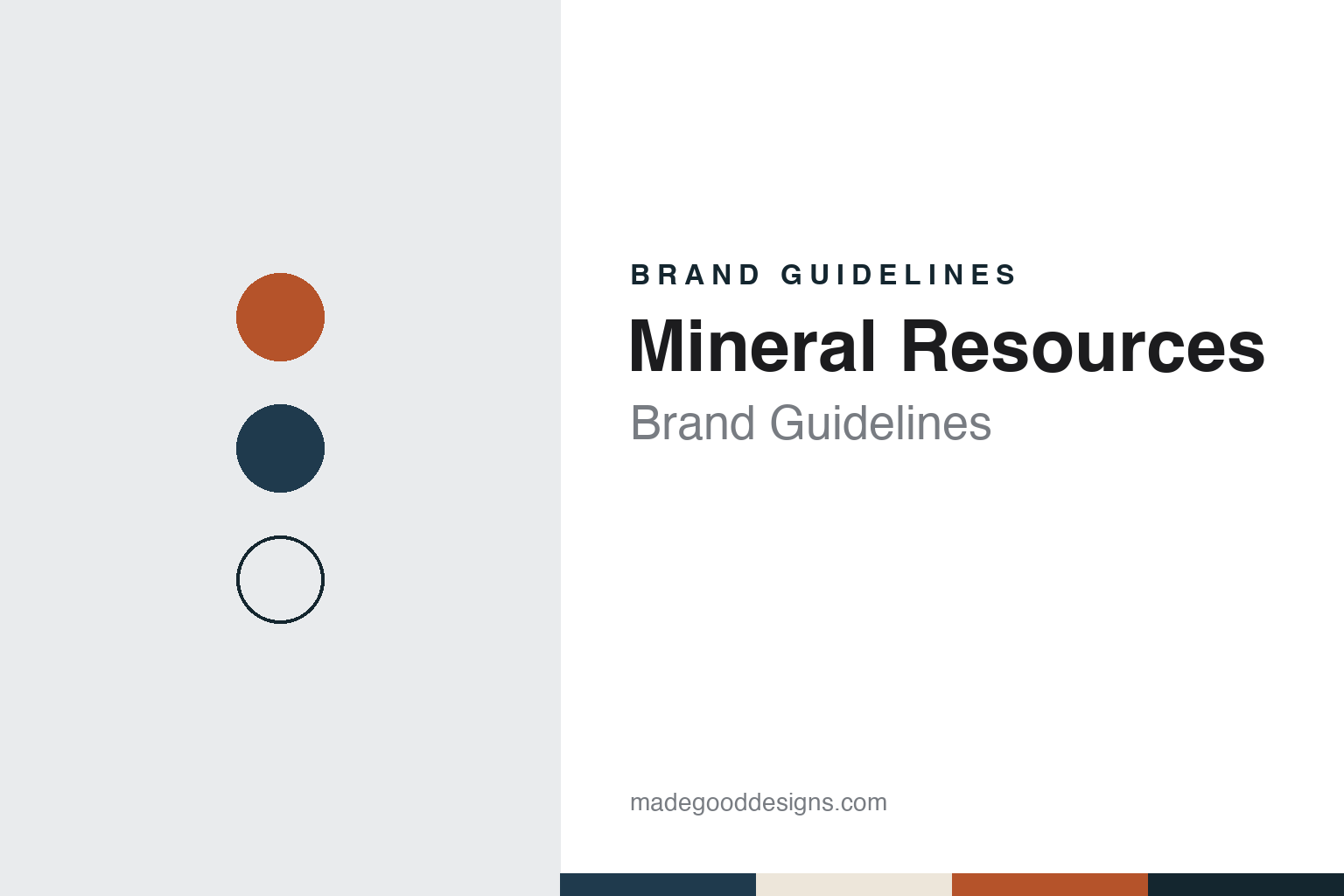
Two constants: a slate, red earth and stone palette and an industrial sans register. Abstract homage — not a Mineral Resources product or mark; no logo, site photograph or nameplate is reproduced.
Three contractors
A pipe-lining firm, a crusher business and a processor, merged and listed.
Mineral Resources, which calls itself MinRes, is a Western Australian company that grew out of contracting rather than prospecting. English Wikipedia says it was established in July 2006, when the pipeline manufacturing and contracting business PIHA, Crushing Services International and Process Minerals International merged and the combined group listed on the Australian Securities Exchange.
All three businesses lead back to one man. The company’s own biography of its managing director, Chris Ellison, describes him as the founding shareholder of each of the three original subsidiaries, and says he founded PIHA, a pipe-lining and infrastructure business, in 1992. The same page dates his appointment as managing director to February 2006, and lists earlier ventures in the Pilbara contracting trade going back to 1979.
That contracting root still shapes how the company presents itself. Its website describes “a leading mining services and diversified resources company” and offers what it calls “pit-to-ship” solutions: building, owning and running crushing plants, processing plants and haulage for other miners, alongside its own iron ore, lithium and energy assets. CSI Mining Services, a descendant of the original crushing business, still runs the crushing plant at Wodgina, the company says.
Like many Perth resource groups, it also runs its own logistics. English Wikipedia records that in July 2024 the company launched MinRes Air, flying its fly-in fly-out workforce between Brisbane and the Pilbara with a former Tigerair Airbus A319, in a venture it half-owns.
Colour
Two hard-rock lithium mines and a third on restart.
Lithium came into the business through spodumene, the hard-rock mineral mined in Western Australia and shipped as concentrate. English Wikipedia names two MinRes mines: Mt Marion in the Goldfields and Wodgina in the Pilbara.
Mt Marion, about 70 kilometres south of Kalgoorlie, was originally developed by a joint venture between Mineral Resources and Neometals and became operational in 2017, according to English Wikipedia; the company dates the start of mining to 2016. Today it is a 50-50 joint venture with Ganfeng Lithium, which MinRes runs under a life-of-mine contract and which ships concentrate from the Port of Esperance, the company says. An underground decline begun in 2024 was put on care and maintenance in December 2024; on 3 November 2026 the company announced the first blasts for an underground access portal at the mine’s Central pit.
Wodgina, about 1,525 kilometres north of Perth on the land of the Kariyarra people, is run by MinRes for both partners. In November 2018 Mining Technology reported that Albemarle had signed an exclusivity agreement to buy a half interest in the project and form a lithium joint venture with MinRes. Today the company describes Wodgina as an unincorporated joint venture held 50% by MinRes and 50% by Albemarle, with MinRes managing everything from exploration to processing and trucking concentrate to Port Hedland. It gives the plant’s capacity as about 750,000 tonnes of spodumene concentrate a year across three processing trains.
The third mine shows how quickly the market can turn. English Wikipedia says MinRes bought the Bald Hill lithium and tantalum mine in November 2023 and put it on care and maintenance in November 2024 after a collapse in lithium prices. The company says Bald Hill, on Ngadju land near Norseman, was first mined for tantalum before spodumene production began in 2019, and that in May 2026 it announced that operations would restart.
Typography
How the sector presents itself.
Lithium and battery-materials companies sell to other companies, not to shoppers, and their imagery is built for investors, carmakers and governments as much as for the public. Most of it starts at the source. Brine producers show their evaporation ponds from the air: long rectangles of turquoise, green and pale yellow laid out across a white salt flat, with mountains on the horizon. Hard-rock miners show open pits cut in terraces into red or ochre earth, haul trucks on the benches and stockpiles of pale spodumene ore.
The next layer is chemistry. Company photographs move indoors to white lithium carbonate and lithium hydroxide powders held in gloved hands or poured from a scoop, bulk bags stacked in a warehouse, and the long kilns and furnaces of refineries and cathode-material plants. These images carry the industry’s main argument: that a mineral dug or pumped in one country becomes a battery-grade chemical in another.
The end use usually appears last, and it is almost always the same: battery cells, electric cars, charging cables and grid-scale storage containers. The pictures show where the material is meant to go.
Much of the visual language is corporate rather than consumer. Investor-day slides and annual reports lean on world maps dotted with mines, plants and offices, flow charts of the supply chain from resource to cathode, and the logos of listing exchanges. Industry gatherings such as Fastmarkets’ Lithium Supply and Battery Raw Materials conference bring producers, refiners and buyers into the same rooms, and the same maps and pond photographs reappear on stage. In a sector where few people see the product, the identity rests on landscapes, laboratories and the cars at the end of the chain.
Aa
An industrial sans for a contractor’s register. (Specimen set in Archivo, a sans STAND-IN; NOT the Mineral Resources logo.)
Mineral Resources
A founder-led company under board review.
Iron ore remains the other half of the business. English Wikipedia lists hubs at Utah Point in Port Hedland and at Yilgarn, and records that in June 2024 the company announced it would close the Yilgarn hub by the end of that year. When the company held its annual meeting in November 2025, chair Malcolm Bundey called the Onslow Iron project “a generational asset,” Resources Review reported.
The same meeting closed a chapter that had begun a year earlier. On 4 November 2024 the board told the ASX that it had been investigating allegations about Mr Ellison. Its announcement set out that between 2003 and 2014 he had held an interest in a British Virgin Islands company that sold mining equipment to Crushing Services International in 2003 and 2004, before CSI became part of MinRes; it also covered his private tax settlement with the Australian Taxation Office. The board imposed financial penalties, announced new governance processes, said the chair would step down at or before the next annual meeting, and said Mr Ellison would stay as managing director during an orderly transition within 12 to 18 months.
That timetable did not hold. On 24 November 2025 Resources Review reported that the company had scrapped the target date at its annual meeting, with Bundey, now chair, telling shareholders that the earlier plan was outdated and that a three-stage succession programme would replace it. In November 2026 the company’s website still listed Mr Ellison as managing director and Bundey as chair.
For a design guide, Mineral Resources shows a contractor’s identity stretched over mines, ports, an airline and a governance story. Compare Albemarle, its partner at Wodgina, and Ganfeng Lithium, its partner at Mt Marion. For this guide we use slate, red earth and a stone tone with a sans, an unofficial interpretation; no product or logo is reproduced.
Explore & save
Keep Mineral Resources’s identity on hand — save it to a board in the Made Good inspiration library.
Mineral Resources identity set
Pin the Mineral Resources slate, red earth and stone palette and the industrial sans register to your own board.