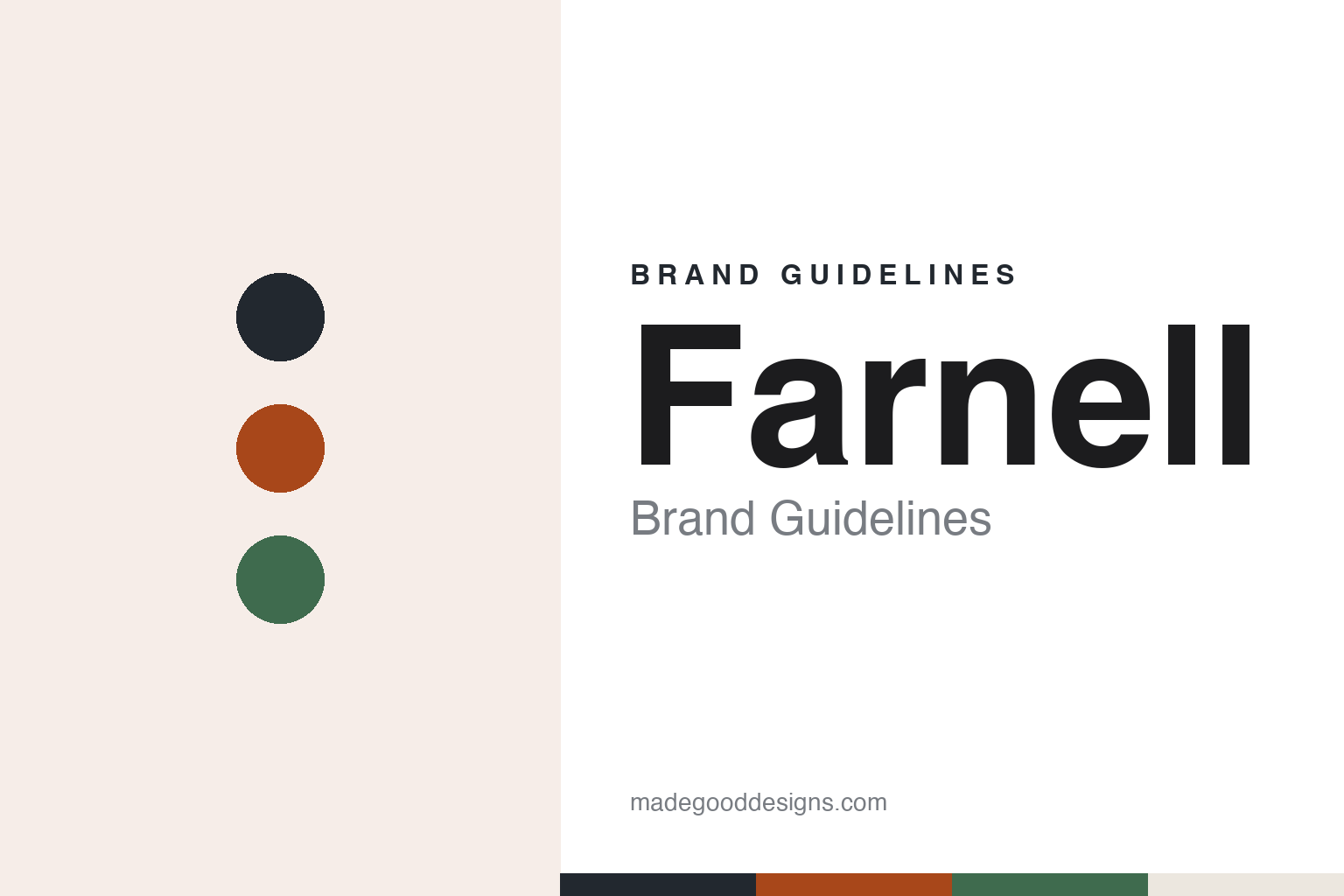
Farnell Brand Guidelines
A Leeds catalogue house that took the name of silicon.
Aa
Two constants: a slate, copper and board-green palette and an engineering sans register. Abstract homage — not a Farnell product or mark; no logo, catalogue or packaging is reproduced.
A.C. Farnell
Two founders and a Leeds business, 1939.
Farnell began in Leeds in 1939. English Wikipedia names its founders as Alan Farnell and Arthur Woffenden and gives its first company name as A.C. Farnell Limited. The business was first listed on the London Stock Exchange in 1966, Wikipedia says, and was based beside Wetherby railway station, north-east of Leeds, before moving to larger offices on the town’s Sandbeck Industrial Estate and, in 1995, to offices in Armley, in west Leeds.
The mid-1990s turned a Yorkshire supplier into a group with reach across the Atlantic. In 1995, according to Wikipedia, Farnell bought Combined Precision Components and sold its manufacturing operations in the same year to concentrate on distribution. In 1996 it bought the American distributor Premier Industrial Corporation and changed its own name to Premier Farnell.
That purchase brought with it Newark, a Chicago business that English Wikipedia says opened in 1934 as Newark Electric, a small shop selling radio parts, its name a homage to Newark, New Jersey; Premier Industrial had taken it over in 1968, making it the corporation’s electronics distribution division. Newark gave the group one of the trade’s defining objects. Its first paper catalogue appeared in 1948, and over the following three decades, Wikipedia says, the phonebook-sized book was sometimes likened to “the bible of the industry.” Farnell’s own business, by Wikipedia’s account, was likewise built on catalogues and trade counters before it moved online.
Colour
From trade counter to element14.
From the mid-2000s, English Wikipedia says, Premier Farnell developed from a catalogue and trade-counter business into an e-commerce operation, under the direction of Harriet Green, who joined as chief executive in 2006. Acquisitions and disposals continued around that change: the industrial supplier Buck & Hickman, bought in 2001 and sold in 2007; a Greater China business, Premier Electronics, launched in 2007 with a warehouse and distribution centre in Waigaoqiao; the Indian distributor Hynetic Electronics in 2008 and the Polish distributor Microdis Electronics in early 2009; and, announced in September 2009, CadSoft Computer, the German developer of the EAGLE circuit-design software, which the group later sold. Towards the end of 2008 the group also began closing Cadillac Electric, part of its industrial products division.
In 2010 the group replaced its regional trading names with a single idea. In Europe the business became Farnell element14 and in the United States Newark element14. The name, Wikipedia explains, refers to silicon, the fourteenth element of the periodic table, which is widely used in integrated circuits and discrete semiconductors. The same name was given to the element14 Community, an online information hub and forum for electronics engineers.
The company’s most public moment came with a credit-card-sized computer. When the Raspberry Pi went on sale on 29 February 2012, BBC News reported that demand had crashed the website of one supplier, “Leeds-based Premier Farnell.” English Wikipedia says that, as of 2024, the group sold about half of the Raspberry Pi computers distributed worldwide. It also says Farnell was named in 2015 as a major partner in the consortium behind the BBC’s micro:bit, responsible for sourcing components and overseeing manufacture of the device, which the BBC announced in July 2015 would be given to every Year 7 pupil in the UK. Wikipedia describes development kits — hardware built around a particular microprocessor or microcontroller, used by engineers to prototype new products — as a major Farnell specialism. The Internet of Things was the main theme of its stand at the electronica trade fair in Munich in November 2014, Wikipedia says, where it showed products such as the RIoTboard; a survey of engineers on the element14 Community named lighting control, sensing and wireless as the big areas for 2014–2015.
Typography
How distributors present themselves.
Electronic-component distributors sit between the companies that make chips, passives and connectors and the engineers who design them into products. For much of the twentieth century their public face was paper: thick printed catalogues, reissued at intervals and kept on the shelf beside the workbench, listing thousands of parts by type, value and package. Many of these businesses began as shops selling radio parts over the counter, and the catalogue carried that counter into offices and factories.
Today the catalogue has largely given way to the search box. Distributor websites lead with a part-number search, filters for specifications and stock levels, and datasheets a click away; the printed book survives, where it survives at all, as a reference rather than the main way to order. Photographs in these companies’ own material tend to show the warehouse behind the website: long aisles of reels, trays and anti-static bins, picking stations and parcels on conveyors, often paired with promises of same-day shipping on orders placed before a cut-off time.
The audience has widened too. Alongside franchised lines from chip makers, distributors now sell development boards, evaluation kits and maker-friendly modules to students, hobbyists and start-ups as well as to large manufacturers, and many run online communities and training material for engineers. Franchised distributors and catalogue houses present themselves differently: the first stress their relationships with manufacturers and their design support, the second their range and speed.
Much of the trade still meets in person. Engineers and buyers walk the stands at shows such as electronica in Munich, Embedded World in Nuremberg and CES in Las Vegas, where distributors take booths beside the manufacturers whose parts they sell. This guide sets out what can be checked about each company — who founded it, who owns it now and how it has changed — and marks clearly what rests only on the company’s own word.
Aa
An engineering sans for a catalogue house. (Specimen set in IBM Plex Sans, a sans STAND-IN; NOT the Farnell logo.)
Farnell
Part of Avnet since 2016.
Premier Farnell remained a listed company until 2016. In March of that year, Wikipedia says, it sold its Akron Brass subsidiary to IDEX Corporation. Then the American distributor Avnet, headquartered in Phoenix, Arizona, bought the whole group. Supply Chain Connect reported on 19 October 2016 that Avnet had completed its all-cash acquisition of Premier Farnell plc, which shareholders representing 99.9% of the votes cast had approved; Wikipedia dates completion to 17 October 2016, after which Premier Farnell’s shares were delisted. The same report described the company as headquartered in Leeds.
In 2019, according to English Wikipedia, the business was rebranded simply as Farnell, while its legal name remained Premier Farnell Limited. Wikipedia lists its trading names as Farnell in Europe, the Middle East, Africa and Japan; Newark in the Americas; element14 in Asia Pacific; and CPC in the United Kingdom, alongside own-label ranges including Multicomp Pro. As of 2024, it says, the group stocked about 950,000 products from 2,000 suppliers across its regional warehouses; Newark’s warehouse for the Americas is in Gaffney, South Carolina. The awards Wikipedia lists date from 2012, among them an ECMOD Direct Commerce award for online business-to-business trading.
For a design guide, Farnell shows how one distributor can carry several regional names — and a lesson in chemistry, in element14 — under a single owner. Compare Avnet, its parent since 2016, and RS Group, another British electronics distributor. For this guide we use a slate grey, a copper orange and a board green with a sans, an unofficial interpretation; no product or logo is reproduced.
Explore & save
Keep Farnell’s identity on hand — save it to a board in the Made Good inspiration library.
Farnell identity set
Pin the Farnell slate, copper and board-green palette and the engineering sans register to your own board.