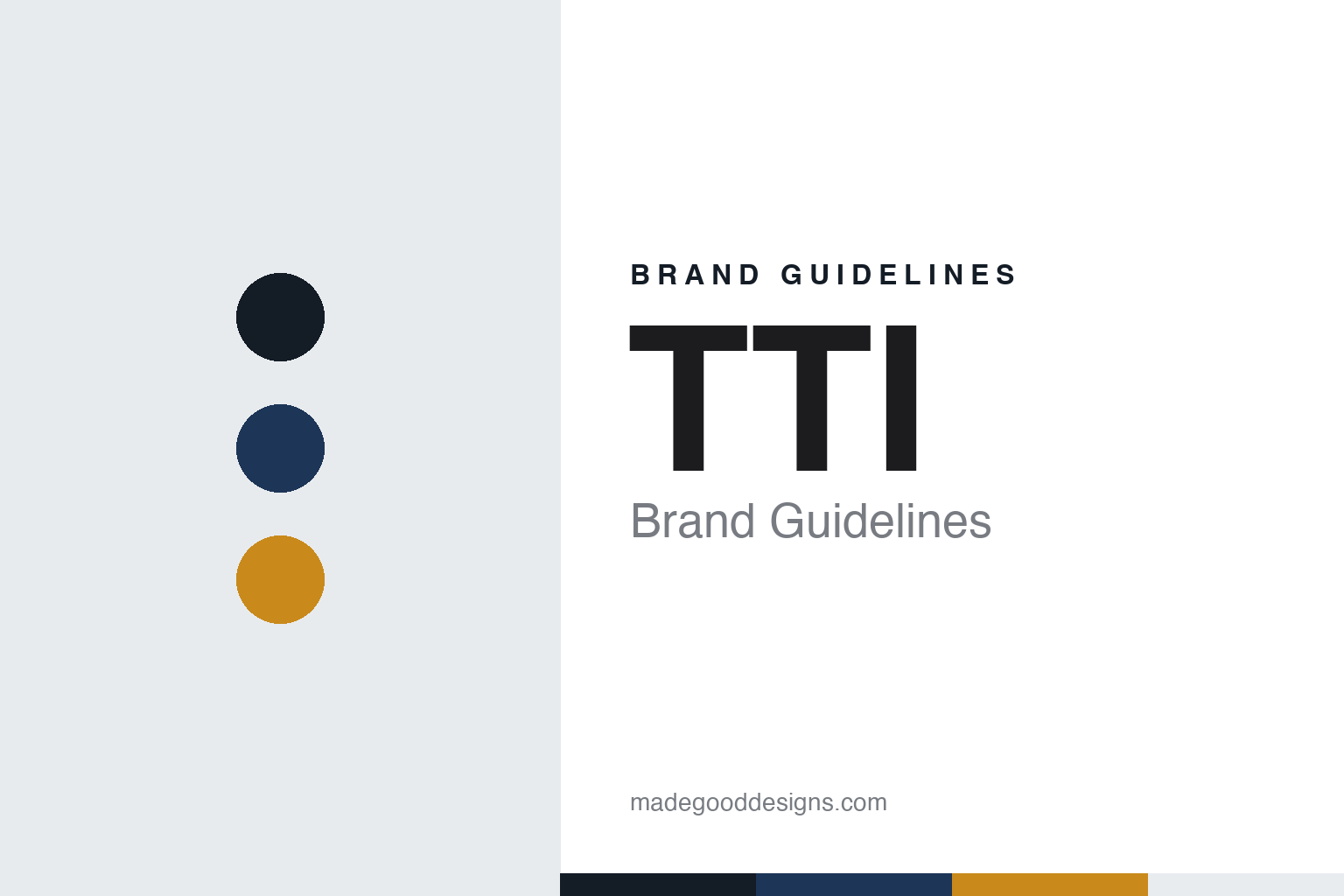
TTI Brand Guidelines
A Fort Worth specialist in passives and connectors.
Aa
Two constants: a navy, amber and steel palette and an industrial sans register. Abstract homage — not a TTI product or mark; no logo, component or packaging is reproduced.
Tex-Tronics
A buyer’s idea in Fort Worth, 1971.
TTI was founded in 1971 by Paul Andrews, English Wikipedia says, a former buyer for the aerospace and defence group General Dynamics. The company was first called Tex-Tronics, Inc.; in 1973, according to Wikipedia, Andrews changed the name to TTI, Inc. to avoid a legal dispute involving another company with a similar name. Its headquarters are in Fort Worth, Texas.
The business was set up to serve aerospace and defence equipment makers, and Wikipedia says Andrews built it around available-to-sell inventory and supply-chain programmes. Its customers later widened to manufacturers in the transportation, industrial, medical and communications sectors. What TTI sells is a specialist’s range rather than a general catalogue: Wikipedia lists capacitors, resistors, connectors, switches, relays, circuit protection, electromagnetics, discrete semiconductors, sensors, RF modules and antennas. In its December 2006 announcement with Berkshire Hathaway the company described itself as “the largest distributor specialist of passive, interconnect electromechanical components,” and said it then employed more than 1,700 people at more than 50 locations in North America, Europe and Asia.
Growth outside Texas came in steps. TTI entered the European market in 1992 with its first office in Munich, and opened its first Asian office in Singapore in 2000, according to Wikipedia; the Munich area and Singapore remain its European and Asian headquarters. In 2008 it bought the Mateleco Group, a large connector distributor in France, which Wikipedia says made TTI the primary distributor of both passives and connectors in that country. By the time of the 2006 announcement, TTI said it operated in more than 19 countries with more than 50 branch locations.
Colour
Mouser, then Berkshire Hathaway.
The purchase that most shaped TTI’s public profile came in 2000, when, Wikipedia says, it bought Mouser Electronics, a broad-line catalogue distributor based in Mansfield, Texas. The two businesses work in different ways: TTI as a specialist in passive, interconnect and electromechanical parts, Mouser, in its own description of 2006, as a distributor focused on “the rapid introduction of new products and technologies to electronic design engineers,” whose printed catalogue was then published every 90 days.
In late 2006 Andrews chose a buyer. Warren Buffett’s letter to Berkshire Hathaway shareholders for 2006, published in early 2007, says the Fort Worth businessman John Roach brought Andrews, then owner of about 80% of TTI, to see him in November 2006, and that the two men met on the morning of 15 November and agreed a deal before lunch. Buffett wrote that Andrews had ruled out a strategic buyer and a private equity firm. On 22 December 2006 TTI and Berkshire Hathaway announced a definitive agreement under which Berkshire would acquire TTI, “a privately held electronic component distributor,” together with its subsidiary Mouser. The terms were not disclosed, TTI’s management was to remain in place, and the deal was expected to close in the first quarter of 2007. Andrews, in the announcement, called it “a real honor for TTI and Mouser to become part of the Berkshire Hathaway Group,” and said Berkshire would allow TTI to continue with its growth plans; the same release noted that Mouser had recently completed a major facility expansion that more than doubled its capacity. Wikipedia dates completion to 30 March 2007, and TTI has been a wholly owned subsidiary of Berkshire Hathaway since.
In 2021, Wikipedia says, Mike Morton, its chief operating officer and an employee of 40 years, became chief executive.
Typography
How distributors present themselves.
Electronic-component distributors sit between the companies that make chips, passives and connectors and the engineers who design them into products. For much of the twentieth century their public face was paper: thick printed catalogues, reissued at intervals and kept on the shelf beside the workbench, listing thousands of parts by type, value and package. Many of these businesses began as shops selling radio parts over the counter, and the catalogue carried that counter into offices and factories.
Today the catalogue has largely given way to the search box. Distributor websites lead with a part-number search, filters for specifications and stock levels, and datasheets a click away; the printed book survives, where it survives at all, as a reference rather than the main way to order. Photographs in these companies’ own material tend to show the warehouse behind the website: long aisles of reels, trays and anti-static bins, picking stations and parcels on conveyors, often paired with promises of same-day shipping on orders placed before a cut-off time.
The audience has widened too. Alongside franchised lines from chip makers, distributors now sell development boards, evaluation kits and maker-friendly modules to students, hobbyists and start-ups as well as to large manufacturers, and many run online communities and training material for engineers. Franchised distributors and catalogue houses present themselves differently: the first stress their relationships with manufacturers and their design support, the second their range and speed.
Much of the trade still meets in person. Engineers and buyers walk the stands at shows such as electronica in Munich, Embedded World in Nuremberg and CES in Las Vegas, where distributors take booths beside the manufacturers whose parts they sell. This guide sets out what can be checked about each company — who founded it, who owns it now and how it has changed — and marks clearly what rests only on the company’s own word.
Aa
An industrial sans for a parts specialist. (Specimen set in Archivo, a sans STAND-IN; NOT the TTI logo.)
TTI
A family of specialists.
Under Berkshire Hathaway, TTI has kept buying. Wikipedia lists Sager Electronics, a New England distributor with roots in the 1800s, which joined in 2012 and now specialises in power products; TTI Israel, formed in 2013 from Net-Aye Components and Ray-Q; the semiconductor distributor Symmetry Electronics in 2017; and, in 2018, South Korea’s CHANGNAM, the RF and microwave specialist RFMW and Switzerland’s Compona with its German subsidiary Cosy Electronics, after which TTI formed a TTI Semiconductor Group. Its design-services arm, Exponential Technology Group, added engineering firms in North Carolina, Texas and Michigan from 2020, and in January 2023 the Australian distributor Braemac. Other additions, by Wikipedia’s account, include the custom battery-assembly specialist Technical Power Systems of Lisle, Illinois, bought by Sager in 2019; SMD, Inc., an authorised distributor in Irvine, California, in January 2022; and Ecopak Power, a UK and Ireland distributor of power supplies and LED drivers, in October 2022.
The group now presents itself as the TTI Family of Specialists, which Wikipedia says includes TTI, Mouser, Sager and Exponential Technology Group and employs more than 8,000 people at more than 136 locations across the Americas, Europe, Asia and Africa. Wikipedia describes a large physical network behind those names: more than 3.5 million square feet of warehouse space worldwide, nearly 600,000 square feet of distribution capacity in Europe, distribution centres in Singapore, Hong Kong and China, and seven proximity warehouses in Mexico, from Tijuana to Guadalajara. As a distributor, TTI sells components made by the manufacturers whose lines it carries.
For a design guide, TTI shows how a three-letter name can stand quietly behind a group of distinct trading brands. Compare Mouser Electronics, its subsidiary since 2000, and Arrow Electronics, another American component distributor. For this guide we use a deep navy, an amber and a steel grey with a sans, an unofficial interpretation; no product or logo is reproduced.
Explore & save
Keep TTI’s identity on hand — save it to a board in the Made Good inspiration library.
TTI identity set
Pin the TTI navy, amber and steel palette and the industrial sans register to your own board.