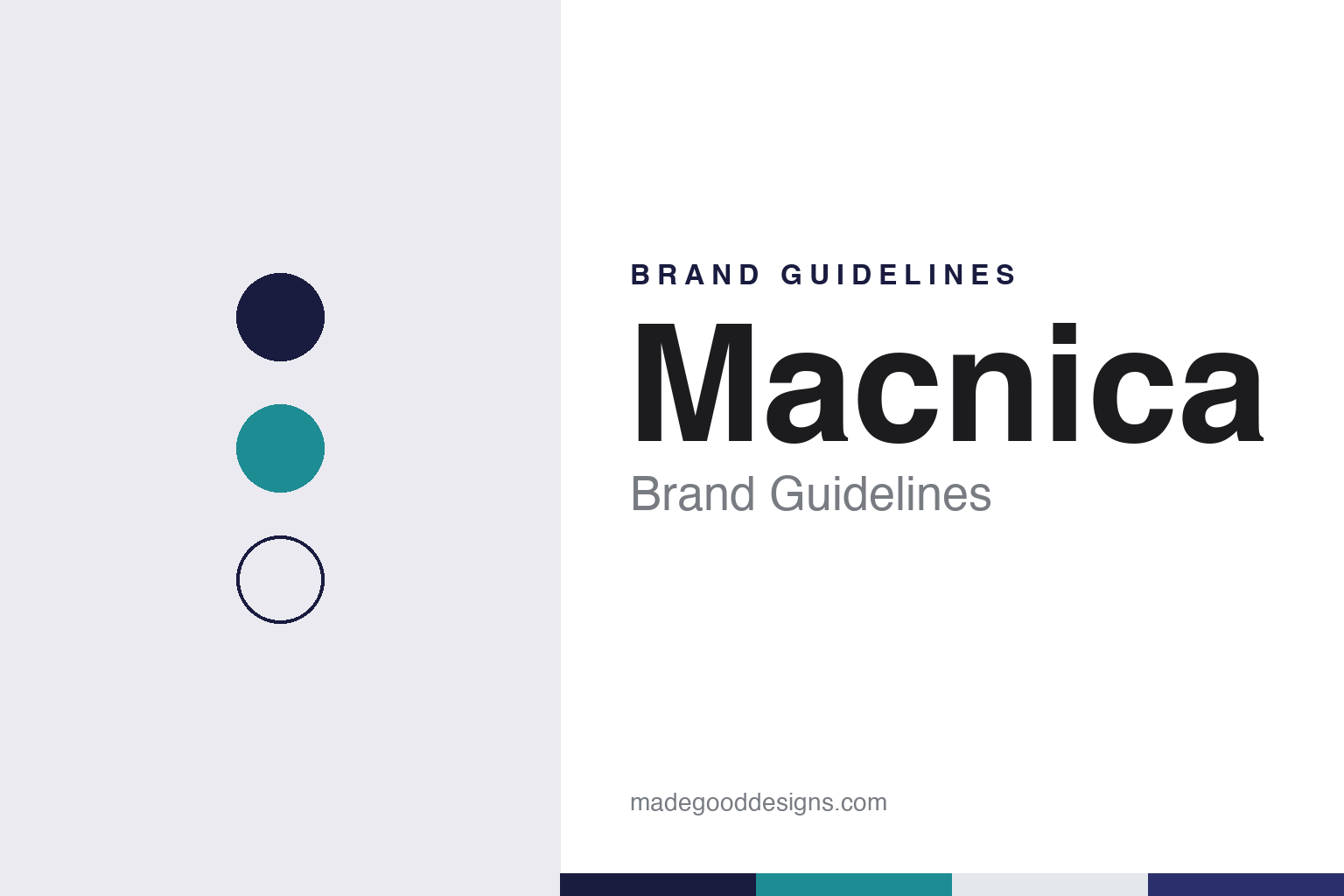
Macnica Brand Guidelines
Japan Macnics: masters of advanced concept in electronics.
Aa
Two constants: an indigo, teal and pale grey palette and an engineering sans register. Abstract homage — not a Macnica product or mark; no logo, board or packaging is reproduced.
Japan Macnics
A founder, a few friends and imported chips.
Macnica began on 30 October 1972, the date the company gives, as Japan Macnics Corporation, set up by Haruki Kamiyama with a few friends to sell electronic components. Sources differ on where: the company’s history places it in Higashi-Hakuraku, in Yokohama, while Japanese Wikipedia says it was founded in Setagaya, Tokyo. The company explains the old name as an acronym for “Masters of Advanced Concept in Electronics,” reflecting Kamiyama’s wish to build an organisation of professionals in the electronics industry. Its website now names him as founder and honorary chairman.
The firm moved to Kawasaki early on — Japanese Wikipedia dates the move to 1975, while the company dates a head-office building in Nakahara Ward to 1983 — and in 1990 to a new building in Yokohama’s Midori Ward. In 1992 it changed its name to Macnica. In 2002 it moved its head office to the Macnica Building 1 in Shin-Yokohama, in Yokohama’s Kohoku Ward, where the group is still based. The shares were listed on the second section of the Tokyo Stock Exchange in 2000 and on the first section in 2001.
From the start the business was a bridge between foreign chip makers and Japanese manufacturers. The company says it began by collecting technology from around the world and proposing it to customers, and that it set out to remove the wall between Japan and overseas suppliers, with their different languages, cultures and business habits. It calls itself a “technical trading company” and says that about one in three of its employees is an engineer. In 2014 EE Times Japan described both Macnica and its later partner Fuji Electronics as trading houses dealing mainly in semiconductors made by overseas manufacturers.
Colour
FPGAs, Ethernet and boards of its own.
Macnica also developed products of its own. The company dates its first original product, the JM-1, to 1979, the same year it entered the microcomputer business. In 1982 it sold the PROMAC10 internationally, and in 1983, a year after Ethernet was standardised, it developed the JET101 Ethernet transceiver series, which it calls the start of its network business. In 1986 it began an in-house data-writing service for programmable logic devices, and in 1994 it launched the MIRACLE SCSI interface card, which it remembers as a major hit.
Programmable logic became a specialty. EE Times Japan reported in May 2014 that Macnica’s range had grown around FPGAs, and that it was then the only distributor in Japan for Altera, alongside lines from Broadcom, Infineon, Texas Instruments and Analog Devices. The company set up Altima Corporation in 1991 and later developed its own FPGA evaluation boards under the Mpression name.
Networking grew into a second business. Macnica says its security work began in 2001 with encryption for entire hard drives, at a time when lost and stolen laptops were a pressing problem. Macnica Networks became a separate subsidiary in 2004 and was merged back into Macnica in October 2021, Japanese Wikipedia says. More recently the company has moved into AI and vehicles: it dates an agreement with NVIDIA to 2016, an automotive Ethernet media converter to 2017, the SENSPIDER edge-computing terminal to 2018 and autonomous buses to 2020.
Overseas growth came largely by acquisition. Japanese Wikipedia records Cytech Technology of Hong Kong joining the group in 2008, Galaxy Far East of Taiwan in 2010 through a tender offer and DHW of Brazil in 2012; the company’s website now lists them as Macnica Cytech, Macnica Galaxy and Macnica DHW. The company says its overseas buying began in 2008, in the middle of the financial crisis, because speed mattered when entering Asian markets.
Typography
How distributors present themselves.
Electronic-component distributors sit between the companies that make chips, passives and connectors and the engineers who design them into products. For much of the twentieth century their public face was paper: thick printed catalogues, reissued at intervals and kept on the shelf beside the workbench, listing thousands of parts by type, value and package. Many of these businesses began as shops selling radio parts over the counter, and the catalogue carried that counter into offices and factories.
Today the catalogue has largely given way to the search box. Distributor websites lead with a part-number search, filters for specifications and stock levels, and datasheets a click away; the printed book survives, where it survives at all, as a reference rather than the main way to order. Photographs in these companies’ own material tend to show the warehouse behind the website: long aisles of reels, trays and anti-static bins, picking stations and parcels on conveyors, often paired with promises of same-day shipping on orders placed before a cut-off time.
The audience has widened too. Alongside franchised lines from chip makers, distributors now sell development boards, evaluation kits and maker-friendly modules to students, hobbyists and start-ups as well as to large manufacturers, and many run online communities and training material for engineers. Franchised distributors and catalogue houses present themselves differently: the first stress their relationships with manufacturers and their design support, the second their range and speed.
Much of the trade still meets in person. Engineers and buyers walk the stands at shows such as electronica in Munich, Embedded World in Nuremberg and CES in Las Vegas, where distributors take booths beside the manufacturers whose parts they sell. This guide sets out what can be checked about each company — who founded it, who owns it now and how it has changed — and marks clearly what rests only on the company’s own word.
Aa
An even engineering sans for a technical trading house. (Specimen set in Noto Sans JP, a sans STAND-IN; NOT the Macnica logo.)
Macnica
Fuji Electronics, a holding company and a new name.
The biggest step was a combination with Fuji Electronics. On 22 May 2014 the two companies announced that they had agreed to integrate under a joint holding company, EE Times Japan reported. Fuji Electronics, founded in 1970, was strong in analogue semiconductors and in selling to mid-sized and smaller Japanese industrial-equipment makers, while Macnica served larger customers and many overseas ones; the two said they would proceed in a spirit of equality. Both companies’ shares were delisted on 27 March 2015, and on 1 April 2015 Macnica Fuji Electronics Holdings was listed on the first section of the Tokyo Stock Exchange, according to a Japan Exchange Group notice. Macnica’s own history recalls that the pairing was at first criticised as “oil and water.”
The two operating companies stayed separate for five more years. In October 2020 Macnica absorbed Fuji Electronics, and in August 2022 the holding company dropped “Fuji Electronics” from its name to become Macnica Holdings, Japanese Wikipedia says; in March 2024 it made Glosel a consolidated subsidiary. Macnica itself is a wholly owned subsidiary of the holding company and is led by Kazumasa Hara, president and co-chief executive, and Akinobu Miyoshi, co-chief executive, according to its website.
The company adopted a group purpose in 2022, its 50th anniversary year, and uses the slogan “Co.Tomorrowing,” Japanese Wikipedia says. It sponsors Nippon Broadcasting’s All Night Nippon radio programme and, since 2024, the Japanese NASCAR driver Takuma Koga, and it has backed Maker Faire events, the company says. In 2026, according to Japanese Wikipedia, it announced a plan to build a new head office in Shin-Yokohama on the site of Shin-Yokohama Prince Pepe, which is due to close in March 2027.
For a design guide, Macnica shows how a distributor can present itself as an engineering partner, with a name built from an acronym about expertise. Compare WPG Holdings, another Asian distribution group formed by combining companies, and Arrow Electronics. For this guide we use a deep indigo, a cool teal and pale greys with a sans, an unofficial interpretation; no product or logo is reproduced.
Explore & save
Keep Macnica’s identity on hand — save it to a board in the Made Good inspiration library.
Macnica identity set
Pin the Macnica indigo, teal and pale grey palette and the engineering sans register to your own board.