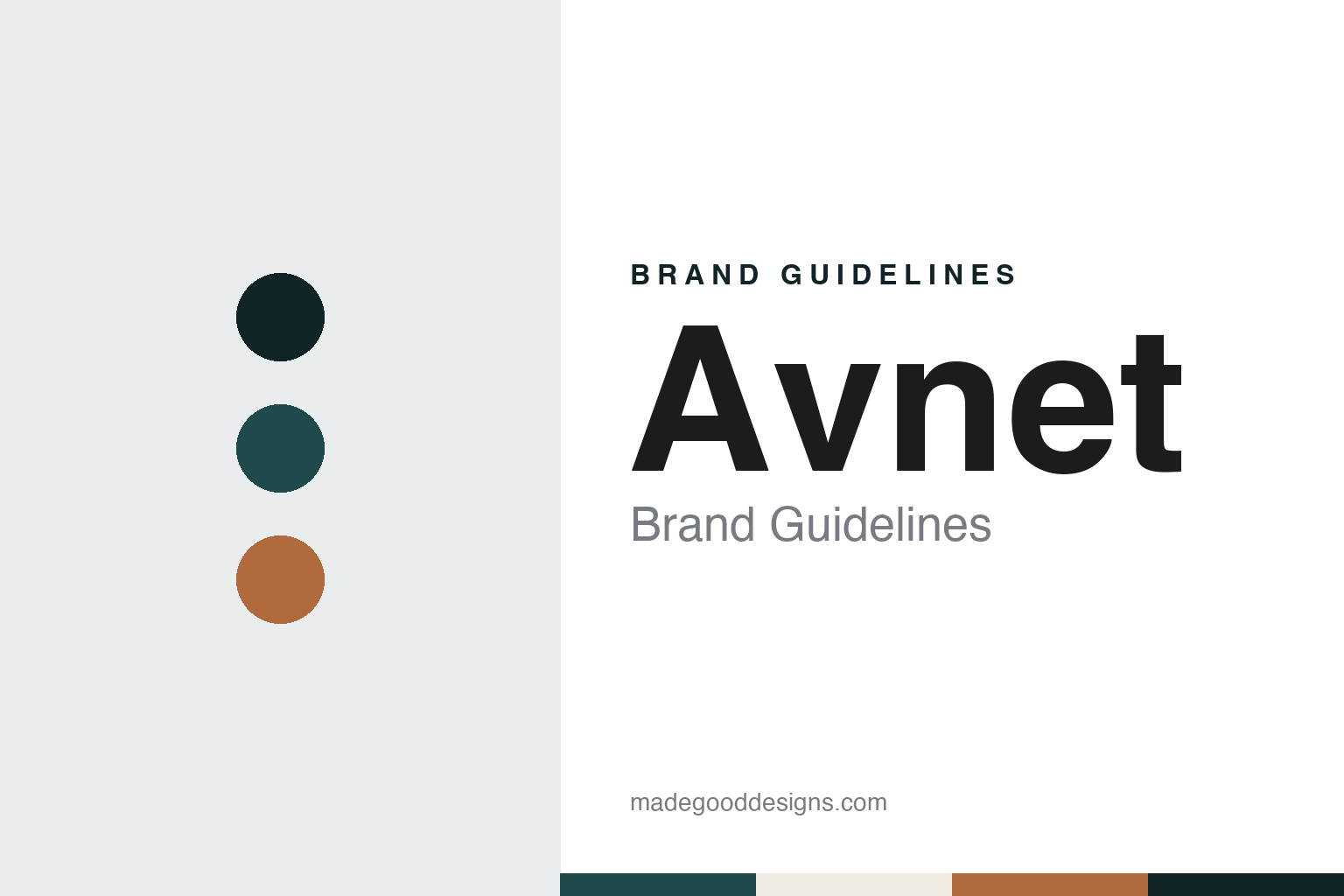
Avnet Brand Guidelines
Charles Avnet’s 1921 radio parts trade, now a Tempe-based distributor.
Aa
Two constants: a deep teal, copper and stone palette and a grotesque sans register. Abstract homage — not an Avnet product or mark; no logo or packaging is reproduced.
Surplus radio parts
A founder’s surname on Radio Row.
Avnet takes its name from its founder. In 1921 Charles Avnet, a 33-year-old Russian-Jewish immigrant, began buying surplus radio parts and selling them to the public on the Radio Rows of American port cities, starting in Manhattan, English Wikipedia says. In the mid-1920s, as factory-made radios began to replace sets built from parts, he turned to selling parts to manufacturers and dealers and branched into car-radio kits; during the Depression he moved the business from retail to wholesale.
During the Second World War Avnet made antennas for the United States armed forces, and Charles’s son Lester joined the business at that time; after the war it concentrated on buying and selling surplus electronic and electrical parts, Wikipedia says, citing the company’s own history. In 1955 the business was incorporated as Avnet Electronic Supply Company, selling capacitors, fasteners and switches, and in 1956 it opened a second connector-assembly plant near Los Angeles to serve the aircraft industry. Three years after incorporation it became Avnet Electronics Corporation, and it went public on the American Stock Exchange the following year.
The 1960s brought a run of purchases outside components. The first, in 1960, was British Industries Corp., an audio-equipment company, which took Avnet into die-casting machines, guitars and television antennas and onto the New York Stock Exchange. In the mid-1960s Avnet briefly owned record labels including Liberty Records and Blue Note, and in 1965 it bought the guitar maker Guild; that year a Guild Starfire 12 guitar was presented to John Lennon and George Harrison of the Beatles, Wikipedia says. Other purchases of the decade added semiconductors, relays and potentiometers. In 1964 the company took the name Avnet, Inc., and Lester Avnet became president and chairman.
Colour
Intel, Hamilton and Farnell.
Semiconductors set the company’s later course. In 1973 Avnet became Intel’s first distributor, English Wikipedia says, and with Intel it went on to sell computer peripherals, complete systems and software. Under Simon Sheib, and Anthony Hamilton of the acquired Hamilton Electro Corporation, the two businesses were combined as Hamilton/Avnet, which later became the Avnet Electronic Marketing Group. The emphasis of those years was on sales, warehouses and stocking, product development and new markets.
In 1998 Roy Vallee became chief executive and chairman, and the corporate headquarters moved from Great Neck, New York, to Phoenix, Arizona. In 2001 Avnet bought Kent Electronics, a Houston distributor of electronic components that also installed computer networks, and in 2012 it added the IT businesses Ascendant Technologies and BrightStar Partners, which expanded its Technology Solutions group, Wikipedia says. Vallee retired in July 2011 and was succeeded by the chief operating officer, Richard Hamada; the chief executives who followed were William Amelio and Phil Gallagher. At the time of the Farnell deal, Supply Chain Connect described Avnet as a business-to-business technology distributor headquartered in Phoenix.
The purchase that most changed the brand family came from Britain. In October 2016 Avnet completed its all-cash acquisition of Premier Farnell, the Leeds-based distributor, after the deal was approved by 99.9% of the votes cast by Premier Farnell shareholders and received all regulatory approvals, Supply Chain Connect reported on 19 October 2016. The same report described Premier Farnell as a global distributor of electronic components that used a digital platform to supply engineers with products, services and development software. On 8 May 2018 Avnet moved its shares from the New York Stock Exchange to Nasdaq, keeping the ticker AVT, and in March 2019 it announced that it was working with the payment provider BitPay to accept cryptocurrency for products and services.
Typography
How distributors present themselves.
Electronic-component distributors sit between the companies that make chips, passives and connectors and the engineers who design them into products. For much of the twentieth century their public face was paper: thick printed catalogues, reissued at intervals and kept on the shelf beside the workbench, listing thousands of parts by type, value and package. Many of these businesses began as shops selling radio parts over the counter, and the catalogue carried that counter into offices and factories.
Today the catalogue has largely given way to the search box. Distributor websites lead with a part-number search, filters for specifications and stock levels, and datasheets a click away; the printed book survives, where it survives at all, as a reference rather than the main way to order. Photographs in these companies’ own material tend to show the warehouse behind the website: long aisles of reels, trays and anti-static bins, picking stations and parcels on conveyors, often paired with promises of same-day shipping on orders placed before a cut-off time.
The audience has widened too. Alongside franchised lines from chip makers, distributors now sell development boards, evaluation kits and maker-friendly modules to students, hobbyists and start-ups as well as to large manufacturers, and many run online communities and training material for engineers. Franchised distributors and catalogue houses present themselves differently: the first stress their relationships with manufacturers and their design support, the second their range and speed.
Much of the trade still meets in person. Engineers and buyers walk the stands at shows such as electronica in Munich, Embedded World in Nuremberg and CES in Las Vegas, where distributors take booths beside the manufacturers whose parts they sell. This guide sets out what can be checked about each company — who founded it, who owns it now and how it has changed — and marks clearly what rests only on the company’s own word.
Aa
A plain grotesque for a distributor named after its founder. (Specimen set in Archivo, a sans STAND-IN; NOT the Avnet logo.)
Avnet
From Phoenix to Tempe.
In 2026 Avnet left Phoenix after nearly three decades. It had occupied its headquarters building in the city since 1997, but the lease expired this year, chief executive Phil Gallagher told the Phoenix Business Journal, in a report republished by the Arizona Technology Council in October 2026. The company spent a year renovating a two-storey, 156,000-square-foot building in ASU Research Park in Tempe — GoDaddy’s corporate headquarters until April 2024 — and moved its global headquarters there in 2026. More than 500 employees work in the building, including the finance, executive leadership and Americas teams, the report says.
Avnet also runs a global solutions centre and a logistics centre in Chandler, and employs more than 1,200 people in Arizona and more than 15,000 worldwide, according to Business Journal research cited in the same report. Gallagher presented the move as a sign that the company intends to stay in Arizona. The old site was close to the airport, he said, while the new one sits just off the freeway, with semiconductor companies including onsemi, Microchip and Intel nearby. The building has an open floor plan with meeting rooms, collaboration spaces and a cafeteria opening onto a patio, and Gallagher said the low cubicles that came with it suit a culture of collaboration and teamwork.
For a design guide, Avnet shows how a founder’s surname, first used on Radio Row, became the name of a global component distributor. Compare Farnell, part of Avnet since 2016, and Arrow Electronics, which also began on Manhattan’s Radio Row. For this guide we use a deep teal, a copper and a pale stone with a sans, an unofficial interpretation; no product or logo is reproduced.
Explore & save
Keep Avnet’s identity on hand — save it to a board in the Made Good inspiration library.
Avnet identity set
Pin the Avnet deep teal, copper and stone palette and the grotesque sans register to your own board.