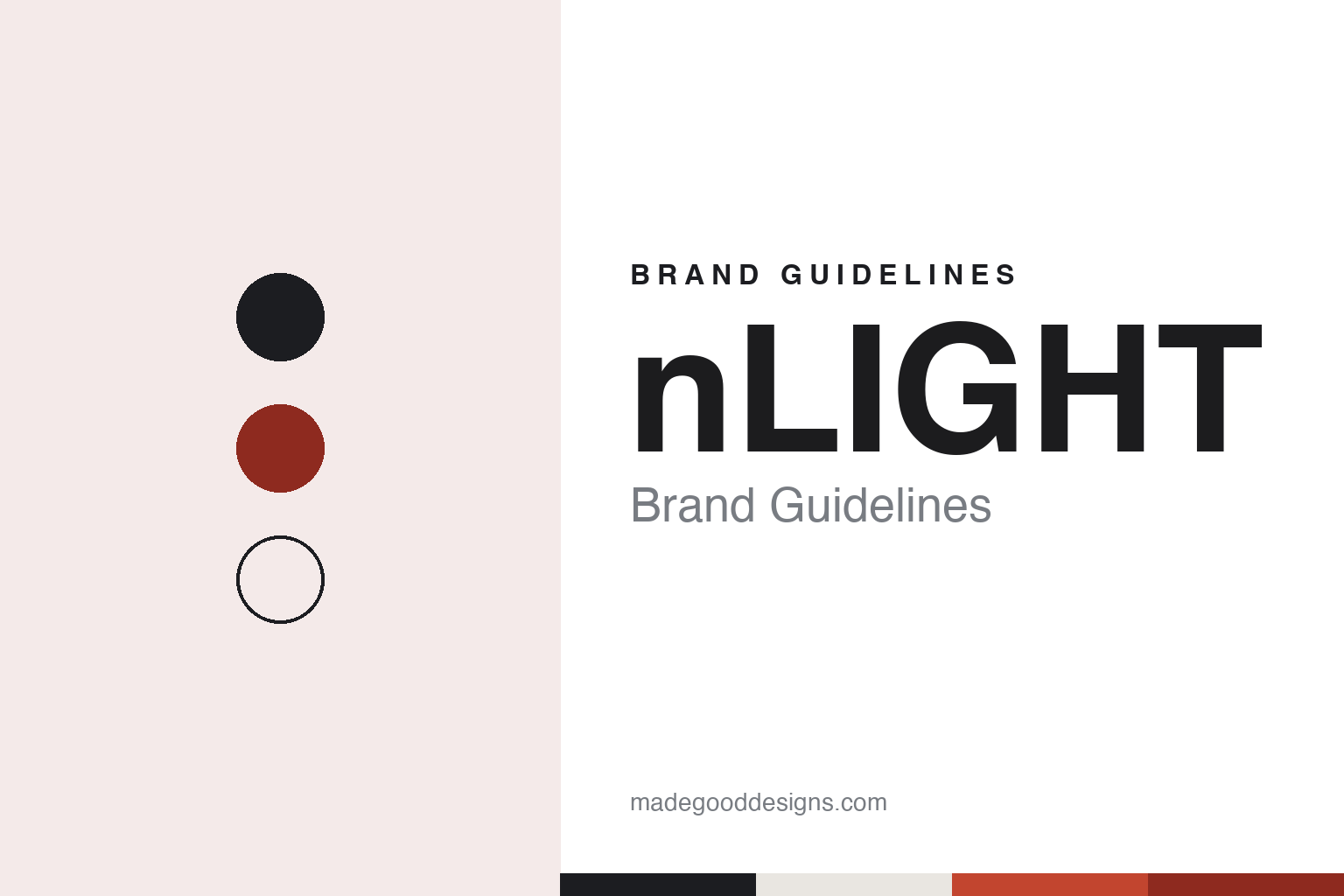
nLIGHT Brand Guidelines
A Seattle start-up of 2000 that built lasers from the chip up.
Aa
Two constants: a graphite, infrared red and fibre white palette and an industrial grotesque register. Abstract homage — not an nLIGHT product or mark; no laser, logo or nameplate is reproduced.
From the chip up
A Seattle start-up that moved down the Columbia.
nLIGHT was founded in Seattle in 2000 to provide high-power semiconductor and fibre lasers, the trade magazine Semiconductor Today reported in April 2018. The company writes its name with the last five letters in capitals, as nLIGHT; much of the trade press writes it nLight. It now says it has been “at the forefront of semiconductor laser innovation” for more than 25 years.
By the time it prepared to go public, nLIGHT was based in Vancouver, Washington. In April 2018 it filed with the US Securities and Exchange Commission for an initial public offering, and its shares began trading on the Nasdaq Global Select Market under the ticker LASR on April 26, 2018, Laser Focus World reported. Semiconductor Today described its operations then as vertically integrated: a semiconductor laser manufacturing plant in Vancouver, an optical fibre plant in Lohja, Finland, and laser packaging and assembly in Vancouver, in Hillsboro, Oregon, and in Shanghai, with a staff of more than 1,000.
That idea of making every layer in-house has stayed central to how the company describes itself. Its website speaks of a “vertically integrated technology stack — from semiconductor chips to full laser systems,” and claims a portfolio of more than 450 patents. In February 2021 its long-time chief executive, Scott Keeney, told investors that “nLight is solely focused on providing high-power semiconductor and fiber lasers,” optics.org reported.
The headquarters later moved to Camas. By March 2023 optics.org was describing nLIGHT as “the Camas, Washington, company,” and reported that it had installed automated manufacturing equipment at its headquarters there.
Colour
Fibre lasers for factories, then beams for defence.
nLIGHT’s product lines are grouped on its website as semiconductor lasers, optical fibres, fibre lasers for additive manufacturing and for medical uses, and defence lasers. On the industrial side, its 2019 press releases introduced members of the Corona family of fibre lasers, including an 8-kilowatt model in June and two further models in November, and a 15-kilowatt fibre laser in September; it showed a 12-kilowatt laser at LASER World of PHOTONICS China in March that year.
The balance of the business has since shifted. In March 2023 optics.org reported that the company was continuing a shift away from cutting applications in China, had reduced its operations there and had cut its workforce, while aiming at higher-value industrial uses outside its once-dominant market and at directed-energy programmes.
The step that made that possible came in November 2019, when nLIGHT bought Nutronics of Longmont, Colorado. optics.org described Nutronics, founded in 1995 and then employing 32 people, as a specialist in coherent beam combining and control, technologies used to combine the output of many lasers into one beam. Keeney said at the time that nLIGHT would offer “a broad range of directed energy products, from semiconductor lasers through beam control.” Jeff Barchers, who had been both chief executive and chief technology officer of Nutronics, joined nLIGHT with the deal, and by November 2023 optics.org was naming him as president of nLIGHT’s defence systems business unit. The Longmont business now appears on nLIGHT’s website as nLIGHT Defense Systems.
In November 2023 optics.org reported that the US Department of Defense had extended nLIGHT’s work under the High Energy Laser Scaling Initiative, with a second phase aiming to scale its coherent beam-combined design from the 300 kilowatts reached in the first phase to one megawatt; the company said that laser would be delivered in a rugged form compatible with shipping containers. In May 2026 the same publication reported that the company had launched Hades, a family of high-energy laser and effector products intended to scale from tens of kilowatts to hundreds.
Typography
How photonics makers present themselves.
Photonics companies sell things most people never see. Their lasers sit inside machine tools, their transceivers inside data-centre racks, and their detectors inside instruments, telescopes and physics experiments. So the way they present themselves leans on a small set of images that make light visible: a laser beam crossing a dark optical table, the glowing end of a fibre, a row of pluggable transceiver modules lined up for a switch, or a photomultiplier tube and a sensor chip photographed under studio light against black.
The catalogue matters as much as the advertisement. Many makers of optics and components publish long product catalogues of lenses, mirrors, mounts, filters, tubes and diodes, each part with a drawing, a part number and a page of specifications. That catalogue habit gives much of the sector a shared look: clean technical photography, plenty of white or black space, careful diagrams and an engineering sans or a restrained serif, with colour used sparingly, often for a single accent.
The trade shows are where the industry gathers in person. Photonics West, LASER World of PHOTONICS and OFC, the optical fibre communication conference, are among the events where companies show new lasers, modules and detectors, and their stands and press releases often borrow the same visual language of beams, fibres and glowing chips. Company histories also lean on science: makers of detectors and light sources often point to the research projects and observatories that have used their parts.
This guide sets out what can be checked about each brand — who founded it, who owns it, what it has bought or sold and what it makes — and marks clearly what rests only on the company’s own word. Pending deals are described as pending, with the date they were announced.
Aa
An industrial grotesque for a laser maker that builds from the chip up. (Specimen set in Archivo, a sans STAND-IN; NOT the nLIGHT logo.)
nLIGHT
A Camas company with sites from Finland to Turin.
Today nLIGHT, Inc. is based in Camas, Washington, and is still led by Scott Keeney, optics.org reported in May 2026, describing it as a developer of high-energy lasers and systems.
The company’s locations page lists nLIGHT, Inc. in Hillsboro, Oregon; nLIGHT Defense Systems in Longmont, Colorado; nLIGHT Oy in Finland, for optical fibres; offices in Shanghai and in South Korea; nLIGHT plasmo in Austria; and nLIGHT Europe in Italy. In 2026 the company announced an expansion of its operations in Turin to assemble and support laser systems for European and allied customers in the region; Keeney said that “proximity to our growing base of international customers and partners is increasingly important,” optics.org reported in May 2026.
On where its products are made, nLIGHT’s website says its solutions are “designed, developed, and manufactured in the United States.” The independent record from 2018 shows a wider spread: chips in Vancouver, Washington, fibre in Lohja, Finland, and assembly in Oregon and Shanghai, according to Semiconductor Today.
Its website lists three core values for the people it hires, “skill,” “will” and “fit,” and its product menus run from defence lasers to additive and medical fibre lasers, semiconductor lasers and optical fibres.
For a design guide, nLIGHT shows a component maker climbing its own supply chain, from laser chips to complete systems, and changing its public emphasis as its customers changed. Compare IPG Photonics, another fibre-laser maker, and Coherent. For this guide we use graphite, infrared red and fibre white with a sans, an unofficial interpretation; no product or logo is reproduced.
Explore & save
Keep nLIGHT’s identity on hand — save it to a board in the Made Good inspiration library.
nLIGHT identity set
Pin the nLIGHT graphite, infrared red and fibre white palette and the industrial grotesque register to your own board.