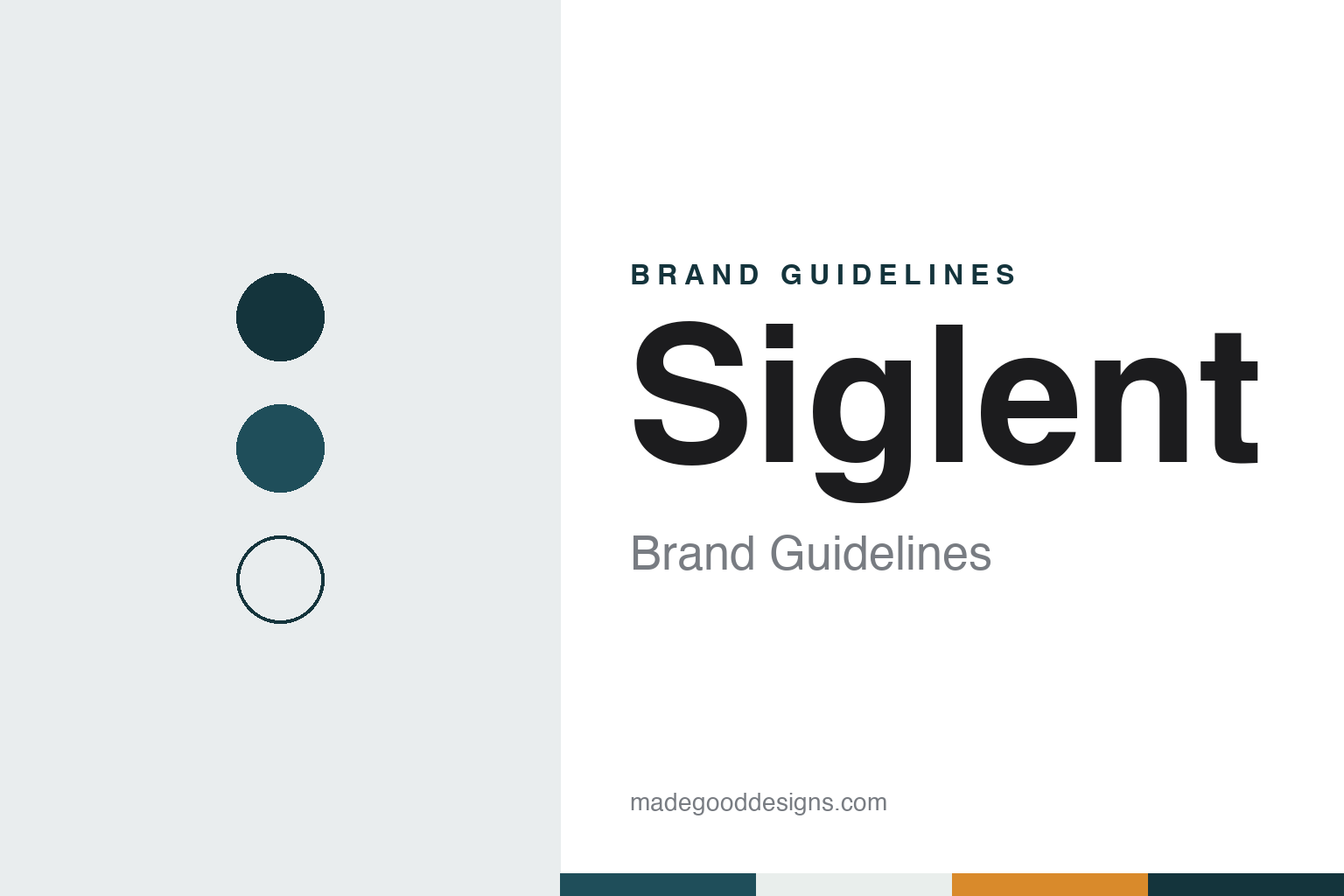
Siglent Brand Guidelines
A Shenzhen oscilloscope maker built for every bench.
Aa
Two constants: a deep teal and amber palette and an instrument sans register. Abstract homage — not a Siglent product or mark; no instrument, logo or nameplate is reproduced.
Shenzhen, 2002
Two founders and a digital oscilloscope.
Siglent is a maker of electronic test and measurement instruments based in Shenzhen, in southern China. Its own history starts in 2002, when, the company says, its two founders began a preliminary study of digital oscilloscopes, with the aim of making professional test equipment available to every engineer. A company profile compiled from S&P Global Market Intelligence data, as published by StockAnalysis in November 2026, also gives 2002 as the founding year and Shenzhen as the headquarters.
The first product came three years later. In October 2005, Siglent says, it launched the ADS7000 series, its first digital oscilloscope, with a sampling rate of 1 GSa/s and a technology the company calls EasyHunting. In 2007 it added the ADS2000 series, and the ADS7000 went on sale in the United States and western Europe. The company’s timeline then marks 2009 as the year Siglent “began sales under its own brand name.”
Over the following years the oscilloscope line grew into the SDS families: the SDS1000C in 2008, the four-channel SDS1000CF in 2009 and, in November 2013, the SDS2000, which the company described as a “Super Phosphor Oscilloscope.” In 2011 it launched the SHS1000, an isolated handheld oscilloscope that combines a scope, a multimeter and a recorder in one battery-powered unit, followed by the smaller SHS800 in 2012. The range was also widening beyond oscilloscopes: Siglent introduced the SDG1000 function and arbitrary waveform generators in March 2011, the SDG5000 generators in October 2012 and the SPD3000 programmable linear DC power supplies in November 2012, the company says.
The company’s slogan, used across its websites, is “Every Bench. Every Engineer. Every Day.”
Colour
From oscilloscopes to four instrument families.
Siglent’s range today is built around four families of general-purpose instruments: digital oscilloscopes, vector network analysers, spectrum analysers and signal generators. The company says it is one of very few makers with research, manufacturing and sales across all four. Around them sit waveform generators, DC power supplies, electronic loads and digital multimeters, all sold under short model codes that begin with the family: SDS for oscilloscopes, SDG for waveform generators, SSA for spectrum analysers and SSG for RF signal generators.
The growth into radio-frequency equipment came in steps. In 2015 Siglent introduced what it called the X-Instrument family, which included the SDS2000X and SDS1000X oscilloscopes, the SDG2000X generators, the SPD3303X power supply and the SSA3000X spectrum analysers. Its first RF signal generators, the SSG3000X, followed in 2018, and the SDS5000X, a 1 GHz oscilloscope the company presented as its flagship, in 2019.
Since 2022 the emphasis has been on higher vertical resolution. Siglent says it launched its first 12-bit high-resolution oscilloscope, the SDS2000X HD, in overseas markets that year. In November 2023 eeNews Europe reported the launch of the SDS7000A, a flagship with four analogue and 16 digital channels, bandwidth of up to 4 GHz, a sampling rate of 20 GSa/s, 12-bit resolution in hardware and a 15.6-inch touch screen. In 2024 three more 12-bit series followed, the SDS800X HD, SDS1000X HD and SDS3000X HD, along with the SHN900A, a portable vector network analyser.
The company lists awards and finalist places on its website, including an R&D 100 finalist place in 2015, an ACE Awards finalist place in 2017 and World Electronics Achievement awards in 2019 and 2022.
Typography
Design and documentation.
Test and measurement companies sell instruments that most people never see, and their marketing is built around the screen. Product pages and brochures tend to lead with an oscilloscope display: a dark background, a fine grid of divisions and bright traces in yellow, cyan, magenta and green, each colour standing for a separate channel. The trace is the product’s face, so photographs are often cropped tight on the display rather than on the case around it.
The second familiar image is the laboratory. Signal and spectrum analysers, generators and power supplies appear stacked in racks or lined up on a bench, cables looping between front panels of knobs, soft keys and connectors. Engineers are shown probing a circuit board with a fine tip, reading a waveform while the device under test sits under a lamp or a magnifier. The tone is calm and technical, with product names and model numbers set in plain sans type.
Further along the chain, the pictures move into the factory. Semiconductor test makers show automated chip testers and handlers in clean production areas, staff in protective suits, and wafer probe cards photographed under magnification, where rows of needle-like contacts meet the pads of a chip. Network and wireless test companies favour antennas, fibre spools, base stations and phones in shielded boxes.
The category also meets its customers in person. Trade shows such as electronica in Munich, DesignCon in Santa Clara and Mobile World Congress in Barcelona are where new instruments are launched and demonstrated live, so stand design, demo screens and printed data sheets carry much of each brand’s visual identity. This guide sets out what can be checked about each company — who founded it, who owns it and where its products are made — and marks clearly what rests on the company’s own word.
Aa
An instrument sans for a front-panel register. (Specimen set in Archivo, a sans STAND-IN; NOT the Siglent logo.)
Siglent
A listed company with offices on three continents.
Siglent became a public company on 1 December 2021, when, according to its own announcement, Siglent Technologies Co., Ltd. was listed on the sci-tech innovation board of the Shanghai Stock Exchange. The company says it was the first maker of general-purpose electronic test and measurement instruments to list on China’s A-share market. At the listing ceremony its founder and chief executive, Eric Qin, said the company would keep its focus on test and measurement and on research and development. The S&P Global data published by StockAnalysis list Ke Qin as chairman and general manager and Haitao Shao as a director and deputy general manager.
The company has spread its operations abroad in stages. Siglent America and Siglent Europe were set up in 2014, the company says; Siglent Japan followed in 2022 and Siglent Malaysia in 2023. Today it lists its headquarters in Shenzhen, a branch in Chengdu, and subsidiaries in North Plains, Oregon, in Augsburg, Germany, in Tokyo and in Penang, Malaysia, where a subsidiary held its grand opening in 2025. It says its products are sold in more than 80 countries and regions.
On manufacturing, the company describes “modern automated workshops” and, on its North American site, a manufacturing facility in Malaysia; we give both as its own description. Siglent says it holds ISO 9001:2015 and ISO 14001:2015 certification and is recognised as a National High-tech Enterprise in China.
For a design guide, Siglent shows how a test-equipment brand can build a range from one product type outward while keeping a single naming system: a family prefix, a series number and, more recently, an HD suffix for its 12-bit models. Compare Rigol, another Chinese oscilloscope maker, and Tektronix, the oscilloscope maker from Beaverton, Oregon. For this guide we use a deep teal, a trace amber and a pale graticule grey with a sans, an unofficial interpretation; no product or logo is reproduced.
Explore & save
Keep Siglent’s identity on hand — save it to a board in the Made Good inspiration library.
Siglent identity set
Pin the Siglent deep teal and amber palette and the instrument sans register to your own board.