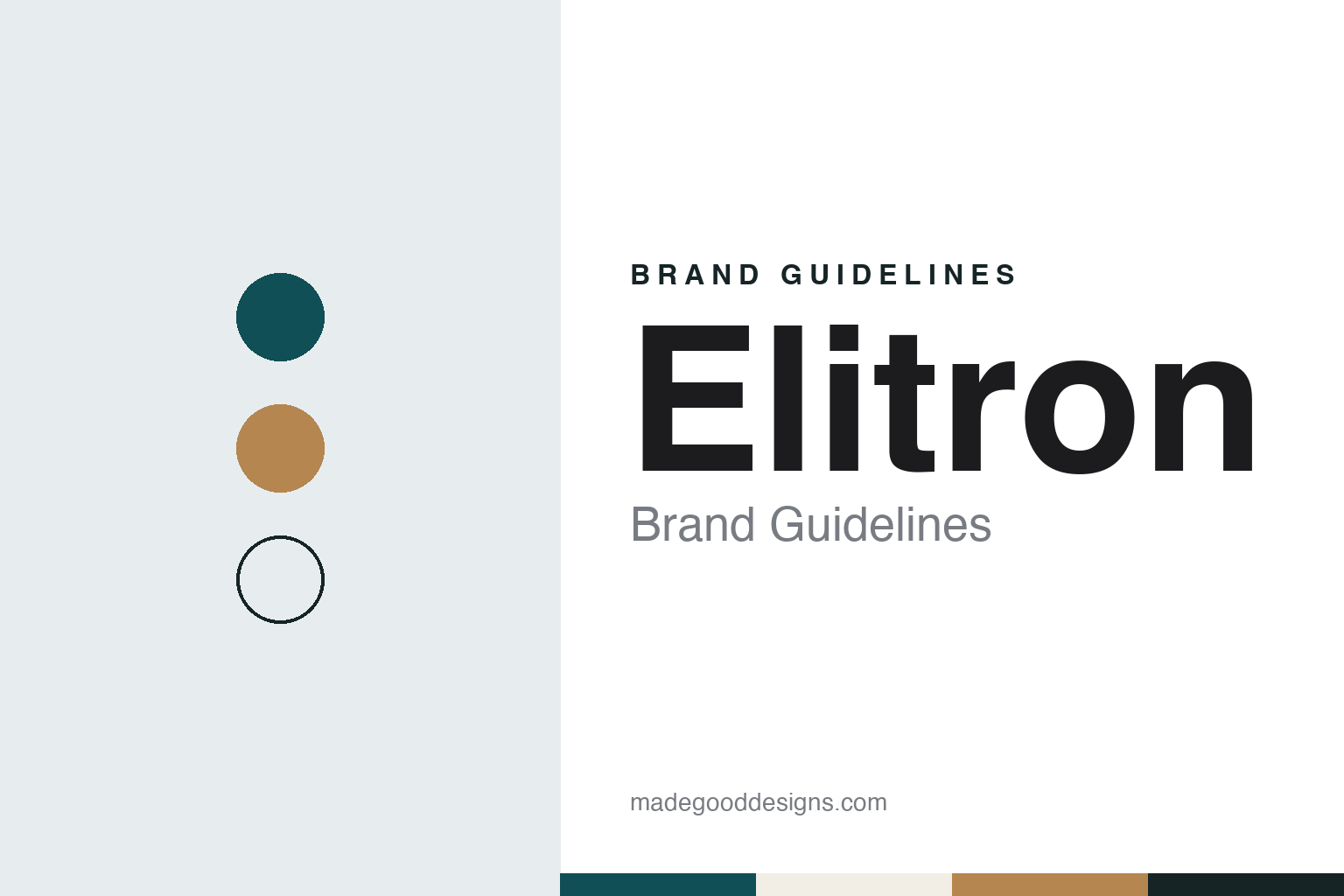
Elitron Brand Guidelines
The Marche cutting-table maker that went from leather to board.
Aa
Two constants: an Adriatic teal, kraft and board-white palette and an engineered sans register. Abstract homage — not an Elitron product or mark; no machine, logo or nameplate is reproduced.
Monte Urano, 1984
From shoes and leather to board and print.
Elitron makes digital cutting tables and automation systems in Monte Urano, in the province of Fermo in Italy’s Marche region. The company dates its beginning to 1984, when, in the words of its own timeline, Elitron was “the brainchild of” Giuseppe Gallucci. That timeline traces a path from shoes and leather to board and print: in 1995 it introduced what it calls its first integrated CAD-CAM system for the footwear and leather goods sectors, and in 2004 it took its systems into furniture and automotive work.
The rest of the timeline follows the same widening. In 2005 the company launched the Kombo system for processing industrial materials, and in 2008 it developed systems for the digital printing and packaging sectors. A focus on automation and robotics followed in 2016, and in 2017 the company founded Elitron America in Atlanta, Georgia. Its timeline lists investment in internal reorganisation in 2021.
Software and vision sit alongside the machines. The website lists Elipack Design, a CAD package for packaging; Elitron CAD, design software for shoes, leather goods and apparel; and Dialogo, which the company presents as its link to other file formats. Its detection systems include the Seeker System, a vision system that identifies printed registration marks and images, and Recut, which scans matched pieces laid freely on the table and captures their outlines. For visual communication and packaging work the company lists PVC, plastics, films, fabrics, paper, corrugated board and foam among the materials it can handle.
The company describes its customers as ranging “from small-medium enterprises to market leaders” that want to redesign their production through robotic cutting and automation, and says that has been its mission since it began. Its boilerplate in 2024 trade coverage described a European headquarters in Monte Urano and an American branch in Atlanta, and said the company designs and produces systems and software for packaging, digital print, fashion, furniture, automotive and industrial work, with production it calls “100% Made in Italy.”
Colour
A range sorted by material.
Elitron sorts its range by material as much as by industry. Its website lists cellulose, fabrics, synthetics, leather, multilayer and honeycomb board, corrugated cardboard, wood and MDF, composites and polymers among the materials its machines cut. For print and packaging the main family is Kombo: the Kombo SD and SDC series for digital printing and the paper industry, the twin-head Kombo TH and THC, the wide-format Kombo SDC+ conveyor cutter, and the Kombo TAV-R, which the company describes as a fully automatic cutting system for the packaging world.
Leather and footwear still run through the catalogue. The Plaza series is described as automatic cutting for large-format leather; the Visio systems capture hides and optimise nesting, on a conveyor or a fixed table; Dinamo 2T is a two-head cutter for soles and insoles; and Booster handles leather and synthetic materials. Among the smaller and supporting machines, the compact Spark C and Spark F are multi-function cutters, Heleva feeds material to large-format digital plotters, and Reversa is an automatic sheet turner that can work alone or in line.
The packaging trade press covered the company at drupa 2024 in Düsseldorf. Packaging Europe reported on 21 May 2024 that Elitron would unveil an updated Kombo TAV there, a system in which multi-stack pallets of board are fed in and single sheets are loaded, aligned, cut and creased and then unloaded into an aligned stack, with a new control board, redesigned electronics and a new motion-control system. The same report said Elitron would also show the compact Spark for sample making, with a multi-tool head and a vision system the company calls Seeker. Elitron’s own announcement for the show, carried by Packaging International, set out a range running from compact cutting systems for sampling to large-format, fully automated lines, and said the company had been answering global challenges “for over 40 years.”
Typography
How the category presents itself.
Wide-format printer and cutting-table makers sell machines that are easiest to understand in motion. Their brochures and stands show flatbed printers with a gantry of printheads passing over rigid boards, roll-to-roll machines feeding out lengths of printed vinyl and textile, and cutting tables whose heads trace shapes in corrugated board. The finished work — a shop-window graphic, a printed box, a length of fabric — usually carries the customer’s brand rather than the maker’s.
Many of these companies arrived from somewhere else. EFI began with the Fiery colour server, which turned office copiers into colour printers, and moved into inkjet when it bought VUTEk in 2005; Durst made photographic enlargers in Brixen for decades before turning to UV inkjet in the early 2000s, according to Wikipedia and the companies’ own histories. Their names, in other words, were built on one kind of machine and carried onto another.
Because the machines are large, makers invite buyers to see them running. EFI names customer experience centres in Londonderry, New Hampshire, in Castellón, Spain, and in Bergamo, Italy; Durst opened a customer experience centre of more than 5,700 square metres at its new Brixen headquarters in 2019, the German trade magazine Druckmarkt reported, saying it wanted customers to come there rather than rely only on trade fairs.
The fairs still set the calendar. The FESPA fair is where Durst added two P5 printers in 2019 and planned to show its Kyveris software in 2026, according to Druckmarkt and Large Format Review; at drupa 2016 in Düsseldorf, Druckmarkt noted, Koenig & Bauer and Xerox announced a digital folding-carton press. This guide sets out what can be checked about each maker — who founded it, who owns it and what it makes — and marks clearly what rests only on the company’s own word.
Aa
An engineered sans for a cutting-table maker. (Specimen set in Titillium Web, a sans STAND-IN; NOT the Elitron logo.)
Elitron
Two offices, one cutting vocabulary.
The people quoted for the company in the 2024 coverage were Paolo Malatesta, Elitron’s executive director, and Daniele Gallucci, president of Elitron America, who spoke to Packaging Europe about the Kombo TAV. On its own account Elitron remains an Italian company with its head office in Monte Urano and an American subsidiary, whose office its website places in Norcross, Georgia, in the Atlanta area. The company sells into five sectors on its website: fashion, furniture, automotive, visual and packaging, and industrial solutions.
Its self-presentation leans on engineering vocabulary. The website calls robotics and artificial intelligence the “DNA” of its technology and describes the team as “technology explorers,” while its mission page presents a cut as a shape that intelligently forms material into new solutions. Its product pages present each machine under a family name, with Kombo, the longest-running, covering the print and packaging range.
For a design guide, Elitron shows how a regional Italian engineering firm can present one cutting technology across very different trades, from hides and soles to corrugated board and printed signs. Compare Zünd, the Swiss cutter maker, and Summa, the Belgian maker of cutters for sign and display work. For this guide we use Adriatic teal, corrugated kraft and board white with an engineered sans, an unofficial interpretation; no product or logo is reproduced.
Explore & save
Keep Elitron’s identity on hand — save it to a board in the Made Good inspiration library.
Elitron identity set
Pin the Adriatic teal, kraft and board-white palette and the engineered sans register to your own board.