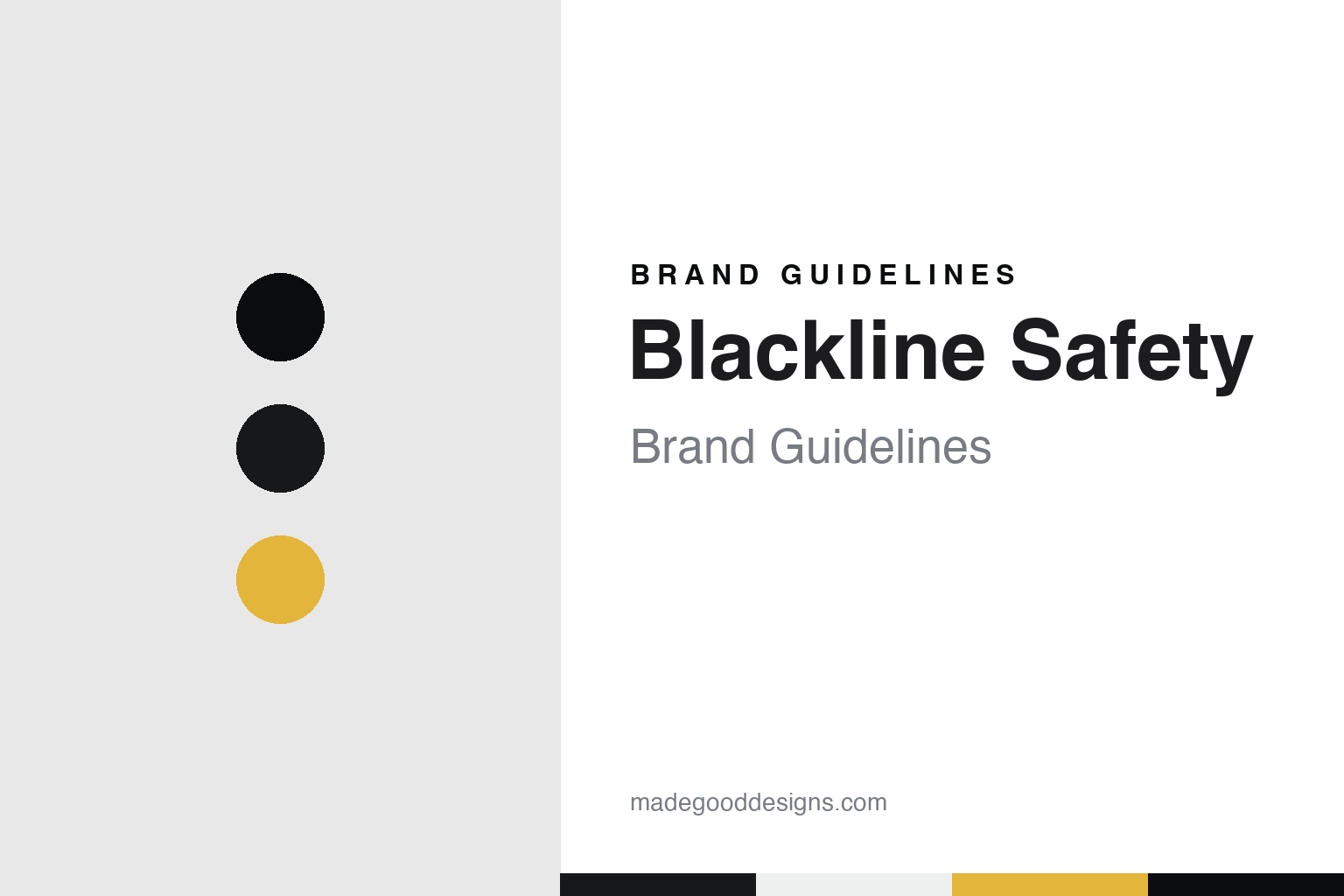
Blackline Safety Brand Guidelines
From Blackline GPS to connected gas detectors in Calgary.
Aa
Two constants: a Blackline Safety near-black and signal yellow palette and a Technical sans register. Abstract homage — not a Blackline Safety product or mark; no device, logo or nameplate is reproduced.
Blackline GPS
A Calgary start in location technology.
Blackline Safety began in Calgary, Alberta, in 2004 under another name: Blackline GPS. English Wikipedia names its founders as Patrick Rousseau and Brendon Cook. The company’s own history describes the young firm as a Calgary technology business that first worked on wireless technology for motorsports and fuel management, before turning to the products it is now known for.
Its early products were aimed at consumers. English Wikipedia records a GPS car tracker called the GPS Snitch, introduced in 2008, which could be controlled over the internet or by text message, and a companion service called Blip for BlackBerry phones. By 2010, Wikipedia says, the company had decided to leave the consumer GPS market and concentrate on industrial customers.
The industrial turn had started a little earlier. The company dates its first product, the Loner GPS and its online portal, to 2007: a wearable device that linked people working alone to help through wireless and location technology. In 2009, it says, Blackline listed its shares on the TSX Venture Exchange, the Canadian market for smaller companies. In 2013 it opened its first office outside Canada, in Colchester in England, and it later added offices in France, the United States and the United Arab Emirates.
A local newspaper gives a snapshot of the business at that stage. In March 2015 the Calgary Herald reported that Blackline GPS, which it described as a maker of employee safety monitoring and portable tracking products, had won a contract under the federal Build in Canada Innovation Program and would work with Correctional Service Canada in Ontario to equip about 100 parole officers with its Loner 900 and Loner Bridge monitors. The newspaper quoted Cody Slater, by then the chief executive, on what the programme meant for a company of that size.
Colour
From Loner to G8.
The name followed the business. In July 2015 the company completed its change of name from Blackline GPS Corp. to Blackline Safety Corp., approved by shareholders that June, and kept its ticker, BLN, on the TSX Venture Exchange, according to its announcement of 7 July 2015. The year before, by the company’s account, Cody Slater, formerly chief executive of the gas-detection maker BW Technologies, had joined as chief executive, with the aim of combining Blackline’s lone-worker monitoring with gas detection. In 2015 the company also opened a monitoring centre and began offering a round-the-clock live monitoring service to its customers.
The products that followed carry short letter-and-number names. The G7, launched in 2017, is a cloud-connected wearable for lone-worker monitoring and gas detection, made in cellular and satellite versions; the company says it won a Red Dot Award: Product Design 2017. The EXO, launched in 2020, is a portable area monitor, and the EXO8 of 2024 extends it to up to eight gases plus gamma radiation, the company says. The G8, announced in January 2026 and shipping from March 2026, combines gas detection using swappable sensor cartridges with lone-worker functions and radio-style voice communication in one device, according to its announcements.
Around the hardware sits software. The company sells a cloud platform it calls Blackline Live, a data service called Blackline Analytics and a Loner mobile app, and it rents devices as well as selling them. Its devices are sold to sectors it lists as including oil and gas, fire and hazardous-materials teams, water and wastewater, utilities, petrochemicals and transport.
Recognition has come from its home city as well as its industry. The 2025 Calgary Awards gave Blackline Safety the Community Achievement Award for social impact in business, according to English Wikipedia’s list of winners, and the company lists a long run of new-product awards from trade magazines on its own website.
Typography
Design and documentation.
Gas detection and respiratory protection grew up underground. Before electronic sensors, miners carried canaries as an early warning of bad air; in 1937 Dräger’s first detector tube offered a chemical alternative, English Wikipedia notes, and the American company now called MSA Safety began in 1914 with an electric cap lamp for mines. In North America, mine-rescue crews are still known as “Drägermen,” a reminder of how closely the trade and its equipment makers have been tied to mining.
The equipment itself sets the visual tone of the category. A personal gas detector is a small, rugged housing clipped to a jacket, a harness or a helmet, with a display and a sensor opening facing outward. Breathing-apparatus sets combine a backplate, a compressed-air cylinder and a full-face mask, and appear most often in pictures of firefighters at work or in training. Fixed detectors are mounted on walls and pipework in plants, tunnels and refineries, where they are meant to be seen rather than hidden.
Many makers use bright housings in yellow, orange, red or black, colours that stand out against dirt, smoke and grey machinery, and pair them with plain sans-serif type and large figures on the display. Product pages tend to show the device in use in a hazardous setting, or as a clean cut-out against white, rather than as a lifestyle object. Test rooms, calibration stations and training galleries are part of the story too, since equipment of this kind is regularly checked and serviced.
Behind the products sit companies of very different ages and shapes: family-controlled groups, listed corporations and young technology firms, some with long histories that include the war years. For a designer, the category is a study in function first: legibility, contrast and durability, with brand colour used as a signal on the job.
Aa
A technical sans — short letter-and-number product names. (Specimen set in Inter Tight, a sans STAND-IN; NOT the Blackline Safety logo.)
Blackline
Built in Calgary, by its own account.
Blackline moved up a market in June 2021, when its shares began trading on the main board of the Toronto Stock Exchange under the ticker BLN and left the TSX Venture Exchange, the company announced on 10 June 2021. In April 2022 it bought Swift Labs, an Ontario internet-of-things design and engineering consultancy founded in 2014, to add product-development capacity, it said.
The company says it builds its devices in Calgary. In May 2018 it announced a surface-mount line to assemble its own printed circuit boards in a new manufacturing building there, with the stated aim of building G7 devices from raw components to finished goods; in May 2023 it said it had expanded manufacturing capacity at its Calgary headquarters so that it could assemble larger volumes on site. Its offices today are in Calgary; Webster, Texas; Colchester; northern France; Cologne; and Abu Dhabi, its website says.
Leadership changed in 2026. On 28 September 2026 the company named Jon Baldwin, previously head of Verra Mobility’s government solutions business and earlier president of Fortive’s Gems Sensors & Controls, as chief executive; Slater, chief executive for more than 15 years, became board chair and chief architect, the company said.
For a design guide, Blackline Safety shows a company that presents gas detectors as connected devices, with short letter-and-number product names and software sold alongside the hardware. Compare Industrial Scientific, another maker of portable gas detectors, and Crowcon, the English gas-detection maker. For this guide we use a near-black and a signal yellow with a sans, an unofficial interpretation; no product or logo is reproduced.
Explore & save
Keep Blackline Safety’s identity on hand — save it to a board in the Made Good inspiration library.
Blackline Safety identity set
Pin the Blackline Safety near-black and signal yellow palette and the Technical sans register to your own board.