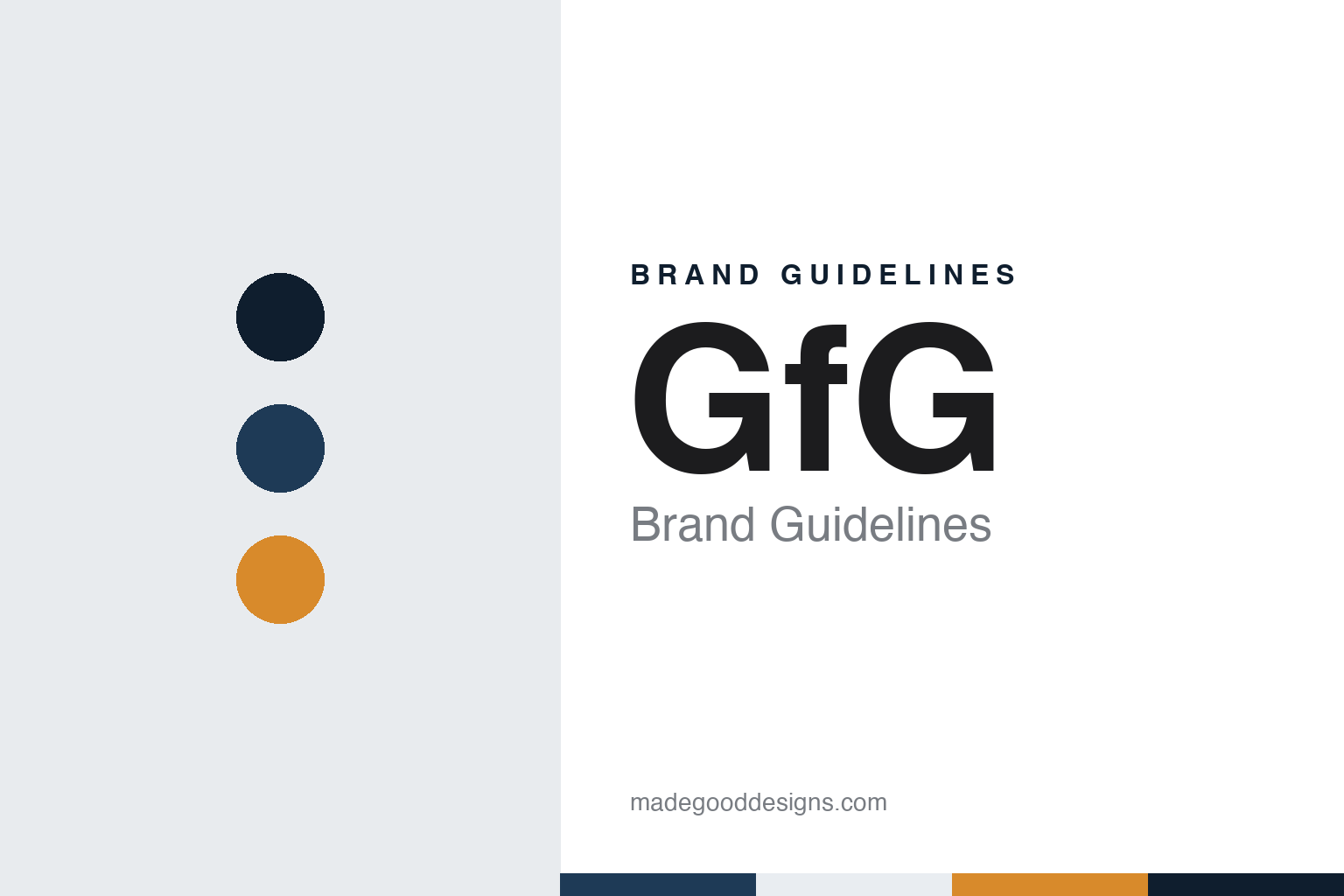
GfG Brand Guidelines
The owner-managed Dortmund maker of Microtector gas detectors.
Aa
Two constants: a GfG blue and amber palette and an Engineered sans register. Abstract homage — not a GfG product or mark; no device, logo or nameplate is reproduced.
Gesellschaft für Gerätebau
An instrument company in the Ruhr.
GfG is short for Gesellschaft für Gerätebau — roughly “company for instrument building” — a maker of gas-detection equipment based in Dortmund, in Germany’s Ruhr. The company says it has developed and made gas-warning equipment for more than six decades. Its American distributor, JJS Technical Services, gives the founding year as 1961, and says the young company began with a methane tester for coal mines, the K95, was making further models for the mining industry by 1964 and was shipping them abroad two years later.
Mining is still on the company’s list of markets. Its mission statement names municipalities, the chemical industry, fire and civil protection, mining, energy utilities, food production, shipping, steel, agriculture, and research institutes and universities as the main places its instruments are used.
The same distributor dates GfG’s international growth to 1978, when it expanded into South Africa, and says the American subsidiary took the name GfG Instrumentation, Inc. in 2001. Today the company says it works through 11 subsidiaries of its own as well as local sales partners. It describes itself as a specialist in gas detection rather than a generalist in safety, and sums up its path in one line: from the heart of the Ruhr in Dortmund, it says, it has grown into a company active around the world.
The company also stresses training. It runs courses under the name GfG Campus for people who operate and maintain its instruments, and says it has trained apprentices in Dortmund for many years, as industrial clerks and electronics technicians.
Colour
Microtector and Polytector.
GfG makes two families of equipment: portable gas detectors, worn or carried by workers, and fixed gas-warning systems, built from controllers and transmitters installed in plants and buildings. Its catalogue also covers water-measurement equipment for spotting leaks in cooling-water circuits, test gases for calibration, accessories, and custom-built sampling systems and control cabinets.
Its fixed systems come with a technology the company brands ACDC, which it describes as “smart communication technology” that carries digital data over an analogue signal line. The company says many of its devices hold ATEX certification, the European scheme for equipment used in potentially explosive atmospheres, and it publishes a customer newsletter, the GfG Gazette, with news about gas measurement and its own products.
Its main portable names are Microtector and Polytector. In September 2012 the German trade magazine GIT Sicherheit described the Microtector II G460 as a small, light multi-gas device with an infrared sensor for flammable gases and carbon dioxide and a built-in photo-ionisation detector for toxic gases, tested and adjusted in a DS400 docking station that works without a computer.
In July 2018 the emergency-services magazine Leitstelle described two successors, the Microtector III G888 and the Polytector III G999: multi-gas detectors that take up to five sensors, show their status in green, yellow and red on the display, include a man-down alarm as standard and can send readings through an optional radio module to a mobile central unit called GfG-Link. The G999, the magazine said, can work by diffusion or with a built-in pump to sample spaces that are hard to reach.
In October 2025, ahead of the A+A trade fair in Düsseldorf, GfG described how portable detectors such as the Microtector III G888M can be linked by radio, through a gateway, to its fixed gas-warning systems, so that an alarm from a worn device is handled by the plant’s fixed installation, according to the company’s press release.
The company also points to a customer abroad. It says it has worked for many years with the Singapore Civil Defence Force, supplying portable devices adapted to the local climate and to the force’s communications network.
Typography
Design and documentation.
Gas detection and respiratory protection grew up underground. Before electronic sensors, miners carried canaries as an early warning of bad air; in 1937 Dräger’s first detector tube offered a chemical alternative, English Wikipedia notes, and the American company now called MSA Safety began in 1914 with an electric cap lamp for mines. In North America, mine-rescue crews are still known as “Drägermen,” a reminder of how closely the trade and its equipment makers have been tied to mining.
The equipment itself sets the visual tone of the category. A personal gas detector is a small, rugged housing clipped to a jacket, a harness or a helmet, with a display and a sensor opening facing outward. Breathing-apparatus sets combine a backplate, a compressed-air cylinder and a full-face mask, and appear most often in pictures of firefighters at work or in training. Fixed detectors are mounted on walls and pipework in plants, tunnels and refineries, where they are meant to be seen rather than hidden.
Many makers use bright housings in yellow, orange, red or black, colours that stand out against dirt, smoke and grey machinery, and pair them with plain sans-serif type and large figures on the display. Product pages tend to show the device in use in a hazardous setting, or as a clean cut-out against white, rather than as a lifestyle object. Test rooms, calibration stations and training galleries are part of the story too, since equipment of this kind is regularly checked and serviced.
Behind the products sit companies of very different ages and shapes: family-controlled groups, listed corporations and young technology firms, some with long histories that include the war years. For a designer, the category is a study in function first: legibility, contrast and durability, with brand colour used as a signal on the job.
Aa
An engineered sans — “smart Gas Detection Technologies.” (Specimen set in Archivo, a sans STAND-IN; NOT the GfG logo.)
GfG
“smart Gas Detection Technologies.”
GfG is owner-managed. Its website names Hans-Jörg Hübner and Paul Dorsch as managing directors, and its October 2025 press release describes Hübner as the company’s managing owner.
Its manufacturing claim is direct: all GfG products are still made at its headquarters in the Ruhr, the company says, under the line “Hightech Made in Germany.” It lists its main customers as industrial companies including semiconductor makers, food producers, research institutions, fire brigades and civil-protection organisations, and counts itself among Germany’s “hidden champions,” the term for little-known specialist firms; those are its own descriptions. Its mission statement speaks of independent, much-awarded design. Its tagline is “smart Gas Detection Technologies,” written with a lower-case “smart.” It shows its range at trade fairs; for the A+A fair in Düsseldorf in November 2025, its press release gave its stand in Hall 1 and promoted the radio link between worn and fixed devices.
The name needs care online. The letters GfG are shared with unrelated German businesses, including a building-management firm; the gas-detection company trades from gfgsafety.com, with GfG Instrumentation as its American arm.
For a design guide, GfG shows an owner-managed engineering firm that presents itself through one specialism and one place of manufacture. Compare Dräger, the Lübeck maker of gas detectors and breathing apparatus, and Testo, another German measuring-instrument maker. For this guide we use a steel blue and a warning amber with a sans, an unofficial interpretation; no product or logo is reproduced.
Explore & save
Keep GfG’s identity on hand — save it to a board in the Made Good inspiration library.
GfG identity set
Pin the GfG blue and amber palette and the Engineered sans register to your own board.