Anthos Brand Guidelines
Imola dental units in the Cefla cooperative since the 1990s.
Aa
Two constants: a teal, stone and terracotta palette and a warm Italian serif register. Abstract homage — not an Anthos product or mark; no dental unit, logo or nameplate is reproduced.
Anthos of Imola
A dental-unit maker and its cooperative owner.
Anthos makes dental units — the treatment centres built around a dentist’s chair — in Imola, in the province of Bologna. It dates itself by span rather than by a year. In November 2005 Australasian Dental Practice, reporting the launch of the Classe A7, said the unit rested on 58 years of product development and research; the Anthos website now speaks of “more than 60 years” of support for dental practitioners.
Anthos calls itself “Italy’s leading producer of dental units” on its own website, and Australasian Dental Practice used much the same words in 2005. Its tagline is “Enjoy the difference.”
Since the late 1990s Anthos has belonged to Cefla, the industrial group based in Imola. Paolo Bussolari, then managing director of Cefla Dental Group, said in a February 2014 interview published by the Russian distributor Unident that Cefla entered the dental market at the end of the 1990s by buying Anthos and Stern Weber. Cefla’s own timeline dates the founding of Cefla Dental Group, now its Medical Equipment business unit, to 1998. In the 2000s the group added Castellini, a purchase Bussolari dated to 2007, and built an imaging arm around MyRay and NewTom. In the same interview Bussolari said the group had first concentrated its dental units on the markets of Italy, France and Germany, before interest in its radiographic products grew there too.
Cefla is a cooperative. A 2015 piece by Cefla Dental Group in Dental Tribune described its parent, Cefla s.c., as a private, employee-owned cooperative with headquarters in Imola, in which employees are also owners. Its other business units work in engineering, finishing and lighting, according to the group’s listing with UNIDI, the Italian dental-industry association.
Colour
Letters and numbers: the A, L, R and C units.
Inside Cefla, Anthos is one of three treatment-centre brands, alongside Castellini and Stern Weber; Cefla describes all three as offering versatile dental units for every clinical stage, while MyRay and NewTom cover imaging and Mocom covers sterilisation. Cefla’s Medical Equipment unit sets out a wider portfolio of dental units, digital radiology, sterilisation systems, diagnostic and image-management software and devices for implantology and oral surgery, the last including brands of its partner Biosafin.
The current range, as listed on the Anthos website in November 2026, runs through letters and numbers. The A-series runs from the A3 to the A7 PLUS. Above it sit the L6 patient chair and the L9; the R7, which the company says converts without tools and offers NFC connectivity and an optional voice assistant; and the C9, which it describes as combining the latest instruments with advanced ergonomics and a high-tech interface. Surgical carts allow endodontic and implant work without a unit body.
Around the units sit handpieces and instruments, LED operating lights — including one with a built-in 4K camera, the company says — integrated imaging, hygiene systems, autoclaves, thermal disinfectors and software. Anthos also runs training courses for dentists, which it describes as a continuing investment.
Older names follow the same logic. Australasian Dental Practice reported the launch of the Classe A7 in 2005, part of a new generation of Classe A units that included international and continental versions, orthodontic models and a version for left-handed operators, and of the Classe A9, presented as a “crossover” unit, in January 2007. Even in 2005 Anthos made X-ray units, digital sensors and intraoral cameras as well as chairs, the magazine reported.
Where the units are made is given in the companies’ own words. Anthos says its A3 is produced “at Europe’s leading dental industry manufacturing hub,” and Cefla’s listing with UNIDI says the group designs and manufactures its dental equipment through its brands, giving Imola as its address.
Typography
Design and documentation.
Dental equipment makers sell to a narrow audience — dentists, clinic groups, dental schools and the dealers who supply them — and their brands are built around a handful of recurring scenes. The treatment unit is the centrepiece: a patient chair with its instrument delivery, operating light and assistant’s element, usually photographed in a clean, bright surgery, either empty or with a clinician and patient posed mid-appointment.
Imaging has its own visual language. Panoramic and cone-beam CT units are shown in rooms of their own, intraoral X-ray arms are fixed to the wall beside the chair, and sensors and intraoral scanners appear in the hand, often next to the screen that displays the result. Software is shown as screenshots: a 3D skull, an arch of teeth, an implant plan. Handpieces get the close-up treatment of precision tools, while sterilisers and washers belong to the back room, photographed as white boxes on a clean counter.
The trade has its own calendar. The International Dental Show (IDS) in Cologne, held every two years, is where many makers launch products; Planmeca, for one, says it introduced a digital imaging system there in 1995. National dental meetings in North America, Europe and Asia fill the years between, and trade publications such as Dental Tribune report the launches and the takeovers.
Ownership in the sector changes often. Family-owned makers sit alongside listed groups and private-equity-backed companies, and brands move between them: Kodak’s dental business became part of Carestream Health and then Carestream Dental, and KaVo’s treatment unit and instrument business passed from Envista to Planmeca at the start of 2022. This guide sets out what can be checked about each maker — its founding, its owners and its products — and marks clearly what rests on the company’s own word.
Aa
A warm serif for a brand that sells Italian design as part of the chair. (Specimen set in Fraunces, a serif STAND-IN; NOT the Anthos logo.)
Anthos
One name in a family of sibling brands.
Anthos reaches dentists through distributors. In Australia, Australasian Dental Practice reported in September 2004 that its local agent, Victorian Dental Services, was adding customer service staff, and that the brand had reached the point where visitors to dental shows no longer asked who Anthos were. Anthos Australia, now the exclusive distributor there, said in April 2026 that it had supported dental professionals for more than four decades, selling Anthos units with MyRay imaging.
In North America the brand arrived later. Cefla Dental Group wrote in Dental Tribune in March 2015 that Anthos operatory packages had recently launched there, sold alongside Stern Weber, MyRay and NewTom and backed by a national network of certified technicians.
The brand now sits in a multi-brand portfolio rather than standing alone: Cefla presents Anthos, Castellini and Stern Weber side by side, each with its own website and tagline, and Anthos product pages link into the group’s wider dental offer.
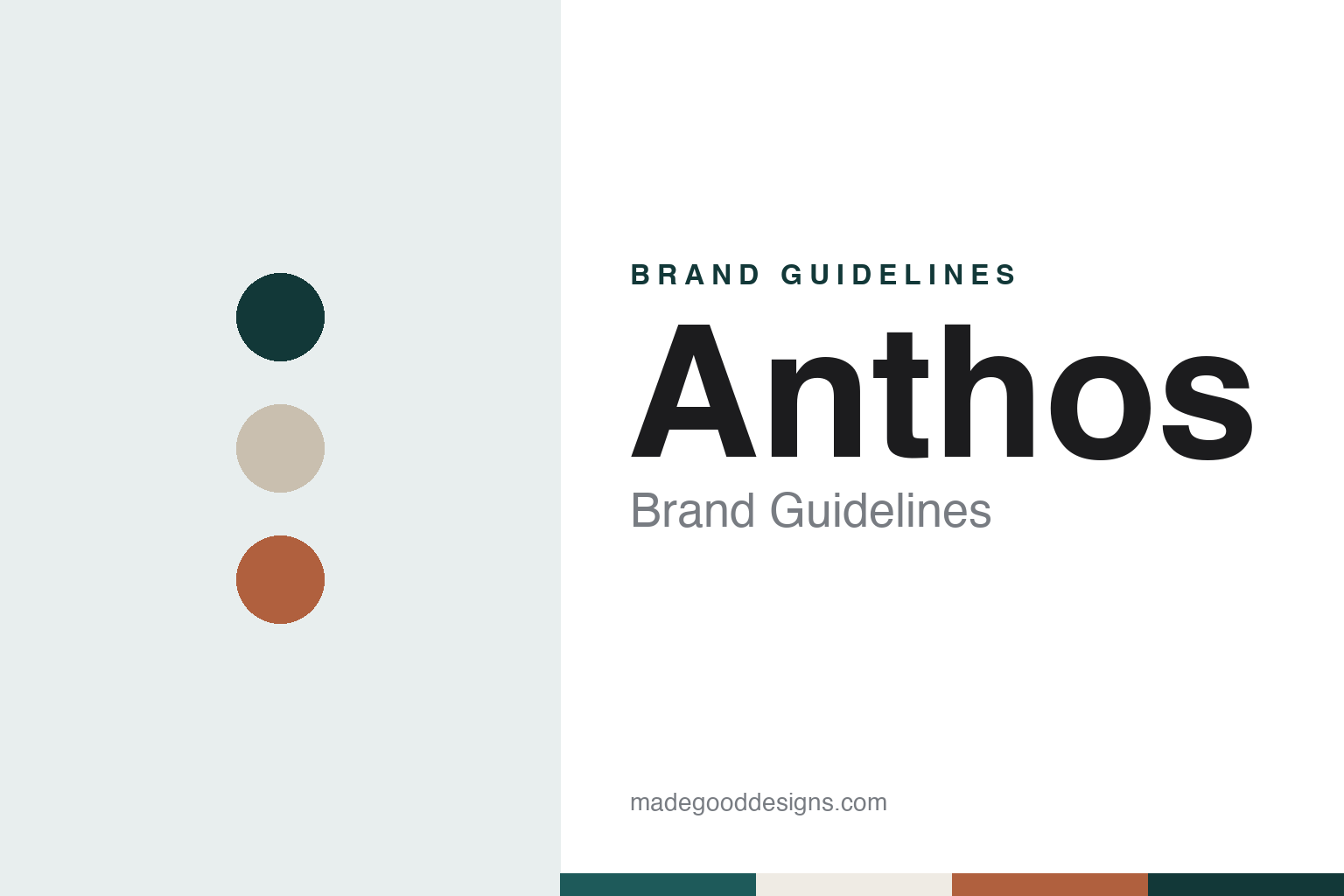
For a design guide, Anthos shows how a brand keeps its own voice inside a cooperative’s family of sibling marks. Compare Stern Weber, its sister brand at Cefla, and Dentsply Sirona, another maker of treatment centres. For this guide we use a deep teal, a soft stone and a terracotta with a serif, an unofficial interpretation; no product or logo is reproduced.
Explore & save
Keep Anthos’s identity on hand — save it to a board in the Made Good inspiration library.
Anthos identity set
Pin the Anthos teal, stone and terracotta palette and the warm Italian serif register to your own board.