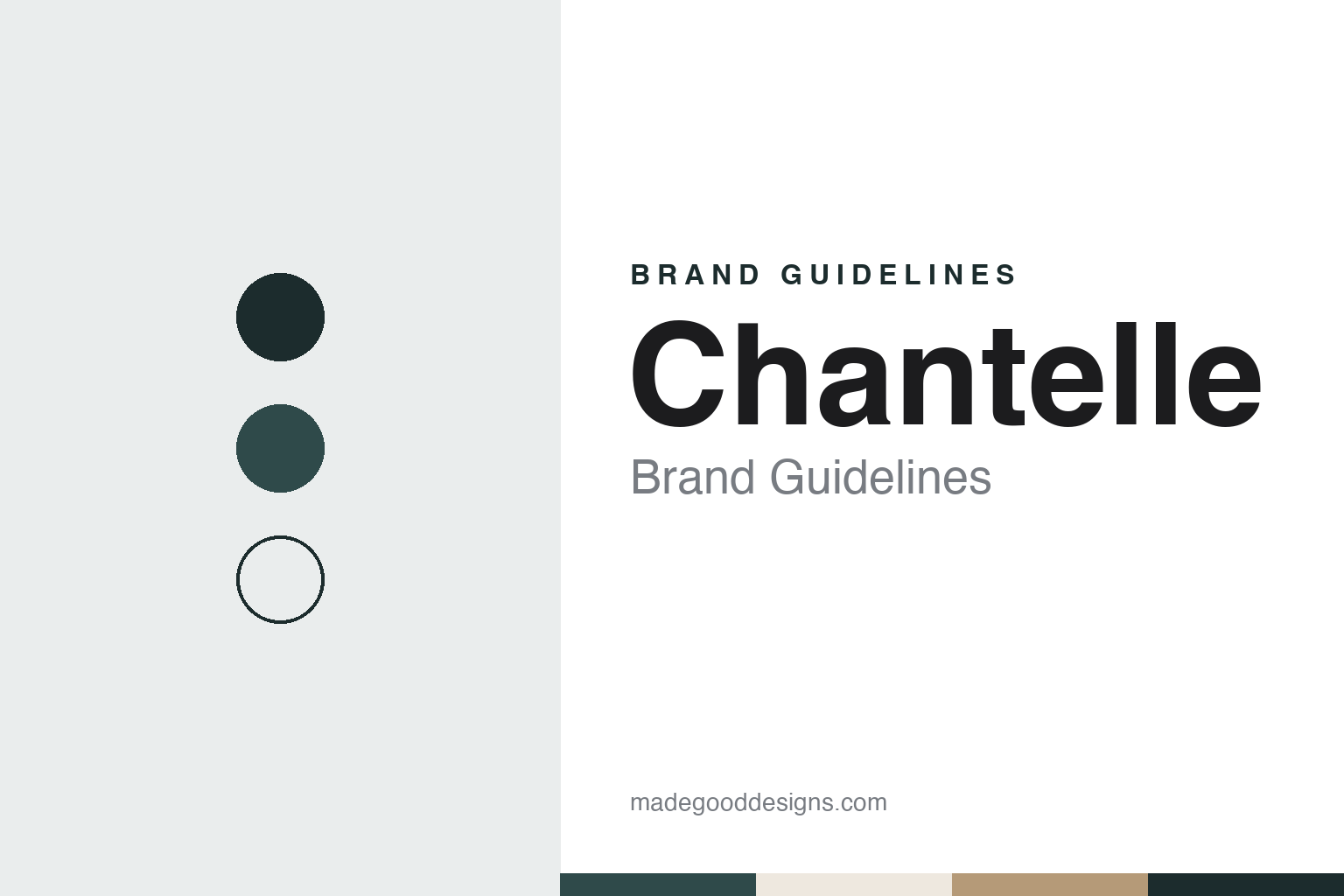
Chantelle Brand Guidelines
Elastic knits of 1876, and a name revived for a girdle.
Aa
Two constants: a Chantelle teal and sand palette and a Parisian serif register. Abstract homage — not a Chantelle product or mark; no garment, logo or label is reproduced.
Elastic knits
Monsieur Gamichon and his nephew.
The company behind Chantelle is older than its name. French Wikipedia and FashionUnited both date it to 1876, when François Auguste Gamichon set up a business making elastic knits, exploiting the vulcanisation of rubber. Wikipedia says it specialised in abdominal belts and elastic cloth, and that its goods were exported as far as Latin America.
In 1898 Gamichon went into partnership with his nephew, Paul-Maurice Kretz, and the firm later became the Établissements Kretz. It has stayed in that family ever since, French Wikipedia says. Corsets made from elastic fabric followed in 1902, according to English Wikipedia.
The technical step came in the 1930s. Jean Kretz, a textile engineer, took over in 1936 and renamed the business the Société nouvelle des Établissements Kretz, or SNEK. French Wikipedia credits him with the “tulle Kretz,” a fabric that stretched in both width and height; FashionUnited says the same and notes that it made the later girdles possible.
The brand itself dates from 1949. Claude Kretz, Jean’s son, took over that year, used the tulle for a girdle and revived the name Chantelle, which his grandfather had registered. The slogan was “la gaine qui ne remonte pas,” the girdle that stays in place, carried in a 1950 advertisement illustrated by Pierre-Laurent Brenot. French Wikipedia says the firm soon became France’s leading corset maker, with about a fifth of the market, and that its film Fugue won first prize at the Cannes advertising festival in 1959.
Colour
Bras, Épernay and Saint-Herblain.
The bra changed the company. Sources differ slightly on the dates: FashionUnited in 2020 and English Wikipedia’s group history put the first bras and the Épernay factory in 1960, French Wikipedia gives a first bra in 1961 and the factory in 1962, and FashionUnited in 2021 gives 1962 for both. The Épernay site is in Champagne.
Two bras are singled out. Fête was made in Calais lace, and French Wikipedia says it sold more than a million a year for several years. Défi, of 1972, is described by Wikipedia as the first moulded bra. By 1976 bras were driving the business, and the company took the name of its brand, Chantelle.
The factories have their own history. French Wikipedia says the firm moved to Saint-Herblain, near Nantes, five years after Épernay opened, and added a plant at Lanester in 1973. Saint-Herblain became a centre of labour organising: its workers struck and occupied the factory in May 1968, and a two-month strike followed in 1981–82, a history studied by the historian Fanny Gallot. In December 1993 the deputy Jean-Marc Ayrault raised the planned closure of the factory, with 200 staff, in the French National Assembly, saying the company had opened two plants in Tunisia, one in Hungary and one in Costa Rica during the previous decade. The factory closed in 1994 after a year of protest by its workers, French Wikipedia says.
Growth then came through more brands. Patrice Kretz joined in 1985 and proposed Passionata, launched in 1988. Darjeeling followed in 1995, and the group added the Orcanta shops in 2006, Femilet and Chantal Thomass around 2010–11, and the Dutch retailer Livera in 2014, English Wikipedia says.
Typography
Lace, boutiques and the trade.
Many lingerie houses present themselves through material first. Close-up photographs of lace, ribbon and stitching run across the category, and the trade sorts itself in the same terms: Interfilière Paris, the show for suppliers, listed fabrics, lace, embroidery, accessories and textile designers among its sectors in a press release of November 2023, with nearly 170 exhibiting suppliers expected.
Behind the photographs sits the workroom: pattern cards, cutting tables and sample rails. Wacoal says its first bra began with a paper pattern, and The Underpinnings Museum, an online collection of dated garments, publishes a pattern library beside its catalogue entries, which record fabric, origin and construction piece by piece.
The shop counts for as much as the cloth. Wacoal says it opened its first department-store underwear counter at the Kyoto branch of Takashimaya in 1950, while Agent Provocateur’s first shop, opened in 1994 on Broadwick Street in London’s Soho, still carried its seasonal windows in February 2026, FashionUnited reported. Boxes and ribbon finish the sale in many houses, and ribbon can be part of the product too: the museum names satin ribbon-slot lace trim and bows as signature details of many early Agent Provocateur designs.
The trade meets in France. The Salon International de la Lingerie and Interfilière Paris, organised by Eurovet, marked sixty years since the Salon’s first edition at Paris Porte de Versailles in January 2024, with nearly 250 brands expected at the Salon, according to the press release.
Aa
A Parisian serif for a name first used on a girdle. (Specimen set in Playfair Display, a serif STAND-IN; NOT the Chantelle logo.)
Chantelle
A family firm and a factory in Champagne.
The visual identity has been reworked in recent years. FashionUnited reported in November 2017 that the group had appointed the fashion photographer Renaud Cambuzat as creative director for image and communication about a year earlier, and that he was reworking Chantelle and Passionata. He told the title the aim was a more open and modern image, with distinct visual territory for each brand. A year later he said the first goal had been a recognisable brand platform. In 2018 the group began opening multi-brand shops under the initials CL. FashionUnited wrote in 2020 that the group had been renamed CL, while its 2021 report still called it the Chantelle group.
Épernay has stayed in use. In January 2021 FashionUnited described the site as having 320 machines and 100 employees, including 20 in product development, and reported that the group was opening it to young labels so they could produce in France. In 2025 Chantelle at Épernay was among the companies awarded the state’s Entreprise du Patrimoine Vivant label, Le Journal des Entreprises reported.
Control has not left the family. French Wikipedia names the Kretz family’s holding as parent, gives Patrice Kretz as head of the group and places its head office at Cachan, south of Paris. FashionUnited called it a family business in 2020. Two books trace the house and its trade: Chantelle Paris by Anne Zazzo (2010) and Lingerie française by Catherine Ormen (2012).
The name is shared: Chantelle is also a commune in the Allier, in central France.
For a design guide, Chantelle shows how a brand can grow out of a material: the fabric came first, and the name followed for one product. Compare Aubade and Simone Pérèle, two other French lingerie houses. For this guide we use a deep teal, a sand and a cream with a serif, an unofficial interpretation; no product or logo is reproduced.
Explore & save
Keep Chantelle’s identity on hand — save it to a board in the Made Good inspiration library.
Chantelle identity set
Pin the Chantelle teal and sand palette and the Parisian serif register to your own board.


