EVE Energy Brand Guidelines
The Huizhou battery maker that began with primary lithium cells.
Aa
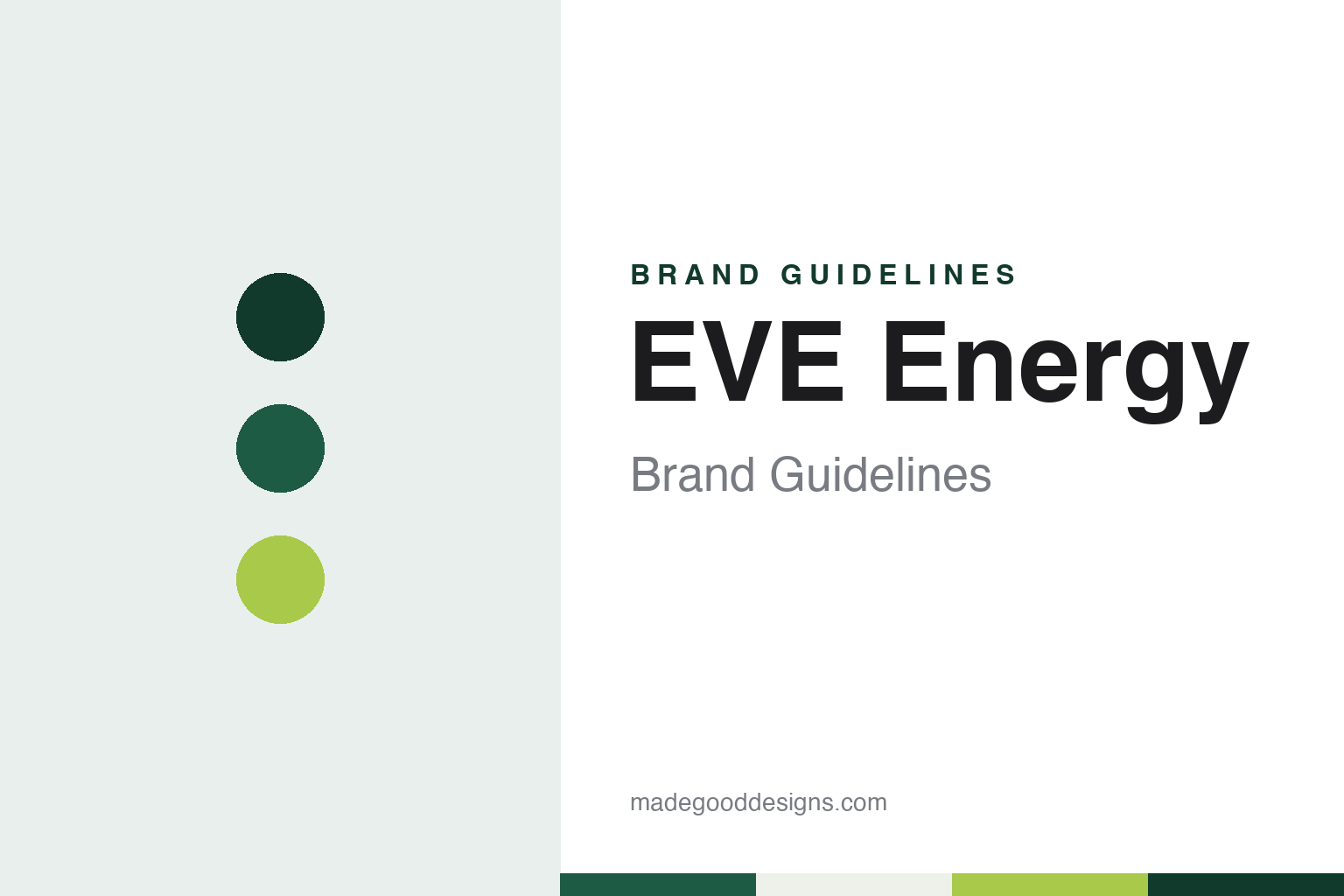
Two constants: an EVE Energy green and lime palette and a Grotesque sans register. Abstract homage — not an EVE Energy product or mark; no cell, logo or nameplate is reproduced.
From Huizhou
A 2001 start in primary lithium cells.
EVE Energy is a Chinese battery maker headquartered in Huizhou, in Guangdong province. English and Chinese Wikipedia both say it was founded in 2001 by Liu Jincheng, and the company’s own profile gives the same year. On its website Liu appears as chairman, beside a line that sums up how the company likes to talk about its work: “The battery is a living thing, we produce them with uncompromised respect and dignity.” The company writes its name as EVE, in capitals, throughout its own pages.
It did not start with car batteries. By the company’s own timeline, it began producing primary lithium batteries — cells that are not recharged — in 2003, brought a primary-lithium production base at Xikeng into use in 2007, and began making consumer lithium-ion batteries in 2010. In 2012 it built its Zhongkai headquarters zone for lithium-ion manufacturing and merged with Huizhou Desay Polypower Battery, and in 2015 it started producing power batteries, the cells used in vehicles. Its website still groups its consumer cells with uses such as smart meters, smart security, automotive electronics and other connected devices.
EVE went public early in that story. It was first listed on the ChiNext board of the Shenzhen Stock Exchange in 2009, the company says, and Wikipedia gives the same year. In June 2025 it announced a plan to issue H shares and list on the Main Board in Hong Kong, CnEVPost reported on 9 June 2025; the board had approved the proposal on 7 June, and the announcement said the move was meant to enhance the company’s international brand image and support its business abroad.
Colour
Cells for tools, cars and storage.
EVE’s range is wide. Its website sorts its products into consumer batteries — primary lithium cells, small lithium-ion cells and cylindrical cells — and power batteries, which include prismatic LFP and NCM cells, pouch NCM cells, cylindrical EV cells, modules, battery management systems and complete battery systems, alongside energy-storage products. LFP and NCM are two lithium-ion chemistries, lithium iron phosphate and nickel cobalt manganese. In 2019, by its own timeline, it launched a small “Bean Cell” for wireless earbuds, and it says it began mass production of large cylindrical and large prismatic cells in 2025.
Car makers became customers from 2018. The company lists a multi-year supply agreement with Daimler in 2018, selection as a supplier to Hyundai and Kia in 2019, and designation letters from the BMW Group in 2020 and 2022. English Wikipedia records a joint venture with SK Innovation for pouch cells, announced in 2019, and a 10 per cent stake in Amplify Cell Technologies, a venture with Accelera, Daimler Truck and Paccar that broke ground on a battery plant in Marshall County, Mississippi, in June 2024 to make LFP cells for commercial vehicles in North America.
Energy storage is the other large business. English Wikipedia describes EVE as the third-largest maker of energy-storage battery cells in the world as of 2023, and the company says it was among the top two energy-storage technology suppliers in 2024, citing its own statistics and industry databases. Its timeline records a 60 GWh energy-storage plant put into production in 2024, and an energy-storage headquarters in the Optics Valley district of Wuhan from 2022. Wikipedia also reports a December 2024 agreement to supply energy-storage cells from EVE’s Malaysian operation to an American customer, later revealed to be Tesla.
The company also lists newer chemistries in its 2025 milestones: a rollout of solid-state batteries and the commercial deployment of sodium-ion batteries. Those are its own descriptions; it gives no customer names for them on the profile page.
Typography
Design and documentation.
Battery makers sell mostly to other companies: carmakers, bus and truck builders, and the developers of grid storage. Few drivers ever see the name on the cells under the floor of their car, so these firms tend to build their public image around the product itself and the scale of the places where it is made, rather than around a consumer logo on a shop shelf.
The visual language that results is fairly consistent across the category. Press images often show a cell or pack in cutaway, with its layers, modules and cooling channels opened up like a technical drawing. Factory photographs favour long, white, brightly lit production halls, with workers in clean-room clothing beside automated lines. Product pages pair battery packs with renders of a bare electric-vehicle chassis, and storage products appear as rows of steel containers set out on open ground.
Trade fairs are where much of this imagery is first shown. Shows such as The Battery Show in North America and CIBF, the China International Battery Fair, gather cell makers, materials suppliers and equipment builders, and many makers time product names and launch films for those stands. Named product ranges, rather than model numbers alone, have become a common way for makers to give a cell chemistry or pack design a memorable identity.
The makers in this group are documented unevenly. Founding dates, stock listings, factory openings and major shareholders can usually be checked in public sources, while claims about chemistry, capacity and performance often rest only on the company’s own word. This guide keeps those two kinds of statement apart and attributes each claim to the source that makes it.
Aa
A plain grotesque sans — “Empower the world with EVE energy.” (Specimen set in Archivo, a sans STAND-IN; NOT the EVE Energy logo.)
EVE Energy
Huizhou, Jingmen, Kulim and Debrecen.
Most of EVE’s manufacturing is in China. The company’s map shows headquarters zones in Huizhou and production bases in Jingmen, in Hubei, and at Ningbo and Qidong; English Wikipedia lists further plants or projects in Chengdu, Jianyang, Qujing, Shenyang and Jingzhou. Its first operating plant outside China is in Kulim, in the Malaysian state of Kedah: English Wikipedia says the first production cells came off the line there on 16 February 2025, for uses such as power tools, two-wheelers and cleaning devices.
Europe is next. In Hungary, the subsidiary EVE Power is building a plant in Debrecen, next to BMW’s factory there. In an interview with CEEnergyNews published on 12 November 2025, the plant’s managing director said the building permit had been obtained in April 2025, that the 45-hectare site would have an annual capacity of 28 GWh, and that production was scheduled to begin in 2027, supplying sixth-generation cylindrical lithium-ion cells for BMW’s Neue Klasse models.
The brand itself is spare. The company’s vision line is “Empower the world with EVE energy,” and its mission speaks of “integrated battery solutions.” Its website groups the business into consumer batteries, power batteries and energy storage, and also links to an online store, EVEMALL.
For a design guide, EVE Energy shows how a battery maker that began with small primary lithium cells can carry one short name into cars and grid storage. Compare CATL, another Chinese battery maker that listed in Hong Kong, and BYD, a Chinese company that makes both batteries and cars. For this guide we use a deep green and a bright lime with a sans, an unofficial interpretation; no product or logo is reproduced.
Explore & save
Keep EVE Energy’s identity on hand — save it to a board in the Made Good inspiration library.
EVE Energy identity set
Pin the EVE Energy green and lime palette and the Grotesque sans register to your own board.