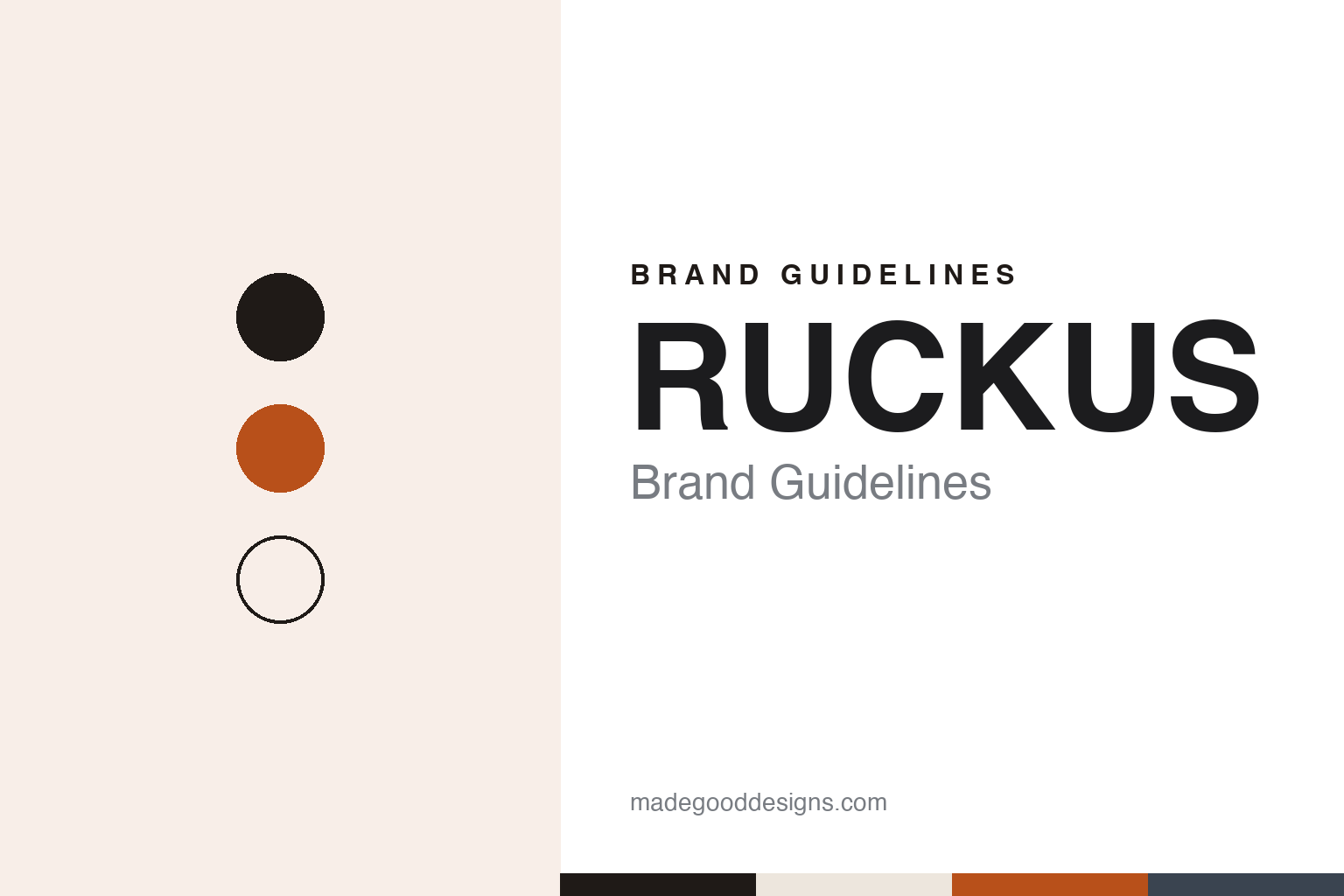
RUCKUS Brand Guidelines
The Wi-Fi maker that began with an antenna that steers itself.
Aa
Two constants: a RUCKUS charcoal and ember palette and a Grotesque sans register. Abstract homage — not a RUCKUS product or mark; no access point, logo or label is reproduced.
Video54
An incubator project about video over Wi-Fi.
RUCKUS began inside a venture firm. English Wikipedia says it started in 2002 as an incubator project funded by Sequoia Capital in Menlo Park, California, and was incorporated in June 2004 as Video54 Technologies by William Kish and Victor Shtrom, with Sequoia, WK Technology Fund and Sutter Hill Ventures as early backers. Network World gave the same founding story in 2009: founded in 2004 as Video54, with the original mission of bringing beamforming to low-cost home Wi-Fi systems built for media distribution.
The early products were about video in the home. English Wikipedia says the company first focused on distributing IPTV content wirelessly inside the house, and in 2007 introduced the MediaFlex USB dongle to connect set-top boxes and media centres. In January 2005, it says, the company licensed its antenna technology to Netgear for that maker’s RangeMax routers. Selina Lo was the first chief executive, according to English Wikipedia, and stayed in the role until the sale to Brocade in 2016.
Around 2008 the business changed direction. English Wikipedia says it turned to enterprises, carriers, education and hospitality, using ZoneDirector controllers built on technology from AirSpider, which it had bought in 2006, and in 2009 it entered city-wide Wi-Fi with an outdoor mesh system. By 2009 Network World described it as a major supplier of wireless media products for carriers and service providers and of enterprise wireless networks under the ZoneFlex brand.
As Ruckus Wireless, the company listed its shares on the New York Stock Exchange on 16 November 2012, TechCrunch reported that day, calling it a Wi-Fi equipment maker and noting that the eight-year-old company had been backed by Sequoia Capital and Sutter Hill Ventures; the debut had been pushed back a week by Hurricane Sandy. English Wikipedia gives its ticker as RKUS. English Wikipedia also lists research centres in Sunnyvale, Taipei, Shenzhen, Tel Aviv and, from 2012, Bangalore.
Colour
Antennas that adapt.
The technical idea at the centre of the brand is BeamFlex, an adaptive antenna system that the company says it pioneered along with adaptive antenna arrays. English Wikipedia describes it as smart antenna technology that adjusts to changes in the radio environment, sold at first to other manufacturers for their own products. In 2009 Network World reported the launch of the ZoneFlex 7962 access point, which used 19 antennas to combine MIMO with beamforming; the magazine’s columnist wrote that Ruckus was the first wireless LAN company to combine the two.
Other named technologies followed. English Wikipedia says the company announced a US patent in 2010 for Dynamic Pre-Shared Key, which gives each user of a network a separate key, and the current RUCKUS website lists DPSK alongside ChannelFly and BeamFlex among its technologies. The range today covers indoor and outdoor Wi-Fi access points, ICX switches inherited from Brocade, the Unleashed line for smaller sites and RUCKUS One, which the company calls a cloud-native platform for network management. Its own pages list hospitality, education, large public venues, healthcare and smart cities among the settings it sells into.
In December 2019 TechCrunch reported that a security researcher had found vulnerabilities in the web interface software of the company’s Unleashed routers, and that the company had since patched them.
The name itself is part of the identity. The company now writes it in capitals, RUCKUS, across its website and press releases, and its “origin story” page describes the brand as “born from a rebellious spirit.” When Arris took the business over in 2017, the executive put in charge, Dan Rabinovitsj, said Arris did not want the brand to disappear “given the cult-like following around the Ruckus brand,” Multichannel News reported.
Typography
Design and documentation.
Networking hardware is mostly bought by people who will never see it in use. Switches sit in locked racks, servers in data-centre aisles, and access points on office ceilings, so the makers rely on a small set of familiar pictures: a rack of switches with rows of lit ports, a white disc fixed to a ceiling tile, a home router with its antennas raised, a long cold aisle of cabinets under strip lighting.
The companies in this group range from makers of home and small-office routers to suppliers of whole data-centre racks, and from long-listed corporations to firms owned through holding companies in Asia. Many design their products in one country and have them built in another, often by contract manufacturers, so what a company says about where its equipment is made is worth reading closely and attributing to the company.
Trade fairs are where much of the industry shows itself. Computex in Taipei, Interop and Mobile World Congress in Barcelona have long been venues for product launches and partner meetings, alongside more specialised events for supercomputing and service providers. Product names do much of the branding work: families of routers, switches and servers carry short names and model numbers that customers learn to read, while the management software that runs them is increasingly sold as a subscription alongside the box.
This guide sets out what can be checked about each brand — who founded it, who owns it now, where it says its products are made, and any regulatory or legal history reported by dated sources — and marks clearly what rests only on the company’s own word.
Aa
A grotesque sans — capitals for a name written in capitals. (Specimen set in Archivo, a sans STAND-IN; NOT the RUCKUS logo.)
RUCKUS
Brocade, Arris, CommScope, Vistance, Belden.
The listed company did not last long. English Wikipedia says Brocade Communications Systems completed its purchase of Ruckus Wireless on 27 May 2016. Within months Broadcom agreed to buy Brocade; that deal was finalised in November 2017, and Broadcom said it would keep Brocade’s storage networking business and sell the IP networking side, including Ruckus.
The buyer was Arris International, the cable equipment maker based in Suwanee, Georgia. Multichannel News reported on 1 December 2017 that Arris had closed its acquisition of the Ruckus Wireless and ICX switch business, about two weeks after Broadcom completed its merger with Brocade. Arris had previously resold Ruckus products; about 1,700 employees joined it, and the business became Ruckus Networks, an ARRIS company, inside a new enterprise networks unit.
Arris itself was then bought. CRN reported in April 2019 that CommScope, the network infrastructure company based in Hickory, North Carolina, had completed its acquisition of Arris, which owned Ruckus. English Wikipedia dates the completion to 4 April 2019.
In January 2026 the structure changed again. CommScope announced on 13 January 2026, in a release carried by TelecomTV, that it had completed the sale of its Connectivity and Cable Solutions business to Amphenol, and that because the CommScope name went with that business, the remaining company would be renamed Vistance Networks from 14 January 2026, as parent of RUCKUS Networks and of Aurora Networks, the new name of its access networks business.
Vistance did not keep RUCKUS for long. English Wikipedia says Belden Inc. agreed on 30 April 2026 to buy RUCKUS from Vistance Networks, and Belden, based in St. Louis, announced on 1 July 2026 that the acquisition was complete. Cabling Install reported the completion on 10 July 2026, noting that RUCKUS had roughly 48,000 customers worldwide, and quoted Belden’s chief executive, Ashish Chand, saying the deal “accelerates our transformation into a full-stack networking solutions provider.” Vistance’s chief executive said the sale would let it focus on Aurora Networks.
For a design guide, RUCKUS shows how a product name and a technology story can carry a brand through a decade of changing owners. Compare Aruba, another enterprise Wi-Fi name, and Cisco. For this guide we use charcoal, an ember orange, slate and sand with a sans, an unofficial interpretation; no product or logo is reproduced.
Explore & save
Keep RUCKUS’s identity on hand — save it to a board in the Made Good inspiration library.
RUCKUS identity set
Pin the RUCKUS charcoal and ember palette and the Grotesque sans register to your own board.