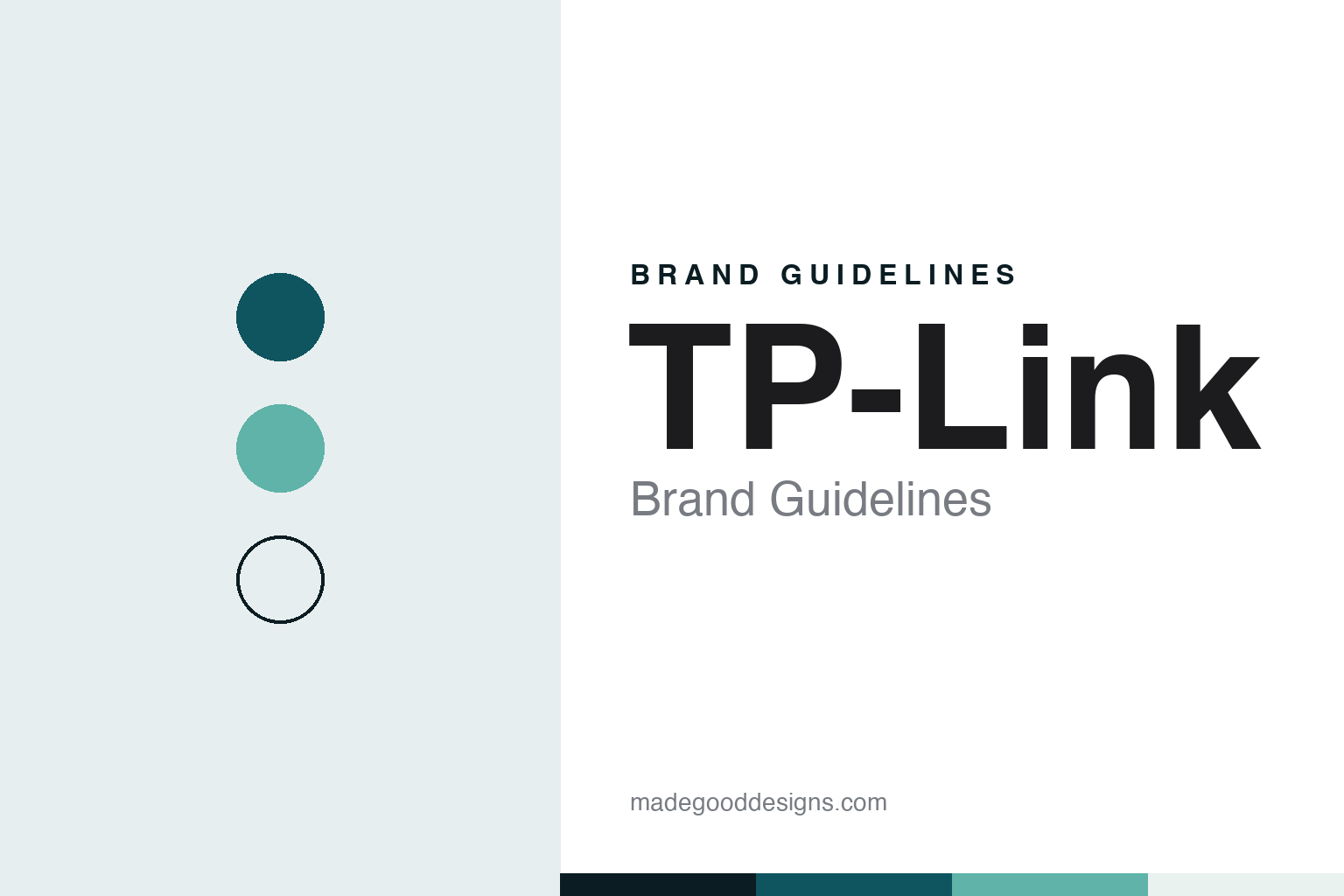
TP-Link Brand Guidelines
The 1996 Shenzhen router maker that redrew itself for the smart home.
Aa
Two constants: a teal, night and mint palette and a rounded geometric sans register. Abstract homage — not a TP-Link product or mark; no router, logo or packaging is reproduced.
Twisted Pair Link
Two brothers, a cable and Shenzhen.
TP-Link was founded in Shenzhen, China, in 1996 by two brothers, Zhao Jianjun and Zhao Jiaxing, the Australian trade site ChannelNews reported in February 2026. The name, the same report says, comes from “Twisted Pair Link,” a reference to the copper network cabling that carries Ethernet: a plain engineering name for a company that began with the parts of a network most people never see.
Growth came from volume and reach. English Wikipedia dates the start of the company’s international expansion to 2005, its move into a large new headquarters in Shenzhen’s Hi-Tech Industry Park to 2007, and the founding of TP-Link USA to 2008. When CNN reported on the company in December 2024, it described a firm “founded in China in 1996” that had grown into a dominant player in the global market for wireless internet routers.
The company’s own US website says simply that TP-Link was “founded in 1996” and supplies distribution to more than 170 countries. It also says the analyst firm IDC has ranked it the number one provider of Wi-Fi devices for twelve consecutive years, a claim it bases on IDC’s quarterly WLAN tracker for the fourth quarter of 2022; we give that as the company’s statement.
The range runs from home to business. Archer routers and Deco mesh systems serve homes; Omada covers business networking; and the US site names seven brands, from Tapo and Kasa to Omada and VIGI, as products of TP-Link Systems Inc. or its affiliates.
Colour
From cabling to the living room.
For its first two decades TP-Link presented itself as a networking company. That changed in August 2016, when it announced a brand redesign. CNET reported that the company wanted to be thought of as a home lifestyle brand, according to a conversation with its president and chairman, Jeffrey Chao. The new logo came with a fresh colour scheme; Chao told CNET that its broad curve and arrow point represent the user interacting with the company. English Wikipedia dates the original logo to 1996–2016.
The redesign was tied to products. CNET reported that TP-Link was investing in research and development for smart-home products in the United States, preparing a smart-home router and smart lightbulbs, and already selling smart plugs controlled through its Kasa app, which worked with Amazon’s Alexa. The same report said TP-Link had developed Google’s OnHub router the year before, and that Chao did not discuss the relationship with Google further. “We’re embarking on a new journey to meet the needs of today’s connected lifestyles,” Chao said.
A decade on, the lifestyle register is visible in how the company names its lines. Deco, Tapo and Kasa read as consumer brands rather than part numbers, while Omada and VIGI address installers and businesses. The company’s newest flagship follows the same pattern: on 30 September 2026 Tom’s Hardware reported that TP-Link had opened preorders for the Archer 8 Ultra, its first Wi-Fi 8 router, built on a Broadcom chipset, in the United Kingdom, Germany, Australia and other markets.
The United States was left off that launch list. Tom’s Hardware said TP-Link had not received the Federal Communications Commission’s Conditional Approval that rivals had obtained, so that earlier certified hardware could still be sold there but new models were effectively blocked. The company told the magazine it planned a Deco 8 Ultra mesh system for the first quarter of 2027 and a Roam 8 travel router for the second.
Typography
Ports, antennas and trade fairs.
Networking hardware is mostly bought by people who will never see it in use. Switches sit in locked racks, servers in data-centre aisles, and access points on office ceilings, so the makers rely on a small set of familiar pictures: a rack of switches with rows of lit ports, a white disc fixed to a ceiling tile, a home router with its antennas raised, a long cold aisle of cabinets under strip lighting.
The companies in this group range from makers of home and small-office routers to suppliers of whole data-centre racks, and from long-listed corporations to firms owned through holding companies in Asia. Many design their products in one country and have them built in another, often by contract manufacturers, so what a company says about where its equipment is made is worth reading closely and attributing to the company.
Trade fairs are where much of the industry shows itself. Computex in Taipei, Interop and Mobile World Congress in Barcelona have long been venues for product launches and partner meetings, alongside more specialised events for supercomputing and service providers. Product names do much of the branding work: families of routers, switches and servers carry short names and model numbers that customers learn to read, while the management software that runs them is increasingly sold as a subscription alongside the box.
This guide sets out what can be checked about each brand — who founded it, who owns it now, where it says its products are made, and any regulatory or legal history reported by dated sources — and marks clearly what rests only on the company’s own word.
Aa
A rounded geometric sans — for a brand that redrew itself in 2016. (Specimen set in Manrope, a sans STAND-IN; NOT the TP-Link logo.)
TP-Link
A split company under scrutiny.
Today TP-Link is two businesses. ChannelNews reported that the company began restructuring in 2022, separating its global business, TP-Link Corporation Group, from TP-LINK Technologies Co., Ltd. in China, and that by May 2024 executives said the global headquarters had moved to Irvine, California. TP-Link Systems Inc. in California and TP-Link Corporation in Singapore say they operate independently of the China-based company, which serves the domestic Chinese market. The company has also said it has made its routers in Vietnam since 2018, Tom’s Hardware reported in October 2026.
That separation has been tested by US authorities. In August 2024 the chairman and ranking member of the House Select Committee on the Chinese Communist Party asked the Commerce Department and other agencies to investigate TP-Link, Tom’s Hardware reported. In December 2024 CNN reported that the Commerce Department had opened a probe in its early stages; a TP-Link Systems spokesperson told CNN that its security practices were “fully in line with industry security standards in the U.S.” and that it welcomed the chance to show this. Tom’s Hardware later reported that the Commerce, Defense and Justice departments had all opened inquiries in 2024.
States followed. In February 2026 the Texas attorney general sued TP-Link Systems in state court, alleging deceptive marketing about security and about its independence from China, a month after a directive barred Texas state employees from using its products, ChannelNews reported; the company has maintained that its global operations are independent. In October 2026 Florida’s attorney general announced a similar suit, and Iowa, Nebraska and Montana had also sued, Tom’s Hardware reported. These are allegations in pending cases. Separately, the FCC has banned imports of new consumer routers from all makers unless they hold a Conditional Approval, which TP-Link had applied for.
For a design guide, TP-Link shows how a component name became a consumer brand, and how a brand’s country of origin can become its hardest design question. Compare NETGEAR, a US maker of home routers, and Cisco. For this guide we use a cable teal, a night tone and a soft mint with a sans, an unofficial interpretation; no product or logo is reproduced.
Explore & save
Keep TP-Link’s identity on hand — save it to a board in the Made Good inspiration library.
TP-Link identity set
Pin the TP-Link teal, night and mint palette and the rounded geometric sans register to your own board.