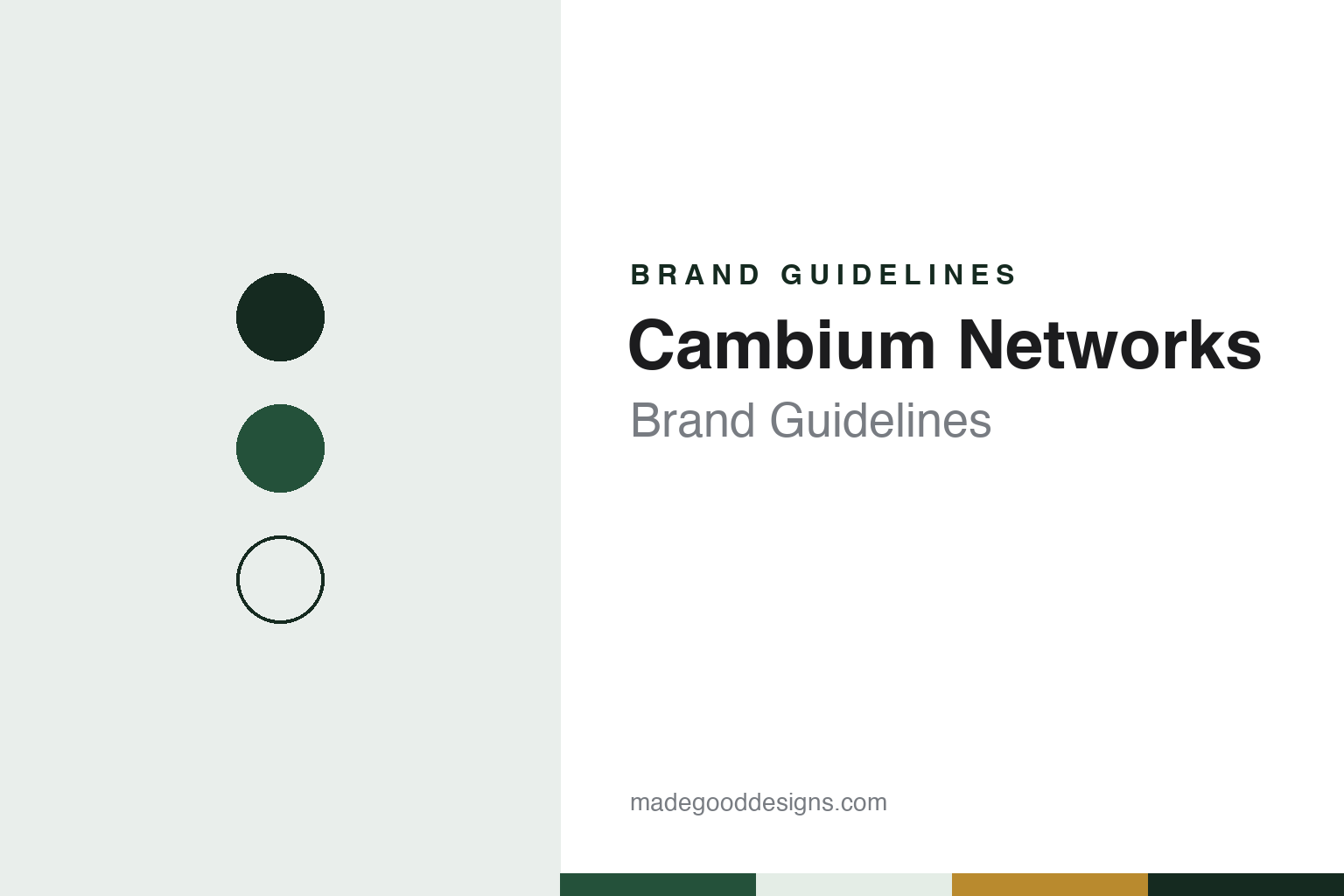
Cambium Networks Brand Guidelines
From Motorola’s Canopy radios to a two-way split in 2026.
Aa
Two constants: a green, mist and ochre palette and an engineering sans register. Abstract homage — not a Cambium Networks product or mark; no radio, logo or nameplate is reproduced.
Out of Motorola
Canopy and Orthogon become one company.
Cambium Networks did not start in a garage. It began as two business units inside Motorola Solutions. On 23 August 2011 Motorola Solutions and the private equity firm Vector Capital announced that Vector would buy Motorola’s point-to-point wireless broadband business, known as Orthogon, and its point-to-multipoint business, known as Canopy, for an undisclosed amount. The press release said Vector intended to run the two as a single standalone company called Cambium Networks, with Phil Bolt, then a Motorola vice president, as chief executive, and that Motorola would keep buying products from it for its public-safety and federal customers. Senior management, sales, supply chain, technical support, product management, marketing and research teams from the two units were to move across to the new company.
English Wikipedia dates the spin-out to October 2011 and notes that the point-to-point radios came from Orthogon Systems, which Motorola had bought in 2006. Cambium carried both families forward and added a third: ePMP. RCR Wireless described ePMP in 2026 as the value line Cambium launched in 2013, built on commodity Wi-Fi chipsets with Cambium’s own scheduling on top, while PMP 450, the premium point-to-multipoint line, was a direct descendant of Canopy, running its own air interface on custom silicon and sold to utilities and critical-communications users as well as to service providers. The two families do not talk to each other, the magazine noted, but both are managed through the same software.
Those radios were sold above all to wireless internet service providers, or WISPs. RCR Wireless wrote that for fifteen years “a WISP tower without a Cambium radio on it was the exception.”
Colour
Fixed wireless, then Wi-Fi and switching.
Cambium grew beyond the tower. In 2019 it bought the Xirrus enterprise Wi-Fi products and cloud services from Riverbed Technology, ChannelVision reported in August that year, adding access points and cloud management for schools, hotels and public venues. English Wikipedia says the company listed on the Nasdaq in June 2019.
By the 2020s the range covered point-to-point backhaul, point-to-multipoint access, Wi-Fi access points, cnMatrix switches and fibre access products, all tied together by cnMaestro, its cloud network management software. The company called this its “ONE Network,” bringing fixed wireless, Wi-Fi, switching and cloud management together. Its global headquarters moved to Hoffman Estates, Illinois, with further offices in San Jose, in the United Kingdom and in Bangalore, according to its contact page.
The listing did not last. Light Reading reported in September 2026 that Cambium had warned in a May 2026 annual filing of “substantial doubt” about its ability to continue as a going concern, and that its shares had been delisted from Nasdaq about three months before and moved to over-the-counter trading.
Then came the collapse. On 11 September 2026 Cambium cut more than half its global workforce, and three days later its UK operating company entered administration, RCR Wireless reported. Light Reading put the layoffs at 260 people, and said the administrators were trying to sell the assets.
Typography
The networking makers.
Networking hardware is mostly bought by people who will never see it in use. Switches sit in locked racks, servers in data-centre aisles, and access points on office ceilings, so the makers rely on a small set of familiar pictures: a rack of switches with rows of lit ports, a white disc fixed to a ceiling tile, a home router with its antennas raised, a long cold aisle of cabinets under strip lighting.
The companies in this group range from makers of home and small-office routers to suppliers of whole data-centre racks, and from long-listed corporations to firms owned through holding companies in Asia. Many design their products in one country and have them built in another, often by contract manufacturers, so what a company says about where its equipment is made is worth reading closely and attributing to the company.
Trade fairs are where much of the industry shows itself. Computex in Taipei, Interop and Mobile World Congress in Barcelona have long been venues for product launches and partner meetings, alongside more specialised events for supercomputing and service providers. Product names do much of the branding work: families of routers, switches and servers carry short names and model numbers that customers learn to read, while the management software that runs them is increasingly sold as a subscription alongside the box.
This guide sets out what can be checked about each brand — who founded it, who owns it now, where it says its products are made, and any regulatory or legal history reported by dated sources — and marks clearly what rests only on the company’s own word.
Aa
An engineering sans for a company of radios and towers. (Specimen set in Barlow, a sans STAND-IN; NOT the Cambium Networks logo.)
Cambium Networks
One brand, two buyers.
The business was sold in two pieces. On 22 September 2026 Airspan Networks Holdings announced it had bought several fixed wireless lines from Cambium Networks Ltd, among them PMP 450, the PTP 670 and PTP 700 backhaul radios and the cnWave millimetre-wave line, along with planning and management software; more than 135 Cambium employees moved across, Light Reading and RCR Wireless reported. ePMP was not part of that deal.
The rest went to India. Cambium says Univastu India Limited, an engineering, procurement and construction company listed on India’s National Stock Exchange, completed its acquisition of Cambium Networks on 14 October 2026, taking the ePMP and Enterprise businesses, including Wi-Fi access points, cnMatrix switches and cnMaestro. Channel Dive reported that Univastu had set up a UK subsidiary on 7 October to buy the remaining assets, and Light Reading reported that Cambium would run as a standalone subsidiary that Univastu plans to use to expand into telecom connectivity. Chief executive Morgan Kurk told Channel Dive that cnMaestro would be split into two versions, each following its own product roadmap. Both buyers now run versions of cnMaestro, according to Cambium’s own FAQ.
So the Cambium Networks name continues, but as a smaller company under new ownership. Its FAQ, updated in November 2026, says Cambium is moving to resume production, that it aimed to restart shipping ePMP and Enterprise orders in the week of 8 November 2026, and that existing warranties will be honoured. It lists the continuing range as ePMP, cnMatrix and NSE alongside Wi-Fi and fibre access products, and says the older Xirrus access points belong to the Wi-Fi business that stayed with Cambium. Analysts quoted by Light Reading called Univastu an unexpected buyer, since it had no earlier record in wireless networking.
For a design guide, Cambium Networks shows how an engineering brand can be split between owners and still keep its name. Compare Ubiquiti, which also sells fixed wireless and Wi-Fi to service providers, and MikroTik. For this guide we use a deep green, a pale mist and an ochre accent with a sans, an unofficial interpretation; no product or logo is reproduced.
Explore & save
Keep Cambium Networks’s identity on hand — save it to a board in the Made Good inspiration library.
Cambium Networks identity set
Pin the Cambium Networks green, mist and ochre palette and the engineering sans register to your own board.