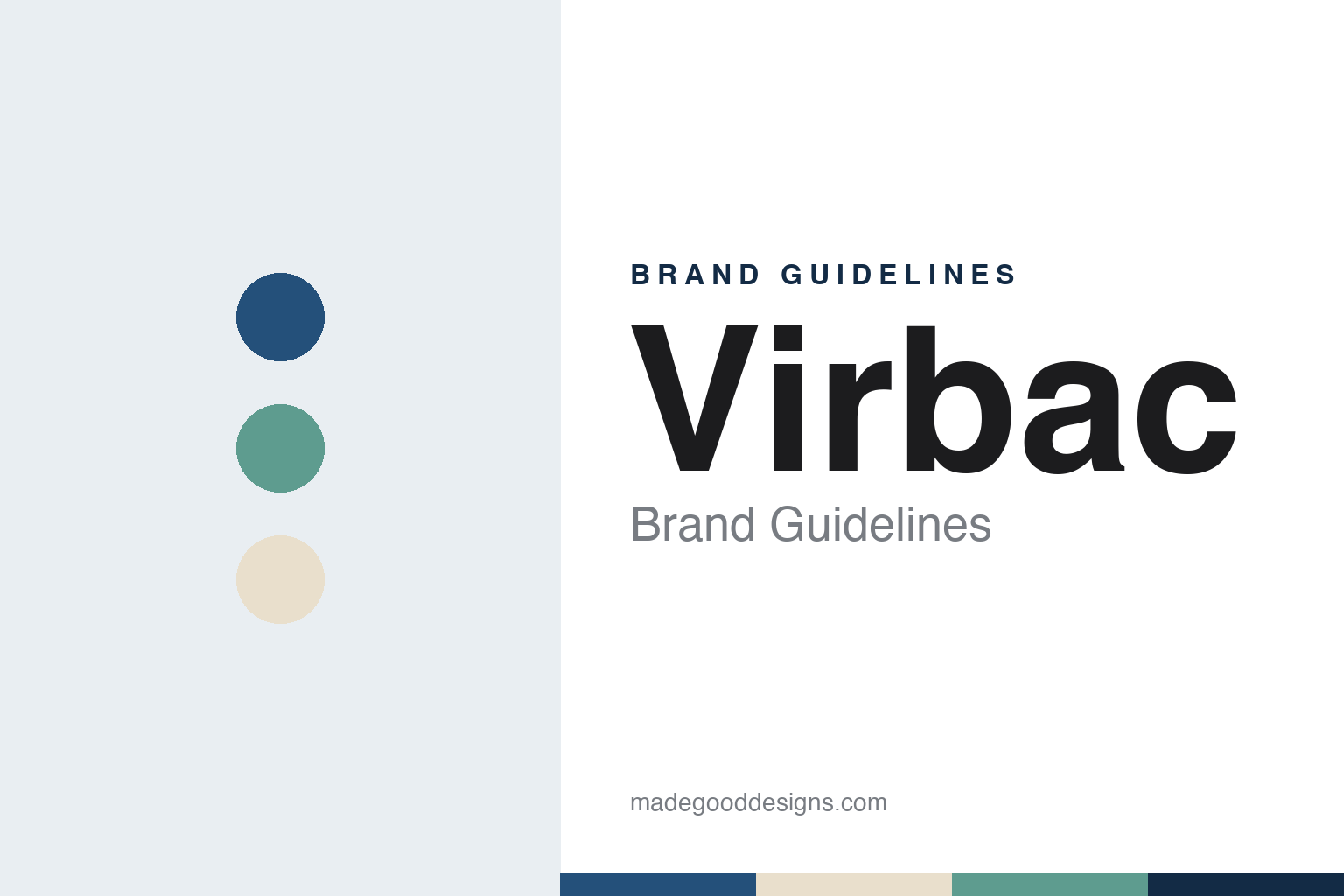
Virbac Brand Guidelines
A Nice veterinarian’s laboratory that became a listed, family-controlled group.
Aa
Two constants: a Riviera blue, sea-glass and sand palette and a clinical sans register. Abstract homage — not a Virbac product or mark; no pack, logo or label is reproduced.
Virology and bacteriology
A veterinarian’s laboratory in a Nice flat.
Virbac began in Nice in 1968. Its founder, the veterinarian Pierre-Richard Dick, had studied microbiology at the Pasteur Institute and become research director at Ronchèse, a biology laboratory in Nice, before leaving in the autumn of 1967 to set up a research laboratory of his own, the company says. He named it from the first letters of virology and bacteriology, an origin that English and French Wikipedia both give. Virbac describes its start as a small biology research centre in a three-room flat in Nice, preparing antibiotic powders for local veterinarians.
Dick’s bet, as Virbac tells it, was on pets. In 1968 France was still largely agricultural and most veterinarians worked with farm animals in the countryside, the company says; it adds that as early as 1969 he wanted dogs and cats to receive the same attention as livestock, and that he built the range around the bond between owners and their animals as well as around farming. A dedicated formulation laboratory followed in the mid-1970s, according to the company, and formulation has remained one of its main areas of know-how.
The business looked abroad early. Virbac says its first steps outside France were in Europe in the 1970s and that its first subsidiary, in Germany, opened in 1982. In 1985 the company was listed on the Paris stock exchange, as both the company and French Wikipedia record. Its headquarters are now at Carros, in the Alpes-Maritimes near Nice, where Le Journal des Entreprises placed the group in April 2025.
Colour
Collars, boluses, vaccines and shampoos.
Virbac works across pets and farm animals. English Wikipedia describes a range of internal and external parasiticides, including collars and pipettes, alongside antibiotics, vaccines and diagnostic tests, and lines for dog and cat nutrition, dermatology, dental hygiene and aquaculture; it also lists reproduction, anaesthesia and electronic identification for pets and horses. In April 2025 Le Journal des Entreprises reported that the group’s companion-animal sales were growing faster than its livestock business, while its aquaculture segment had slipped.
The company’s own history picks out a handful of developments. It says variations of its parasiticide collar have been fitted to almost 300 million dogs and cats over four decades. It says it developed prolonged-release boluses for ruminants with farmers in 1985, and that in 1997 it used micro-encapsulation as the basis for a dermatological shampoo for dogs and cats designed to stay active after rinsing. On the biological side, Virbac says it produced a homologous vaccine for canine parvovirus in 1982 and a genetically engineered feline leukaemia vaccine in 1988, calling both the first of their kind, and it recalls an oral rabies vaccine for foxes that was dropped from helicopters.
Virbac is now an international group. The company says it sells in more than 100 countries and runs production units and research centres on five continents; English Wikipedia, citing company figures, names production in about ten countries, among them France, the United States, Mexico, Brazil and Vietnam. Le Journal des Entreprises gave the workforce as 6,400 in April 2025 and reported that the purchase of Sasaeah, a Japanese animal health company, had closed in April 2024. The same report quoted Virbac as saying that around two-thirds of its United States sales in 2025, and close to 80 percent by the end of 2026, should come from its own production in the United States.
Typography
How the sector presents itself.
Animal health companies speak to several audiences at once: veterinarians in clinics, farmers and producers, and the owners of dogs and cats. Their imagery tends to follow those audiences. A vet examining a dog or a cat on a consulting-room table is one of the most familiar scenes, alongside cattle in a barn, pigs in a pen and flocks of poultry, often shown with the people who look after them.
The products themselves are less photogenic, so the same few objects recur: vaccine vials, syringes, blister packs of tablets, spot-on pipettes and collars, along with laboratory benches, protective clothing and production lines. Many companies in the sector make both medicines for pets and vaccines for livestock, and their websites usually split the range by species rather than by product.
The sector also meets its customers in person. Trade fairs and congresses such as the VMX veterinary conference in Orlando and the World Veterinary Congress are where companies launch products, run booths and sponsor talks, and their stands carry much of the same photography of animals, clinics and farms.
Many of these companies also present themselves through the idea of One Health, which links the health of people, animals and the environment, and through the language of independence, family control or shared ownership where it applies. Ceva, for example, uses the slogan “Together, beyond animal health,” while Virbac points to the family that still controls it. This guide sets out what can be checked about each company: who founded it, who owns it and where it works.
Aa
A clinical sans for a laboratory brand. (Specimen set in Figtree, a sans STAND-IN; NOT the Virbac logo.)
Virbac
Listed since 1985, still a family company.
Virbac is listed but family-controlled. Its investor pages describe it as “a family controlled company, listed on Euronext Paris since 1985,” and say the family of Pierre-Richard Dick holds 66.21 percent of the voting rights; French Wikipedia gives the family’s share of the capital as just over half. The board is chaired by Marie-Hélène Dick-Madelpuech, the founder’s youngest daughter and herself a veterinarian, according to English and French Wikipedia and the company’s governance page, which also lists Pierre Madelpuech as vice-chairman and further family members among the board and its advisers.
Day-to-day management sits with a separate executive team. English Wikipedia, citing L’Usine Nouvelle and Boursier of June 2025, says Paul Martingell was named chief executive that month, to take over in September 2025, after Sébastien Huron resigned in September 2024 and Habib Ramdani served as interim chief; the company’s governance page now names Martingell as chief executive, with Ramdani as deputy and chief financial officer. Virbac says the board and management work collegially and that it uses France’s Afep-Medef governance code as its reference.
The company’s own language leans on continuity. Its corporate site says that, present in more than 100 countries, it has “maintained our independence and our essence,” and French Wikipedia records the slogan “Shaping the future of animal health.” Virbac’s history page ties its range to the care of companion and farm animals and to the link between people, animals and their environment.
For a design guide, Virbac shows how a founder’s laboratory can grow into an international listed group while the family keeps the controlling vote. Compare Ceva Santé Animale, another French animal health company, majority-owned by its managers and staff, and Vetoquinol, another French veterinary group. For this guide we use a Riviera blue, a sea-glass green and warm sand with a sans, an unofficial interpretation; no product or logo is reproduced.
Explore & save
Keep Virbac’s identity on hand — save it to a board in the Made Good inspiration library.
Virbac identity set
Pin the Virbac Riviera blue, sea-glass and sand palette and the clinical sans register to your own board.


