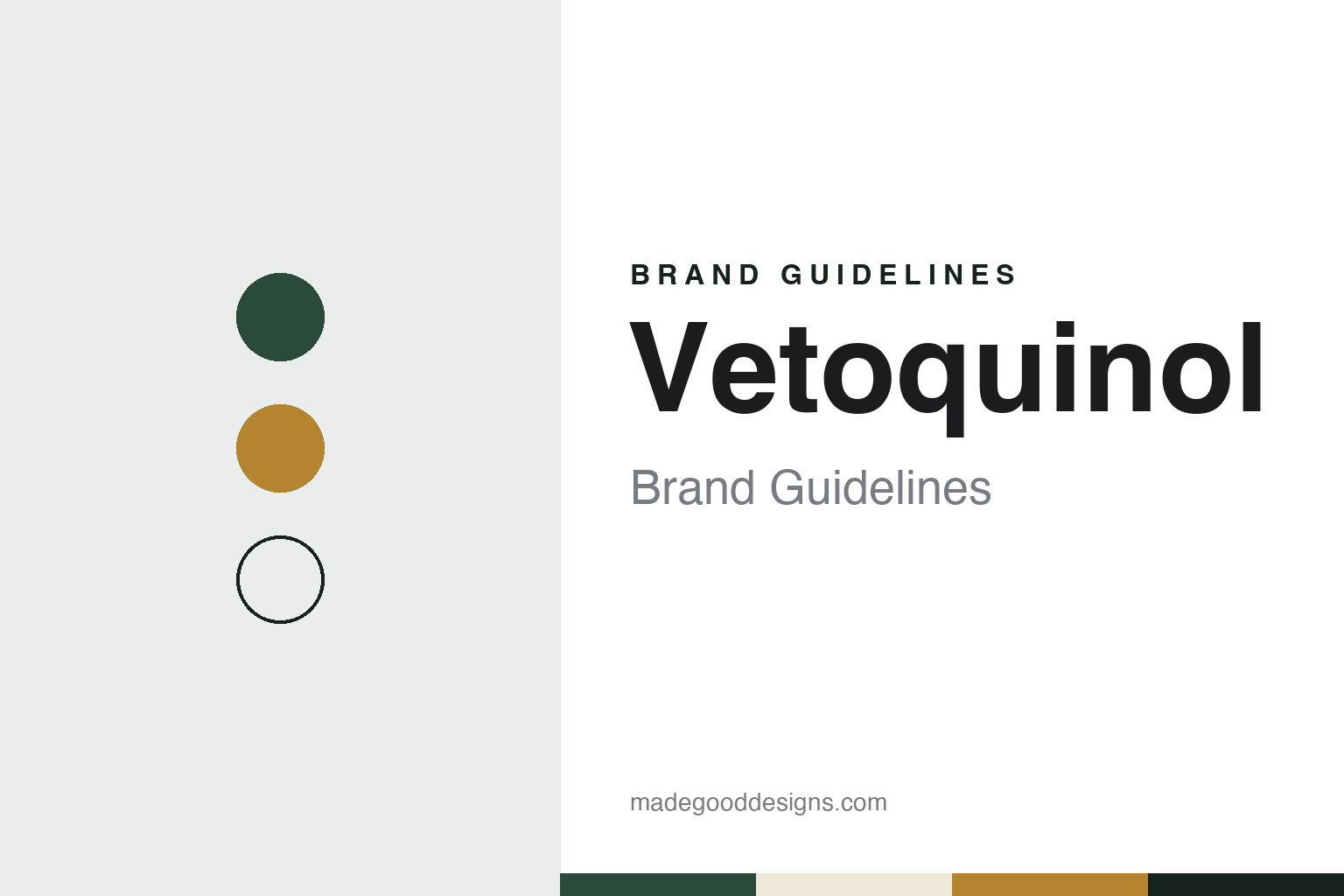
Vetoquinol Brand Guidelines
A pharmacy antiseptic that became a family veterinary group.
Aa
Two constants: a forest, oat and ochre palette and a bookish serif register. Abstract homage — not a Vetoquinol product or mark; no pack, logo or label is reproduced.
Lure
An antiseptic behind a pharmacy counter.
Vetoquinol began in 1933 in Lure, a small town in the Haute-Saône in eastern France. French Wikipedia says Joseph Frechin founded the business as the Laboratoires Biochimiques de l’Est, which at first worked in human pharmacy, and that its first veterinary product was an antiseptic based on oxyquinoline, called vétoquinol. The Korean veterinary trade paper Dailyvet, reporting on the company’s 90th anniversary in June 2023, describes Joseph Frechin as a pharmacist who ran a pharmacy in Lure.
The company tells the story in more detail. In its anniversary history of January 2023 it says Joseph Frechin made human medicines behind his pharmacy and in 1933 bought a stock of four tonnes of oxyquinoline to help a chemist friend. He then had the idea of using the antiseptic on animals, the company says, and asked his father, Charles, a veterinarian known in the region, to test it. The product was sold as soluble tablets, gels and ointments under the name Vetoquinol, which later became the name of the company.
The company’s anniversary history passes over the Second World War and picks up after it, when, it says, farmers had to rebuild livestock herds to feed the population and needed veterinary care to do so.
Colour
Magny-Vernois and the second generation.
Sources give slightly different accounts of the 1960s. French Wikipedia says Vétoquinol S.A. was created in 1962 to work only in animal health, with its head office and factory at Magny-Vernois, a village near Lure. The company says that in 1962 it added a veterinary department called Vetoquinol to its pharmaceutical business, employing more than 80 people, and that the move to Magny-Vernois followed after Étienne Frechin, Joseph’s son, joined in 1963 to lead its development. Both accounts put the group at Magny-Vernois, where it remains; by the time of the move, the company says, it had about 100 employees.
Under Étienne Frechin, the company says, it expanded internationally and built subsidiaries on five continents. French Wikipedia says the group now sells in about a hundred countries across Europe, the Americas and Asia-Pacific, with a targeted presence of its own in 24 of the largest animal-health markets. The company describes itself as an “independent pure player” in animal health, growing both through its own products and through acquisitions in markets it considers promising, and reported more than 2,500 employees at the end of 2022. French Wikipedia records that by 2019 it had seven industrial sites — two in France, two in Brazil, one in Canada, one in Italy and one in Poland — and a Polish arm, Vetoquinol-Biowet, with offices in Gorzów Wielkopolski. It sells medicines and non-medicinal products for farm animals such as cattle and pigs and for dogs and cats, and, French Wikipedia says, it concentrates on four areas: parasite treatments, mobility, dermatology and dairy cows.
Its product names include Zylkène, Marbocyl and Flexadin, which Dailyvet listed among the ranges sold by its Korean subsidiary, and Equistro, a range of nutritional products for horses that French Wikipedia names. The same Dailyvet report said the Korean arm had launched several companion-animal products over the previous two years, including Flexadin Advanced for cats and a larger Zylkène format, alongside antibiotics, kidney-support supplements such as Azodyl and Ipakitine, and a range for farm animals. French Wikipedia calls Vetoquinol the world’s eighth-largest veterinary laboratory; the company itself says it is among the world’s top ten animal health companies.
Typography
How the category presents itself.
Animal health companies speak to several audiences at once: veterinarians in clinics, farmers and producers, and the owners of dogs and cats. Their imagery tends to follow those audiences. A vet examining a dog or a cat on a consulting-room table is one of the most familiar scenes, alongside cattle in a barn, pigs in a pen and flocks of poultry, often shown with the people who look after them.
The products themselves are less photogenic, so the same few objects recur: vaccine vials, syringes, blister packs of tablets, spot-on pipettes and collars, along with laboratory benches, protective clothing and production lines. Many companies in the sector make both medicines for pets and vaccines for livestock, and their websites usually split the range by species rather than by product.
The sector also meets its customers in person. Trade fairs and congresses such as the VMX veterinary conference in Orlando and the World Veterinary Congress are where companies launch products, run booths and sponsor talks, and their stands carry much of the same photography of animals, clinics and farms.
Many of these companies also present themselves through the idea of One Health, which links the health of people, animals and the environment, and through the language of independence, family control or shared ownership where it applies. Ceva, for example, uses the slogan “Together, beyond animal health,” while Virbac points to the family that still controls it. This guide sets out what can be checked about each company: who founded it, who owns it and where it works.
Aa
A bookish serif for a family laboratory. (Specimen set in Source Serif 4, a serif STAND-IN; NOT the Vetoquinol logo.)
Vetoquinol
Listed, but still a family business.
Vetoquinol joined the Paris stock market, then NYSE Euronext Paris, in 2006, French Wikipedia says, and the company’s 2023 releases describe it as listed on Euronext Paris since 2006. Listing did not end family control. French Wikipedia, citing the market-data site Zonebourse, lists the Frechin family as holding about two-thirds of the shares in May 2026, and names Soparfin as the parent company.
The third generation runs the business. Dailyvet reported in 2023 that Matthieu Frechin, Joseph’s grandson, had led the company as chief executive since 2010; the company says he joined in April 2001, and that the family aims to keep the company independent and its main activity in Lure. Its June 2023 release describes the 90th-anniversary celebration held at Lure on 16 June 2023, attended by more than 700 employees and retirees, with Étienne Frechin speaking as group chairman and the group’s 24 subsidiaries joining by video. The release shows teams marking the day in Trois-Rivières in Canada, near Mumbai in India, in Tokyo and in Seoul; Dailyvet described the Korean team’s celebration on the Han River the same week. The company gives its mission as “To enrich the lives of People through dedication to animal health and welfare.” French Wikipedia gives its slogan as “Achieve More Together.”
For a design guide, Vetoquinol shows how a company can keep a product name, a home town and a family at its centre for more than 90 years while operating worldwide. Compare Virbac, another French veterinary group with a controlling family, and Boehringer Ingelheim, a family-owned German pharmaceutical group. For this guide we use a forest green, an oat and an ochre with a serif, an unofficial interpretation; no product or logo is reproduced.
Explore & save
Keep Vetoquinol’s identity on hand — save it to a board in the Made Good inspiration library.
Vetoquinol identity set
Pin the Vetoquinol forest, oat and ochre palette and the bookish serif register to your own board.