Dechra Brand Guidelines
A Staffordshire buy-out that became a global veterinary specialist.
Aa
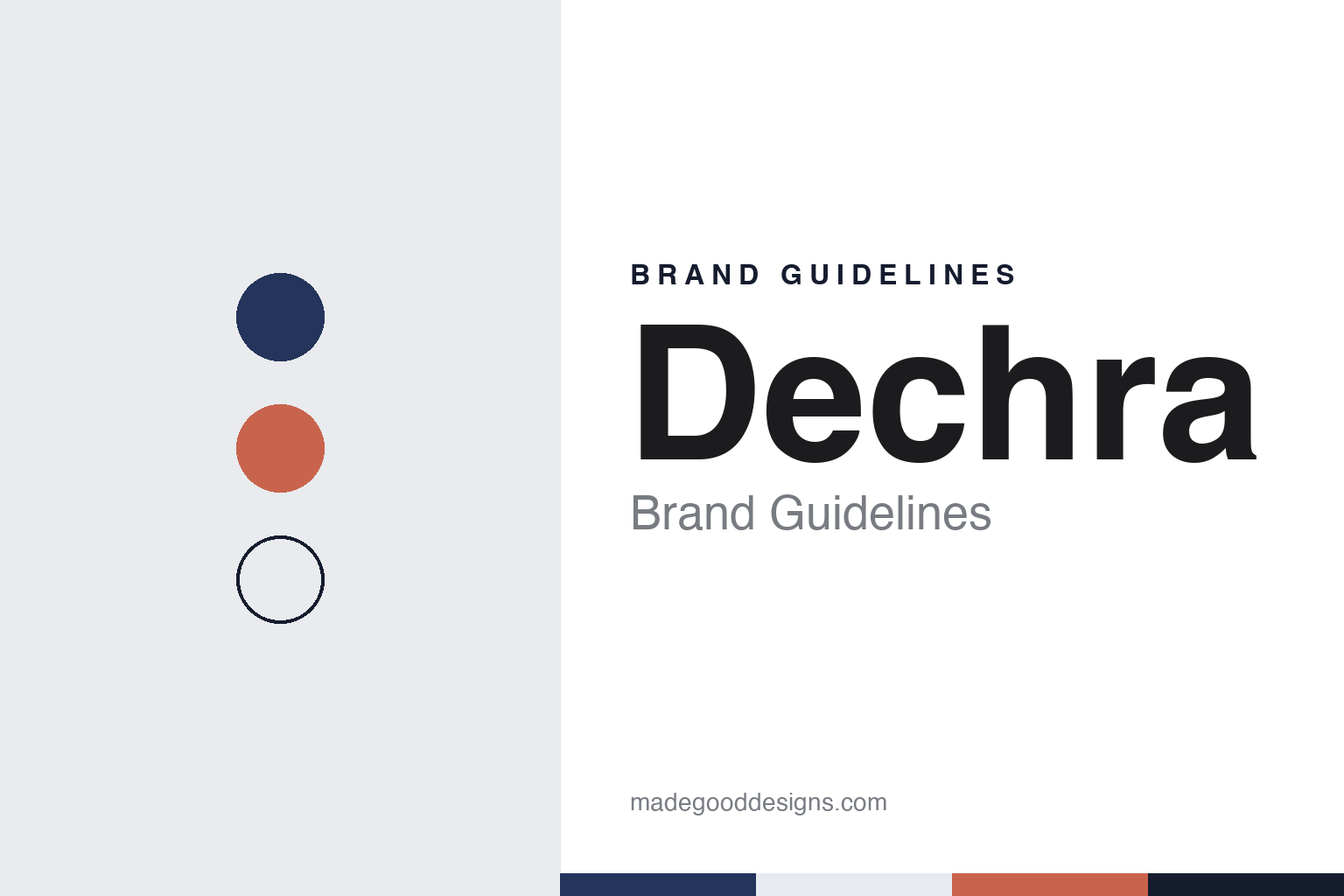
Two constants: a navy, mist and coral palette and a geometric sans register. Abstract homage — not a Dechra product or mark; no pack, logo or label is reproduced.
NVS
A wholesaler, a buy-out and a new name.
Dechra grew out of a veterinary wholesaler. According to the company history of National Veterinary Services, the business was founded in August 1989 as National Veterinary Supplies by Peter Ashton, his uncle Alan Ashton and Paul Hill, and its first employee was Ian Page, who later ran Dechra. By 1992, NVS says, it had about a seventh of its market, and that year it was bought by the pharmacy group Lloyds Chemists. In 1994 it bought Southern Veterinary Services and West Midland Veterinary Supplies, and in 1995 it moved from Fenton into a 50,000-square-foot warehouse at Talke, near Stoke-on-Trent.
The group itself dates from 1997. That year, NVS’s history says, a management team bought NVS, Arnolds and Dales Pharmaceuticals out of the Lloyds Chemists Group, and the new group was named “Dechra.” English Wikipedia also gives 1997 and describes the deal as a management buy-out from Lloyds Chemists.
Dechra joined the London Stock Exchange in September 2000 and entered the FTSE 250 in December 2008, NVS says. Business Live, reporting in June 2023, gave the 2000 flotation and quoted the company’s then chair describing how Dechra had developed from “a specialist UK only veterinary distribution business” into a global veterinary pharmaceuticals business. Business Live called it a North Staffordshire company in its report on the Genitrix purchase and “Northwich-based” in 2023.
Colour
From distribution to medicines.
The shift from wholesaling to making and selling its own medicines came through acquisitions. English Wikipedia lists the Danish veterinary products business VetXX in 2007, the Florida dermatology specialist DermaPet in 2010 and, the same year, Genitrix of Sussex. Business Live reported that Genitrix brought equine and companion-animal products to Dechra’s UK range, including a newly approved product for dogs with epilepsy, Libromide.
In July 2013 Dechra sold its veterinary services business to the American firm Patterson Companies, English Wikipedia says, to concentrate on manufacturing; NVS, which still trades as a veterinary distributor, dates its own sale to Patterson to August 2013.
English Wikipedia names two of the group’s products as notable: Vetoryl, a medicine for Cushing’s disease in dogs, and Felimazole, a medicine for hyperthyroidism in cats. The company says its products cover companion animals, horses and food-producing animals, and that it also sells a range of specialist therapeutic pet diets under the Specific brand.
Dechra describes itself as working in 27 countries with more than 2,700 employees. It says about half of what it sells is made in-house across five manufacturing sites — at Skipton in England, Bladel in the Netherlands, Zagreb in Croatia, Fort Worth in Texas and a smaller site at Somersby in Australia — and the rest by contract manufacturers, with a distribution centre at Uldum in Denmark. It organises its sales into three commercial divisions: North America, which it calls the largest in the group; Europe, the Middle East and Africa, where it names France, Germany, Poland, Spain and the UK as key markets; and an International division covering Asia-Pacific and Latin America, with its own companies in Australia, New Zealand, South Korea, Brazil and Mexico. A separate research and development division handles product development and the regulatory work of keeping product licences in force in each country. In November 2026 it announced plans for an aseptic manufacturing facility in East Windsor, New Jersey, in a building completed in 2019, which it expects to be fully operational in 2028.
Typography
How the category presents itself.
Animal health companies speak to several audiences at once: veterinarians in clinics, farmers and producers, and the owners of dogs and cats. Their imagery tends to follow those audiences. A vet examining a dog or a cat on a consulting-room table is one of the most familiar scenes, alongside cattle in a barn, pigs in a pen and flocks of poultry, often shown with the people who look after them.
The products themselves are less photogenic, so the same few objects recur: vaccine vials, syringes, blister packs of tablets, spot-on pipettes and collars, along with laboratory benches, protective clothing and production lines. Many companies in the sector make both medicines for pets and vaccines for livestock, and their websites usually split the range by species rather than by product.
The sector also meets its customers in person. Trade fairs and congresses such as the VMX veterinary conference in Orlando and the World Veterinary Congress are where companies launch products, run booths and sponsor talks, and their stands carry much of the same photography of animals, clinics and farms.
Many of these companies also present themselves through the idea of One Health, which links the health of people, animals and the environment, and through the language of independence, family control or shared ownership where it applies. Ceva, for example, uses the slogan “Together, beyond animal health,” while Virbac points to the family that still controls it. This guide sets out what can be checked about each company: who founded it, who owns it and where it works.
Aa
A geometric sans for a medicines maker. (Specimen set in Manrope, a sans STAND-IN; NOT the Dechra logo.)
Dechra
From the stock market to private ownership.
Dechra’s years as a listed company ended in 2024. In June 2023, Business Live reported, the board agreed a takeover by the Swedish private equity firm EQT, which was bidding together with the Abu Dhabi Investment Authority; an EQT partner told the paper that Dechra was “a high-quality, innovative business founded in the UK with an impressive global footprint,” and that private ownership would let management take a longer-term view; the newspaper said that, if shareholders backed it, it would be one of the biggest take-private deals in the UK that year so far. English Wikipedia says the necessary competition and regulatory approvals were confirmed in December 2023 and that the deal completed on 16 January 2024, ending its London listing.
The biggest change since then has been geography. In March 2026 the company announced that it would move its global headquarters from Northwich, England, to Boston, taking more than 28,000 square feet in the city’s Seaport District and folding its American offices in Kansas City, Kansas, and Portland, Maine, into a remote-first model. The company said most employees would keep working remotely or in hybrid arrangements, with the Boston office used for global meetings and collaboration. It celebrated the official opening of the Boston office in June 2026, with chief executive Jesper Nordengaard based there. The company now calls itself “a global leader in veterinary specialty care”; that is its own description. Dechra’s website keeps a long list of country sites, from the UK and Ireland to Brazil, Mexico and Australia, under one name.
For a design guide, Dechra shows how a name coined for a 1997 buy-out can carry a business through flotation, a sale of its founding wholesaler, private-equity ownership and a move across the Atlantic. Compare Zoetis, another animal-health company spun out of a larger group, and Elanco. For this guide we use a harbour navy, a mist grey and a clay coral with a sans, an unofficial interpretation; no product or logo is reproduced.
Explore & save
Keep Dechra’s identity on hand — save it to a board in the Made Good inspiration library.
Dechra identity set
Pin the Dechra navy, mist and coral palette and the geometric sans register to your own board.