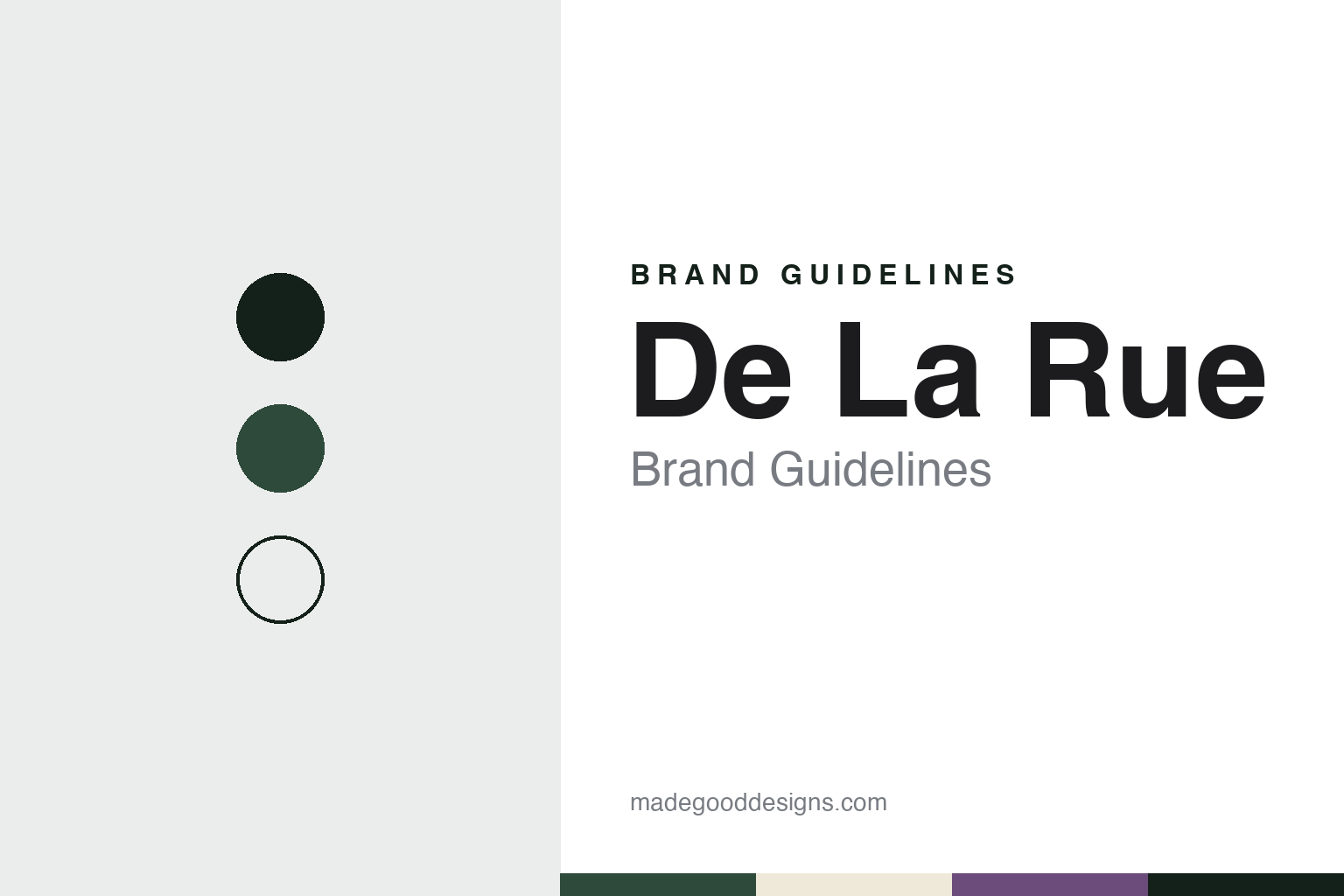
De La Rue Brand Guidelines
The Basingstoke banknote printer with Guernsey roots.
Aa
Two constants: a De La Rue green and violet palette and an Engraved serif register. Abstract homage — not a De La Rue product or mark; no banknote, logo or security feature is reproduced.
Thomas de la Rue
From straw hats to playing cards.
De La Rue begins with Thomas de la Rue, a Guernsey man who moved to London in 1821. English Wikipedia says he first set up as a maker of Leghorn straw hats, then as a stationer and printer. Playing cards came early: English Wikipedia says he secured a Royal Warrant to produce them in 1831, while the company history in the International Directory of Company Histories, published online by FundingUniverse, dates the start of card printing to 1830. English Wikipedia adds that De La Rue’s card designs of 1843 became the basis of the standard pattern still used today.
Security printing followed. The company began printing postage stamps in 1855, including, by the FundingUniverse account, its first British stamp and stamps for the East India Company, and in 1860 it won its first banknote contract, for Mauritius. Its works stood at Bunhill Row in London. In 1881, English Wikipedia says, it developed the fountain pen later sold as the Onoto; pen production in Britain ended in 1958.
The family partnership became a private company in 1896, and in 1921 the family sold its interests. Sources differ on the next step: the FundingUniverse history says the company went public in 1921, while English Wikipedia dates its first London Stock Exchange listing to 1947. Its name changed from Thomas De La Rue & Company to The De La Rue Company in 1958, and to De La Rue plc in 1991.
The war years reached both ends of the business. In the 1930s, by the FundingUniverse account, De La Rue printed for the Chinese market from a factory built quietly in the French settlement of Shanghai, with a reserve plant in Rangoon; as the war spread it moved that work to Rangoon and then to Bombay. In London its Bunhill Row works were destroyed in the Blitz in 1940, and the company resumed printing elsewhere by offset lithography and, by that account, met all its commitments.
Colour
Paper, presses and the cash-handling years.
After the war De La Rue grew by acquisition. The FundingUniverse history lists the purchase of its long-standing rival Waterlow and Sons in 1961; English Wikipedia and that history both record De La Rue Giori, a joint venture formed in 1965 with the Italian printer and inventor Gualtiero Giori in Switzerland to build banknote printing machinery. In 1968 the Rank Organisation bid for the company, and the Monopolies Commission blocked the bid as against the public interest. The playing-card business was sold to John Waddington in 1969.
For a time De La Rue was also a cash-handling machine maker. The FundingUniverse history records its purchase in 1974 of Crosfield Electronics, then a maker of banknote handling systems, and in 1992 of Inter Innovation, a Swedish maker of automated currency handling machines; it also joined the Camelot consortium, which won the UK National Lottery licence in 1994. English Wikipedia says the cash-handling division, Cash Processing Systems, was sold to Privet Capital in 2016.
Paper was the other half of a banknote. In 1995 De La Rue bought Portals, the paper maker that, English Wikipedia says, had made banknote paper for the Bank of England since 1724; the FundingUniverse history credits Portals with weaving a fine security thread into its paper in 1940, a method that became standard practice. In 1997 it bought Harrison and Sons, the stamp and banknote printer of High Wycombe, and in 2003, English Wikipedia says, it took over the Bank of England’s banknote printing operation at Debden. The paper business was sold in 2018, with De La Rue keeping a small share, and its identity business went to HID Global in 2019.
Typography
Design and documentation.
Cash-handling makers sell machines that most people meet without ever choosing them. Their products appear in bank lobbies and in the walls of branches, behind teller counters as cash recyclers, beside supermarket tills as coin counters, and in the printing halls where banknotes are made. The maker’s name is often a small plate on a large machine, so the brand does much of its work in brochures, trade stands and service contracts rather than on the street.
The machines themselves come in families. NCR’s first serious ATM generation, the 5070 of 1983, was developed at its Dundee plant in Scotland and came in lobby and through-the-wall versions, with modules that could be taken out for repair or refilling, according to English Wikipedia. That modular build lends itself to cutaway diagrams, which trace the path a note takes through a machine from cassette to dispenser.
Trade fairs and bank technology conferences are where new machines are shown. Diebold demonstrated a cash machine prototype at the American Bankers Association’s annual meeting in 1966, and in October 2015 showed two ATM concepts at the Money20/20 show in Las Vegas, English Wikipedia says. The ATM Industry Association gives its own awards, which makers list on their websites.
Ownership in this sector changes often. Diebold took over Germany’s Wincor Nixdorf in 2016, NCR split off its ATM business as NCR Atleos in 2023, and in February 2026 the cash carrier Brink’s agreed to acquire NCR Atleos, ATM Marketplace reported. This guide sets out what can be checked about each brand — who founded it, who owns it and where its machines are made — and marks clearly what rests on the company’s own word.
Aa
An engraved serif — the register of a banknote printer. (Specimen set in Libre Caslon Text, a serif STAND-IN; NOT the De La Rue logo.)
De La Rue
From a listed group to a private printer.
The last few years narrowed De La Rue to currency. English Wikipedia says that in February 2024 it was contracted, alongside the Bank of England, to design new banknotes carrying the portrait of King Charles III, and that in October 2024 it agreed to sell its authentication business, which covered government revenue technology, brand protection and identity security, to Crane NXT.
The company itself then changed hands. In June 2025 Alliance News, published by AJ Bell, reported that the takeover of De La Rue, which it described as a Hampshire-based banknote and security document printer, by the American private equity firm Atlas Holdings had been cleared in the UK and in Malta and approved by shareholders, with completion set for 2 July and the shares to leave the London market the next day. English Wikipedia gives the completion date as 3 July 2025. On 23 July 2025 the Canadian trade title PrintCAN reported the takeover completed, describing De La Rue as a maker of banknotes and banknote polymer with its UK headquarters in Basingstoke and sites in the United States, Brazil and China. De La Rue is now privately owned.
Its work today, as English Wikipedia describes it, is banknotes, polymer substrate for banknotes, and security features such as holograms and threads, sold to central banks and other issuing authorities. English Wikipedia and the FundingUniverse history both describe it as a leading commercial banknote printer. Its components also turn up inside other makers’ machines: Triton’s 9700 ATM, by Triton’s account, came with a De La Rue dispensing mechanism.
For a design guide, De La Rue shows how a printer of other people’s money builds its own identity from two centuries of engraving, paper and royal warrants rather than from a consumer product. Compare Crane Payment Innovations, another name in the cash-handling chain, and Triton, whose 9700 carried its dispenser. For this guide we use a deep green, a warm note-paper cream and a violet with a serif, an unofficial interpretation; no product or logo is reproduced.
Explore & save
Keep De La Rue’s identity on hand — save it to a board in the Made Good inspiration library.
De La Rue identity set
Pin the De La Rue green and violet palette and the Engraved serif register to your own board.