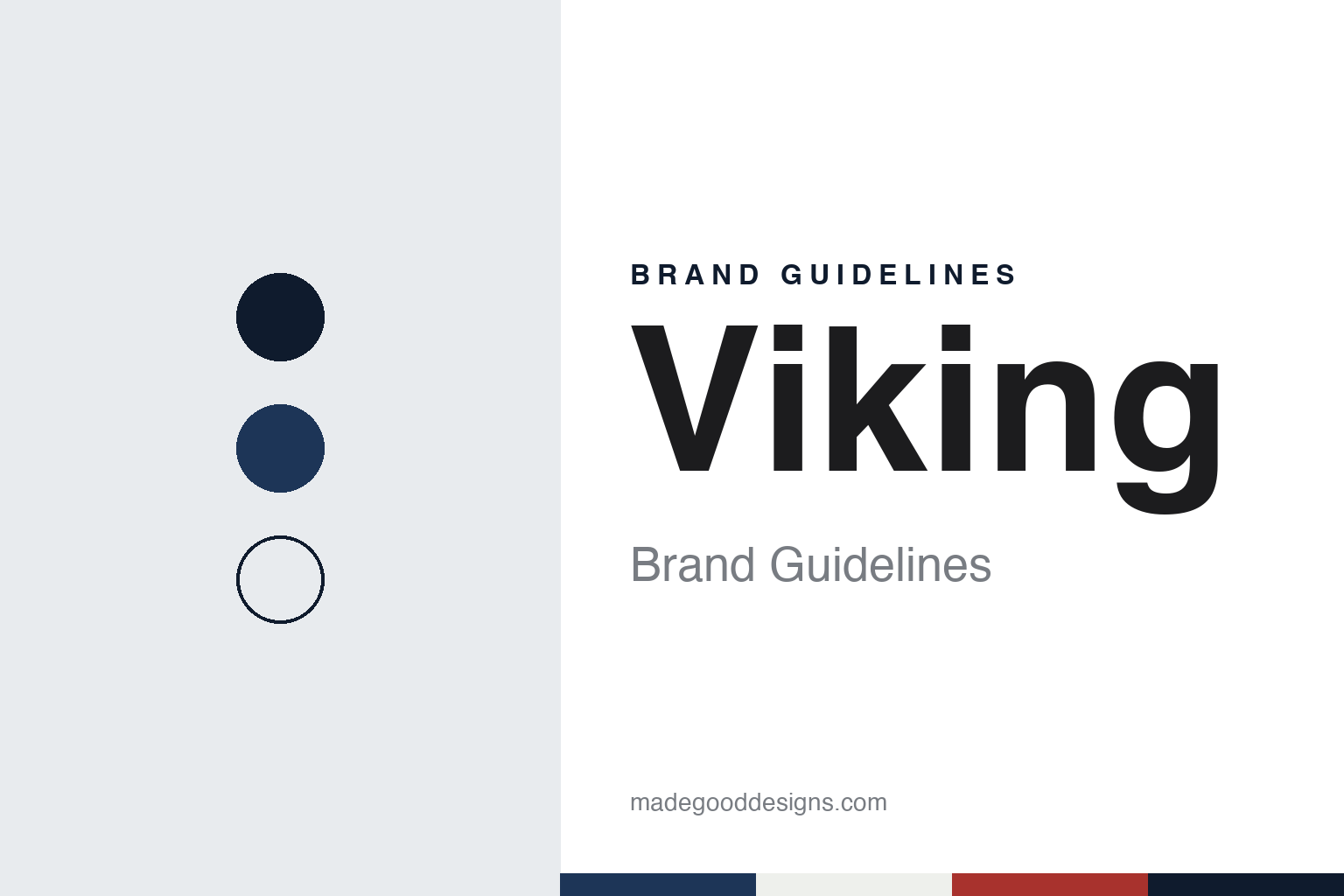
Viking Brand Guidelines
Emil Tyden’s Hastings sprinkler maker, part of Minimax Viking.
Aa
Two constants: a Viking navy, red and white palette and an industrial sans register. Abstract homage — not a Viking product or mark; no sprinkler, logo or label is reproduced.
A seal maker in Hastings
A railroad seal, a factory fire and a sprinkler firm.
Viking’s story starts with a seal rather than a sprinkler. The company says Emil Tyden, a Swedish immigrant, developed a railroad car seal in Chicago in the 1880s and in the late 1890s moved to Hastings, Michigan, where he set up a company to make the patented seals. The company calls it the International Seal and Lock Company; Industry Today, profiling Viking in November 2001, named it the Tyden Seal Company and dated it to 1897.
A fire turned Tyden toward fire protection. The company says a fire destroyed his factory in 1920, after which he resolved to enter the sprinkler business. He was introduced to a St. Louis businessman who said he had designs for sprinklers and valves; when that business ran into trouble, Tyden bought all of The Viking Corporation and began making sprinklers and valves in Hastings. Industry Today gave a shorter version, quoting the then president, Bill Maddox: Tyden found the bids to protect his factory expensive and decided he could design a system himself.
The business stayed with the founding family for most of the century. In 2001 Industry Today described Viking as family-owned and run by the fourth generation of Tyden’s family, with about 7,000 products. It listed the company’s markets as office buildings, hotels and shopping malls, warehouses and factories, and schools and student housing, with residential work added since the 1980s and a special-hazards business ranging from computer rooms to aircraft hangars and power plants.
The same article described how Viking presented its quality work: a sprinkler design sealed with a Belleville spring and a low-zinc alloy frame, ISO 9002 certification, and in-house test facilities used to check products against the requirements of approval bodies such as Underwriters Laboratories and FM Global. It also named public buildings in several countries that the company said used its products.
Colour
Sprinklers, valves and the contractor trade.
Viking sells mainly to fire sprinkler contractors rather than to building owners. Industry Today described the chain in 2001: Viking supplies the components, and the sprinkler contractors who install them typically work with general or mechanical contractors on construction projects. Today the company says the group is made up of The Viking Corporation, which designs and makes the products; Viking Fabrication Services, which threads, grooves and welds pipe to order; Viking SupplyNet, with more than 30 storefronts in North America; and Viking Plastics, which works with BlazeMaster CPVC pipe and fittings.
The product list on the company’s website runs from sprinklers, including standard, extended-coverage, storage, residential and dry-barrel types, to valves and riser assemblies, wet, dry, deluge and preaction systems, foam systems including fluorine-free foam, and the Oxeo clean-agent system. One named system appears in both the 2001 profile and the current range: Firecycle, which Industry Today described as a system that responds to heat and cycles the water off and on again as needed.
The same profile described other products then in the range: pre-assembled TotalPac system packages; a Grate Nozzle, an in-floor device developed with the US military to spread a foam-water solution in aircraft hangars without fittings that protrude into the floor; and a concealed sidewall sprinkler with a low profile aimed at student housing. The company’s website now lists EasyPac riser assemblies, data-centre systems and design software among its resources.
Typography
How the category presents itself.
Fire protection makers sell to engineers, contractors, insurers and building owners rather than to shoppers, and their pictures tend to show the product at work in a building. A common image is the sprinkler head in close-up: a small brass or chrome fitting, often with a coloured glass bulb, photographed against a ceiling. Another is the pipework itself, grooved or threaded, running in red-painted lines above warehouse racking or through a plant room.
Suppression systems are shown in the rooms they are designed for. Catalogues and project pages picture rows of gas or water-mist cylinders standing in a side room next to a server hall, a control room or an archive, with pipes leading off to nozzles in the ceiling. Detectors and alarm panels appear in the same matter-of-fact way: a round detector head on a plain ceiling, a call point on a corridor wall, a panel with its status lights in a plant room.
Testing and training make up much of the rest of the imagery. Makers and their distributors publish photographs of test rigs, live-fire demonstrations and installer courses, and many list training centres and technical schools alongside their products. Approvals and listings from testing bodies are usually printed on data sheets and in catalogues.
The trade meets at shows. The NFPA Conference & Expo in the United States and Firex in London are among the events where makers set out sprinklers, valves, cylinders and panels on stands for contractors and engineers. The brands in this guide range from privately held specialists to units of large building-technology groups, and their colours, names and typography are set out here as an unofficial reading of how each presents itself.
Aa
An industrial sans — technical, catalogue-like. (Specimen set in Barlow Semi Condensed, a sans STAND-IN; NOT the Viking logo.)
Viking
A Michigan company inside Minimax Viking.
Family ownership ended in 2009, when Viking joined the German fire protection company Minimax. German Wikipedia describes it as an acquisition by Minimax, which was founded in Berlin in 1902 and is now based in Bad Oldesloe, and says the group has traded as Minimax Viking since then; the group’s own website calls it a merger of the two companies in 2009. Ownership of the group has since passed between investors. German Wikipedia names Kirkbi and Intermediate Capital Group as shareholders alongside management from 2014 to 2018, and in August 2018 Kirkbi announced it had completed the sale of all its shares, leaving funds controlled by ICG and co-investors with the majority.
Viking has stayed in West Michigan. In January 2018 the company announced a new global headquarters and research and development centre in Caledonia Township, between its Hastings and Grand Rapids sites, Trade and Industry Development reported. Its chief executive, James Golinveaux, said Hastings would continue to house manufacturing, and the announcement said Viking products were sold in more than 90 countries. The plan, due for completion in early 2019, included an expanded research and development centre and a training facility, and nearly 100 staff were expected to move there from the Grand Rapids and Hastings offices. The website now presents the business as Viking Group, Inc., under the line “Trusted above all,” with regional sites for the Americas, Asia and Europe, the Middle East and Africa.
For a design guide, Viking shows how a Michigan family firm kept its name and its Hastings factory through a move into a German-led group, speaking to contractors through product names, catalogues and training rather than to the public. Compare Reliable and Tyco Fire Protection. For this guide we use a lake navy, riser red and frost white with a sans, an unofficial interpretation; no product or logo is reproduced.
Explore & save
Keep Viking’s identity on hand — save it to a board in the Made Good inspiration library.
Viking identity set
Pin the Viking navy, red and white palette and the industrial sans register to your own board.