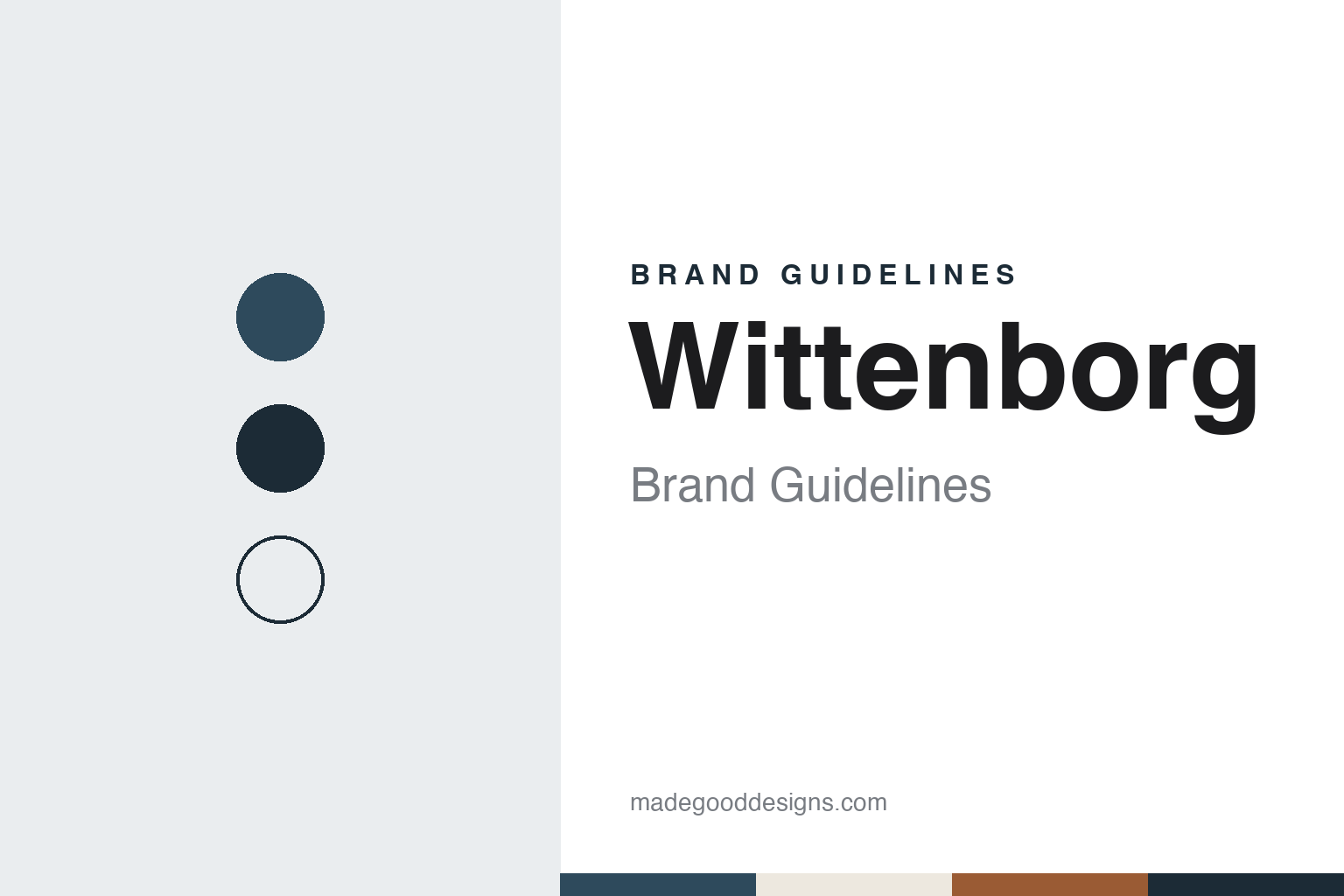
Wittenborg Brand Guidelines
The Odense vending maker behind a century of Scandinavian coffee machines.
Aa
Two constants: a slate, oat and copper palette and a Nordic sans register. Abstract homage — not a Wittenborg product or mark; no machine, logo or nameplate is reproduced.
Odense, 1924
A tinware factory, then a vending-machine company.
Wittenborg began in Odense, on the Danish island of Funen. The company dates its founding to 1924, when, in its own words, “a Danish plumber called Alexander Wittenborg” set up a company in Odense called Wittenborgs Automatfabriker and produced his first food vending machine the same year. Its own history says food vending was the company’s speciality until the 1960s, when it began making hot drink machines.
The vending business grew out of an older factory. The Dansk Biografisk Leksikon, in its entry on the industrialist N.J. Haustrup, records that Alex Wittenborg had set up a tinware factory in Odense in 1914, and that in 1924 Wittenborg split off a department for vending machines as an independent company. The sources read for this guide do not describe the company during the German occupation of Denmark from 1940 to 1945. The tinware side passed to Haustrup, who bought it outright in 1928 and built it into Haustrups Fabrikker. Trap Danmark, the Danish topographical reference, likewise lists “Wittenborgs emballagefabrik,” a maker of tins for the food industry, as the forerunner of Wittenborg A/S.
Danish Wikipedia gives the same founding year and founder. It says Wittenborg A/S, the Danish manufacturer of vending machines, no longer exists as such, and that Wittenborg today is a machine brand owned by Evoca Group. It says the business grew strongly after the Second World War, and that staff numbers peaked at about 800 at the end of the 1980s before falling to about 350 during the 1990s.
The machines travelled early. English Wikipedia, citing Billboard from January 1953, records that Wittenborg-brand food-vending machines, made by a Danish firm, were being distributed in New York at that time.
Colour
From family firm to vending group.
For much of its life Wittenborg was a family business. The company says it was family-owned for many years and sold in the 1980s; Danish Wikipedia says a grandson of the founder held the majority of the shares until 1984. The Danish reference work Lex lists Wittenborg A/S among the companies in which the investment group Incentive held a stake, and Danish Wikipedia says Incentive sold Wittenborg to Compass Partners in 2000.
That sale created a new group. In 2000 Wittenborg was combined with Necta, the vending business founded in 1968 as part of Zanussi at Valbrembo, near Bergamo, to form N&W Global Vending. Evoca Group’s own history describes N&W as “born from the merge of Wittenborg and Necta Vending Solutions.” The group bought Saeco Vending and Cafection in 2017 and, on 29 November 2017, renamed itself Evoca.
The Danish factory did not survive the change. In July 2010 the trade magazine Vending International reported that N&W intended to move production of Wittenborg machines from Odense to its plant in Valbrembo, Italy, where the Wittenborg research and development department was already based, while keeping a sales and service organisation in Odense for the Scandinavian market. The company’s own history confirms that the Odense factory closed in 2010 and production moved to Valbrembo. Danish Wikipedia says 35 Danish staff moved into the smaller trading company, and that the Nordic business, Evoca Nordic, is still based in Odense.
So the documented position is clear: Wittenborg machines are made in Italy under a Danish name. The company presents them as tabletop machines “with a distinctly Scandinavian design,” offering fresh brew and bean-to-cup coffee, touch screen interfaces and matching base cabinets, and uses the line “designed to last.”
Typography
Design and documentation.
Commercial coffee machine makers sell mainly to businesses rather than to homes. Their customers are hotel groups, coffee-shop chains, office caterers and restaurants, and their products sit on hotel breakfast buffets, office counters, convenience-store shelves and behind café bars. Some build fully automatic machines that grind, dose, brew and froth milk at the touch of a screen; others build large batch brewers that fill urns and airpots for a busy service.
Much of the trade grew from a practical problem. SWI swissinfo.ch reported in 2024 that Swiss restaurants in the 1970s faced higher wage costs and fewer staff behind the buffet, and the historian Jonathan Morris told the publication that Swiss automatic machines set out to make coffee and milk drinks simpler for staff without barista training. Switzerland remains a centre of that business, with makers in Weggis, Zuchwil and elsewhere.
The machines now present themselves through screens and options as much as through steel. In 2025 TOP HOTEL Projects described one fully automatic model offered with touchscreens of two sizes, modes for staff service, self-service and office use, and interchangeable panels in a customer’s chosen colour. Milk systems, cleaning routines and service networks also feature in how these makers describe what they offer.
Launches tend to happen at trade fairs rather than in shops. HOST Milano, the hospitality fair held in Milan, is one such stage; specialty-coffee events such as World of Coffee are another. This guide sets out what can be checked about each maker — who founded it, who owns it, and what it says about where its machines are made — and marks clearly what rests only on the company’s own word.
Aa
A Nordic sans for a brand that sells Scandinavian design. (Specimen set in Manrope, a sans STAND-IN; NOT the Wittenborg logo.)
Wittenborg
A century-old Danish name on an Italian-made machine.
Wittenborg marked its centenary on 21 March 2024, and its current range centres on the W100 and the W100 Core, bean-to-cup and fresh-brew coffee machines for offices, hotels, restaurants and cafés. The W100 has gathered design awards. Wittenborg announced that it had been named a Top Design Winner in the beverage and food category of the 2024 European Product Design Awards, and that it won an iF Design Award 2025 in the product discipline, under kitchen and coffee makers.
The Red Dot award is documented on Red Dot’s own project page, which lists the Wittenborg W100 coffee machine with Evoca Group of Valbrembo as manufacturer, in-house design by Nicola Belotti, Dario DePrà and Sergio Mazzetti, and design work by Avalon Innovation of Helsingborg, Sweden. The jury statement says the machine “meets the requirements of modern HoReCa environments in a distinctive manner,” and the page notes that “the Scandinavian design tradition is evident in the clean lines and orderly structure.” Wittenborg announced the award in April 2025 and called it the machine’s third design prize in a row.
That split credit sums up the brand today. Evoca describes the W100 as a blend of Scandinavian design and Italian craftsmanship; Red Dot credits designers in Italy and Sweden and names Evoca Group of Valbrembo as the manufacturer, under a name that began beside a tinware factory in Odense.
For a design guide, Wittenborg shows how a regional design identity can outlast the factory that made it, carried by a group that keeps the name for its Nordic look. Compare Cafection, another Evoca Group brand, and Bravilor Bonamat, another maker of coffee machines for offices. For this guide we use slate, oat white and a copper accent with a sans, an unofficial interpretation; no product or logo is reproduced.
Explore & save
Keep Wittenborg’s identity on hand — save it to a board in the Made Good inspiration library.
Wittenborg identity set
Pin the Wittenborg slate, oat and copper palette and the Nordic sans register to your own board.