Diebold Nixdorf Brand Guidelines
Cincinnati safes, Paderborn computers and a 2016 merger.
Aa
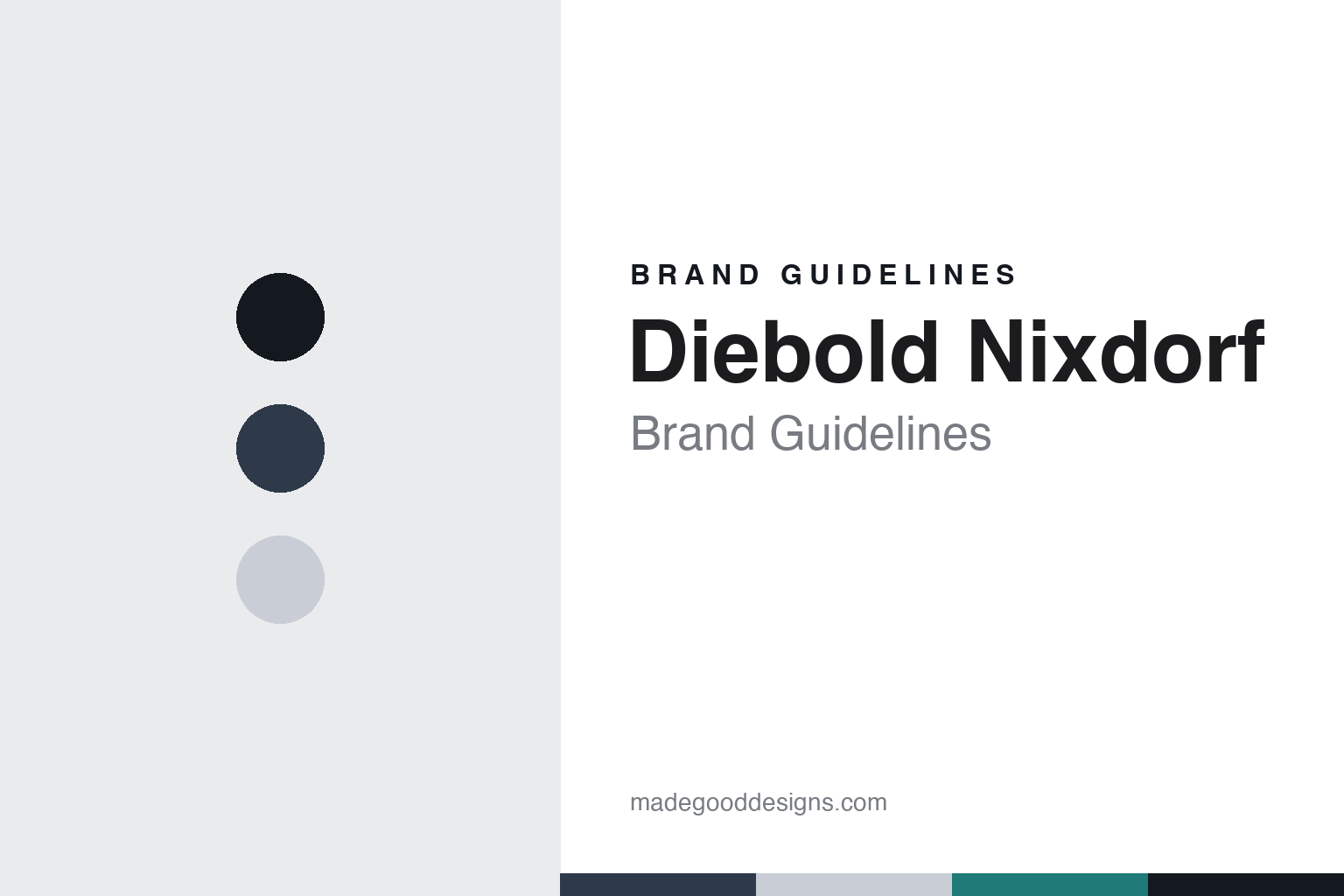
Two constants: a Diebold Nixdorf slate and steel palette and an Engineered sans register. Abstract homage — not a Diebold Nixdorf product or mark; no machine, logo or nameplate is reproduced.
Two founders
An Ohio safe maker and a German computer laboratory.
Diebold Nixdorf joins two company histories, one American and one German. The American half began in 1859 in Cincinnati, Ohio, as the Diebold Bahmann Safe Company, founded by Charles Diebold, a German immigrant, English Wikipedia says. It made safes and bank vaults. Diebold says 878 of its safes came through the Great Chicago Fire of 1871, and in 1872 the company moved its operations and headquarters to Canton, Ohio, to meet demand. It became the Diebold Safe & Lock Company in 1876 and Diebold, Incorporated in 1943.
War work is part of that record. English Wikipedia says that between 1939 and 1945 Diebold devoted 98 percent of its activity to the war effort, including armour plate for more than 36,000 US Army scout cars. In 1964 it listed on the New York Stock Exchange, and its move into cash machines followed. A Diebold cash machine prototype was shown at the American Bankers Association’s annual meeting in 1966; from 1970 Diebold distributed machines made by the British firm Chubb, stopping in 1973; and its own TABS 500, short for Total Automatic Banking System, was first installed in 1974. From 1990 to 1998 Diebold and IBM sold ATMs through a joint venture, InterBold, until Diebold bought IBM’s share.
Its ATM ranges multiplied. Diebold launched the Opteva line in 2003, and in December 2014 the 3500 and 3700 series, both able to recycle cash; in 2002 it announced ATM production in Goa, India, with Tata Infotech. In 2014 it bought Cryptera, a Danish maker of PIN pads, and in 2015 Phoenix Interactive Design, an ATM software company in London, Ontario. In October 2015 it showed two concept machines at the Money20/20 show in Las Vegas: Irving, which let customers withdraw money with an iris scan instead of a card, and Janus, which Fortune described as a dual-sided ATM able to serve two customers at the same time, English Wikipedia says.
The German half began on 1 July 1952, when Heinz Nixdorf founded the Labor für Impulstechnik, a laboratory for pulse technology, in Essen, backed by a development order from the utility RWE, German Wikipedia says; its first valve-based computer went to RWE’s accounting department that year. The business moved to Paderborn in the late 1950s, bought its largest customer, the Wanderer-Werke of Cologne, in 1968, and became Nixdorf Computer AG on 1 October 1968. From the 1970s it added electronic tills and bank terminals to its small business computers.
Colour
Siemens, Wincor and a takeover.
Nixdorf changed hands twice before Diebold arrived. On 1 October 1990 Siemens took a majority and formed Siemens Nixdorf Informationssysteme. In 1998 the banking and retail side became Siemens Nixdorf Retail & Banking Systems, and on 1 October 1999 the investors KKR and Goldman Sachs bought it and renamed it Wincor Nixdorf; “Wincor” stood for “win” and “core,” according to German Wikipedia. Wincor Nixdorf listed in Frankfurt in May 2004. Its BEETLE till system, developed by Siemens Nixdorf in the early 1990s, has stayed in the range under every later name.
Diebold, meanwhile, spread widely. English Wikipedia records an iris-recognition ATM in 1999 and what it calls the first talking ATM in the United States, installed at San Francisco City Hall that October; the purchase of Brazil’s Procomp in 1999 and of the Mosler safe company in 2001; and an elections business, Diebold Election Systems, bought in 2002, which drew controversy over the security of its voting machines and was sold in 2009. Legal findings are part of the record too. Several Diebold executives settled a Securities and Exchange Commission accounting case in 2010 without admitting liability, and in 2013 the company resolved Foreign Corrupt Practices Act charges with the Justice Department under terms that included compliance monitoring, English Wikipedia says.
The two halves met in 2015. Diebold and Wincor Nixdorf signed a business combination agreement on 23 November 2015; the takeover was completed on 15 August 2016, and the company began operating as Diebold Nixdorf the next day. German Wikipedia says a squeeze-out of the remaining German shareholders ended in May 2019, after which the German listed company was merged into the group’s German holding company.
Typography
Design and documentation.
Cash-handling makers sell machines that most people meet without ever choosing them. Their products appear in bank lobbies and in the walls of branches, behind teller counters as cash recyclers, beside supermarket tills as coin counters, and in the printing halls where banknotes are made. The maker’s name is often a small plate on a large machine, so the brand does much of its work in brochures, trade stands and service contracts rather than on the street.
The machines themselves come in families. NCR’s first serious ATM generation, the 5070 of 1983, was developed at its Dundee plant in Scotland and came in lobby and through-the-wall versions, with modules that could be taken out for repair or refilling, according to English Wikipedia. That modular build lends itself to cutaway diagrams, which trace the path a note takes through a machine from cassette to dispenser.
Trade fairs and bank technology conferences are where new machines are shown. Diebold demonstrated a cash machine prototype at the American Bankers Association’s annual meeting in 1966, and in October 2015 showed two ATM concepts at the Money20/20 show in Las Vegas, English Wikipedia says. The ATM Industry Association gives its own awards, which makers list on their websites.
Ownership in this sector changes often. Diebold took over Germany’s Wincor Nixdorf in 2016, NCR split off its ATM business as NCR Atleos in 2023, and in February 2026 the cash carrier Brink’s agreed to acquire NCR Atleos, ATM Marketplace reported. This guide sets out what can be checked about each brand — who founded it, who owns it and where its machines are made — and marks clearly what rests on the company’s own word.
Aa
An engineered sans — two founders’ names side by side. (Specimen set in Archivo, a sans STAND-IN; NOT the Diebold Nixdorf logo.)
Diebold Nixdorf
Restructured, and back on the exchange.
The combined company went through a court restructuring. ATM Marketplace reported on 31 May 2023 that Diebold Nixdorf would file for Chapter 11 protection in a Texas court, with a similar process in the Netherlands, and quoted its chief executive saying the company would keep its global headquarters in Hudson, Ohio, and keep investing in its North Canton manufacturing site. English Wikipedia says it filed on 1 June 2023, was delisted from the New York Stock Exchange, and emerged in August 2023, rejoining the exchange.
Today its website lists two global headquarters, North Canton in Ohio and Paderborn in Germany, with a US manufacturing and operations site in North Canton. Its banking range is sold as the DN Series of ATMs, with Vynamic software and AllConnect services, and its retail side sells tills, self-checkouts and kiosks. The company says it “started out making safes” and has worked with its clients for more than 160 years.
For a design guide, Diebold Nixdorf shows how a merged company can carry two founders’ names side by side: an Ohio safe maker’s and a Paderborn computer pioneer’s. Compare NCR Atleos, the other American ATM maker with nineteenth-century roots, and GRG Banking, an ATM maker from Guangzhou. For this guide we use a slate blue, a steel grey and a teal with a sans, an unofficial interpretation; no product or logo is reproduced.
Explore & save
Keep Diebold Nixdorf’s identity on hand — save it to a board in the Made Good inspiration library.
Diebold Nixdorf identity set
Pin the Diebold Nixdorf slate and steel palette and the Engineered sans register to your own board.