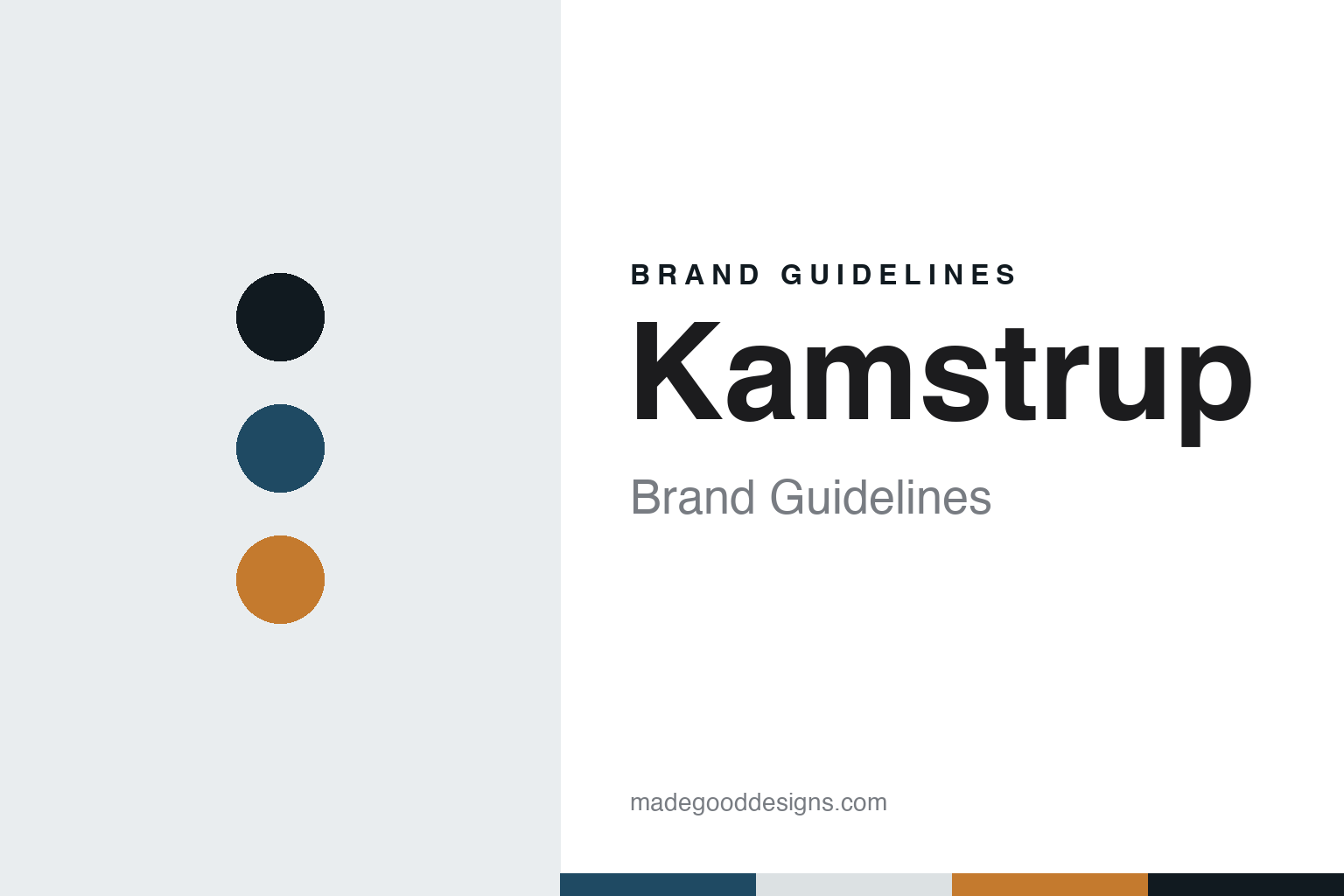
Kamstrup Brand Guidelines
An Aarhus workshop, calorie meters and a Danish cooperative owner.
Aa
Two constants: a fjord blue, ink and heat amber palette and a geometric sans register. Abstract homage — not a Kamstrup product or mark; no meter, logo or nameplate is reproduced.
Kamstrup-Metro
A workshop in Aarhus and a better solution.
Kamstrup began in a small workshop in Aarhus, Denmark, in the years after the Second World War. Lex, the Danish national encyclopaedia, says the entrepreneur Olaf Kamstrup built the firm there around a simple motto: “there is always a better solution” (in Danish, “der er altid en bedre løsning”). The business made its name in measurement. In 1959, Lex says, it launched its first energy meters for district heating, the so-called “kaloriemålere,” or calorie meters.
For decades the company stayed in the family. Under the name Kamstrup-Metro it was owned by the Kamstrup family until the middle of the 1980s, when, according to Lex, a change of generation led the family to invite the Danish energy cooperative OK to become a co-owner. In 1987 OK took over half of the share capital. At that point Kamstrup-Metro was based in Åbyhøj, on the western edge of Aarhus, and had 130 employees. Three years later the family was bought out, and since 1990 the company has been part of the OK group under the plain name Kamstrup.
Colour
A cooperative owner and two factories.
Kamstrup’s owner is unusual for an industrial group. Lex describes OK a.m.b.a. as a cooperatively owned energy company, owned by more than 11,000 dealers and customers, whose history goes back to 1913, when Danish dairy associations led the founding of a joint buying association for coal, the fuel their steam engines needed. The short name OK arrived in 1963 with OK Olie, a petrol venture set up with a Swedish consumer-owned company whose initials it borrowed. A 1978 merger created Olieselskabet Danmark, and the official name has been OK a.m.b.a. since 1998. Since 2024 OK has also owned just over half of Coop Danmark, Lex adds.
The cooperative’s roots are still visible in its structure. The Jutland coal association of 1913 became national within a few years and took the name Dansk Andels Kulforretning in 1915, and OK Olie introduced Denmark’s first automatic payment station at its pumps a year after its launch, Lex says. Around 80 per cent of OK today is owned by independent cooperative shops, businesses, farmers and ordinary consumers, and the remaining 20 per cent by Coop-owned shops. That is the parent behind every Kamstrup meter.
Today Kamstrup makes meters for water, heat and electricity. Its headquarters are in Stilling, near Skanderborg in East Jutland, and Lex says the group employs a little over 1,500 people, with subsidiaries, branches and representative offices in 22 countries. Production, by the same account, runs at a highly automated factory in Stilling and at a factory in the US state of Georgia. The company itself puts automation at the centre of its story: announcing its first American production facility in February 2018, it said it was known around the world for automated production, WaterWorld reported.
The American side has grown quickly. WaterWorld reported in February 2018 that Kamstrup was opening a water meter production facility in the United States, with a ribbon cut by the Danish ambassador, Lars Gert Lose. In March 2024 the subsidiary Kamstrup Water Metering opened a new North American headquarters and manufacturing facility in Forsyth County, Georgia, outside Atlanta: a 150,000-square-foot building that, according to the company’s press release as reported by WaterWorld, more than quadruples its previous footprint. Kamstrup has been in the United States since 2013, the same report says, and its American water utility customers include El Paso in Texas, Jackson in Mississippi, Madison County in Alabama and Greer in South Carolina.
The 2024 site was chosen after a search of the American Southeast. Bruce Bharat, the company’s vice president and country manager, said in the press release that 13 other cities in the region had been considered, and that the Atlanta area made the most sense as a global hub. The property firm JLL, which handled the lease, said Kamstrup had made a 15-year commitment to the building.
Typography
Design and documentation.
Utility meters are everywhere and rarely looked at. They sit in cupboards and basements, in pits under the pavement and in boxes on outside walls, and today they are read far more often by machines than by people. The makers in this guide build electricity, water, gas and heat meters, and increasingly the radio networks and software that collect and manage their readings.
Their imagery follows that shift. Factory photographs show rows of grey and white meters clamped into test rigs, brass water-meter bodies waiting for assembly and the dials of mechanical registers. Newer material shows small digital displays and communication modules, and control-room screens where a utility follows consumption, outages and the state of its network across a town or a region. Product shots tend to sit on plain light backgrounds, close in spirit to the technical drawings of a catalogue.
People appear mostly as installers and operators: field engineers beside liveried utility vans, technicians opening a meter cabinet or lifting the lid of a water-meter pit, staff in front of dashboards. Trade fairs such as Enlit, where the power industry meets, and national utility shows are where these companies present themselves to their customers, and their stands lean on the same mix of hardware, maps and screens.
Ownership in the sector has changed often, with listed groups, private equity investors and family firms buying and selling meter businesses across borders. This guide sets out what can be checked about each brand — who founded it, who owns it now and where its products are made — and marks clearly what rests only on the company’s own word.
Aa
A geometric sans for a founder’s surname. (Specimen set in Figtree, a sans STAND-IN; NOT the Kamstrup logo.)
Kamstrup
A founder’s surname, kept by a cooperative.
Kamstrup’s identity is built on a surname. The founder’s name has stayed on the door through every change of ownership: as Kamstrup-Metro during the family years, and on its own since OK completed its purchase in 1990. That continuity is the clearest documented thread in the brand’s story, and the palette and type on this page are our own unofficial interpretation rather than the company’s colour codes or logo lettering.
The current leadership is recent. Lex names Søren Kvorning as chief executive since 2024. He represented the company at the 2024 opening in Georgia, where the state’s governor, Brian Kemp, thanked him for his confidence in the state, WaterWorld reported. Lex lists Michael Lindhart Løve as chair of the Kamstrup board, and its entry on OK names him as the cooperative’s chief executive.
For a design guide, Kamstrup shows how a founder’s surname, kept unchanged by a cooperative owner, can carry a company from a post-war Aarhus workshop to automated factories in Denmark and Georgia. Compare it with Itron and Landis+Gyr, two other meter makers. For this guide we use fjord blue, ink and heat amber on a pale meter grey with a geometric sans, an unofficial interpretation; no product or logo is reproduced.
Explore & save
Keep Kamstrup’s identity on hand — save it to a board in the Made Good inspiration library.
Kamstrup identity set
Pin the Kamstrup fjord blue, ink and heat amber palette and the geometric sans register to your own board.