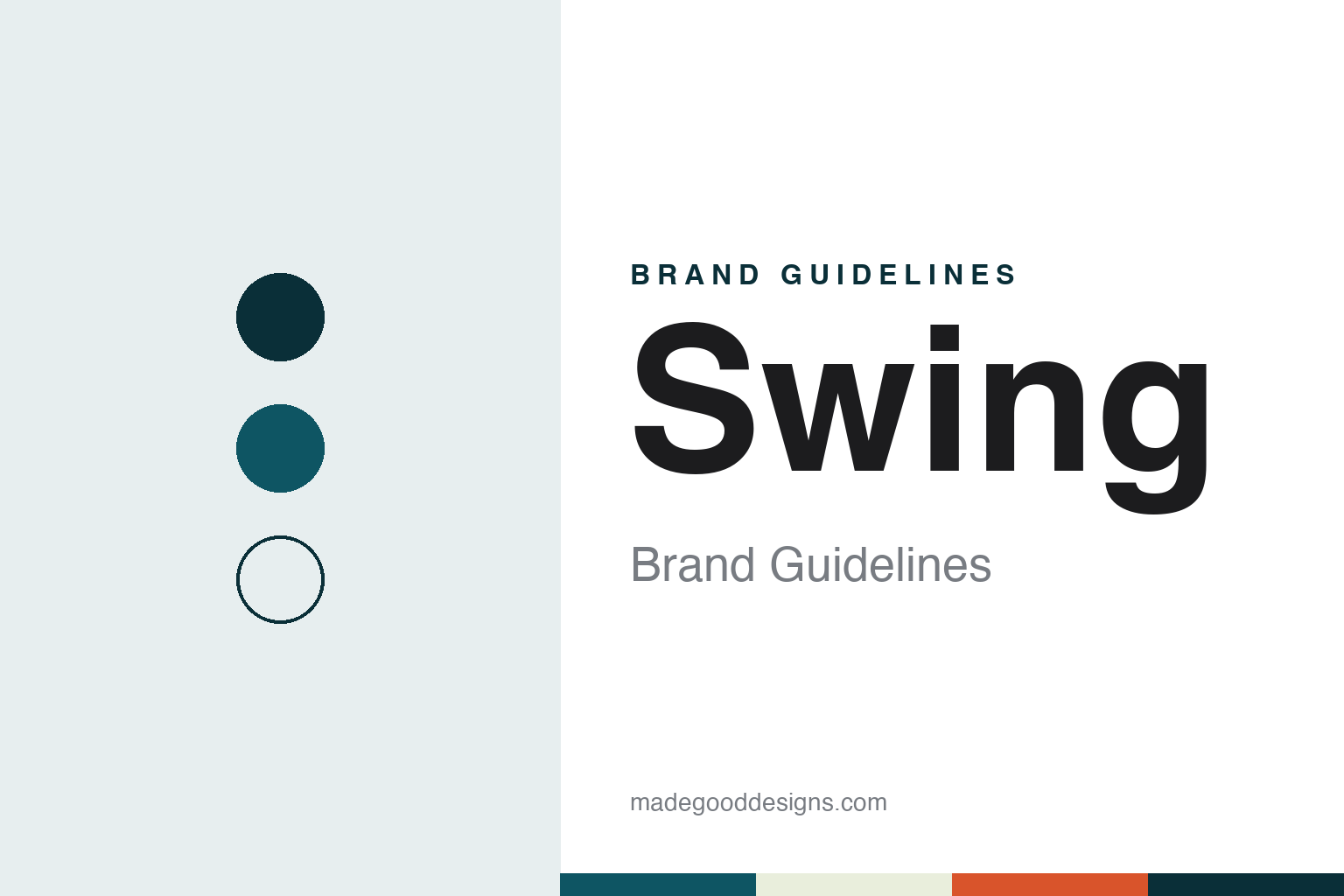
Swing Brand Guidelines
The Bavarian paraglider maker that put a wall inside the wing.
Aa
Two constants: a petrol, lime and flame palette and a friendly sans register. Abstract homage — not a Swing product or mark; no wing, logo or lettering is reproduced.
From Swiss Wing to Swing
A sail workshop, a new sport and a school wing.
Swing gives two starting points. English Wikipedia and the company itself date the business to 1986, and Wikipedia describes Swing Flugsportgeräte GmbH as a maker of paragliders and paramotor wings in Landsberied, 30 kilometres west of Munich. But the company’s own history now runs from 1975 and speaks of 50 years of experience. It says everything began in a small sailmaking workshop in Switzerland, where sails were made under the name Swiss Wing, and that the name Swing grew out of those roots.
Günther Wörl leads the company. Its history calls him a founder and managing director, and also a pilot and test flyer who played a decisive part in building Swing up in Germany. Its team page lists him as managing director and owner, and the legal notice on its website names him as managing director.
Paragliding was still young. Swing says that in the late 1980s it was one of the first manufacturers to turn to producing paragliders, in what was then a new and unproven trade, and that its sailmaking experience fed into the wings. Wikipedia, citing a company page of 2016, calls Swing one of the oldest paraglider manufacturers, with 170 distributors in 48 countries.
The defining product of that era was the Arcus, a beginner wing developed with flight schools and pilots, the company says. Wikipedia, again citing the company in 2016, counted more than 8,500 sold and called it one of the best-selling designs in the sport. Swing goes further and says no other model has been sold as often. The Cirrus, an advanced cross-country line, ran from the 1990s to the mid-2000s, according to Wikipedia.
Colour
A crosswise wall inside the canopy.
Swing’s modern identity rests on one structural idea: RAST, or Ram Air Section Technology. Swing describes it as a technical design element in which one or more panels of cloth run across the canopy inside and divide it into sections, and compares this with a bulkhead in a tank. Nesler told Cross Country in April 2018 that the “RAST wall” sits about a third of the way back from the leading edge.
Dates vary slightly. Swing’s RAST page says the first series wing with the system was the Mito, a school wing presented in 2014, while its brand history says RAST was developed in 2015 with the designer Michael Nesler. Cross Country’s March 2016 report described much online discussion of RAST on the EN-A Mito, and its 2018 interview said it had arrived about two years earlier.
Nesler told the magazine he first had the idea 20 years earlier, but that production thought it too difficult and expensive; development in its current form took about two years and some 60 gliders. Cross Country said reaction had ranged from “marketing gimmick” to “hmm, interesting,” called the technology “a bit of a slow-burner” and reported that Swing was in talks with four other manufacturers about licensing it.
RAST also became part of the product naming. Cross Country explained in June 2016 that the “RS” in the Twin RS tandem stood for RAST. The suffix now runs through the catalogue, from the Miura 2 RS and Nyos 2 RS to the two-line Sphera 2 RS, which the magazine reported in July 2026 as rated EN-C. Swing’s RAST page carries the line “Rock solid flight by SWING.”
Swing has also moved beyond standard wings. It says it released its first miniwing in 2007, after speedriding emerged in France in 2005, and its Spitfire and Mirage lines serve speedflying. In 2004, it says, it founded ISTEC AG and developed the Parasailor, a patented boat sail built around a paraglider profile. More recent work includes the lighter D-Lite series and the Sonic RS parakite of August 2026, developed by what Cross Country called Swing’s Italian R&D team, led by designer Alessio Casolla.
Typography
Wings, lines and launch slopes.
A paraglider has no bodywork or badge plate, so most of what a maker shows the world is cloth. The wing is the largest thing it builds, and it is seen in two main ways: spread out on a launch slope before take-off, or overhead in the air. Makers’ websites and catalogues return to those two views again and again.
Colour comes in panels, because a wing is sewn from many pieces of sail cloth rather than painted. Makers often sell a small set of schemes: Cross Country reported in February 2026 that one new wing came in two standard colour schemes. The cloth is named as well, by mill and weight, in launch notes and reviews, and the stitched cell openings along the leading edge are among the details a close-up photograph tends to pick out.
Engineering drawing is part of the look. Manuals carry line plans and riser diagrams, and catalogues add feature tables and glossaries, so a brand’s printed material can read like technical documentation. Video does a similar job in a friendlier voice. Test pilots and designers appear on camera to explain what went into a new wing, and Cross Country has filmed one such session at a maker’s headquarters.
The trade’s shop window is the Coupe Icare festival. Cross Country describes its expo as a chance to see all the free-flight brands together in one space, and as the moment when companies celebrate their successes and announce next season’s gliders and harnesses. Stands there can be part of the brand: Ojo Volador reported that one maker marked its founder’s 40 years in free flight in 2018 with a party on its stand, a special red harness and live Korean folk music. This guide sets out what can be checked about each maker, and marks what rests only on the company’s own word.
Aa
A friendly sans for a brand that has long served schools and new pilots. (Specimen set in Figtree, a sans STAND-IN; NOT the Swing logo.)
Swing
Bavaria, Ukraine, Croatia and an Italian design team.
Production is a large part of how Swing presents itself. Its history says that in the years from 2000 to 2014 it moved into a modern company building in Landsberied and set up its own production in Ukraine. It then says it shifted part of its production to Croatia, and that “Made in Europe” became a fixed pillar of the company’s philosophy.
The company’s Made in EU page lists the Spitfire 3, the Mirage 2 RS, its reserves and various accessories as made at its production site in Croatia under that label, and says up to 40 percent of the goods it needs can come from suppliers within 1,000 kilometres. Swing also says it plans to expand its European production there. The history describes the mix in national terms: engineering from an Italian development team around Casolla, joined with German precision at the Bavarian headquarters. Those are the company’s words.
Colour runs through the range. Cross Country reported that the Twin 3 RS of 2024 came in three colours, petrol, lime and flame, the tones that inspired this guide’s palette. Swing also offers special designs, letting buyers try colour combinations on a product’s web page and order their own scheme, and it can place a customer’s logo on a wing if supplied with vector artwork. Line colour has a job as well: the magazine noted that the Sphera 2 RS has unsheathed lines coded magenta, blue and orange, and that the Mito 3 has colour-coded lines too. Its review of the Nyos 2 RS in March 2023 pointed out the strings at the cell openings as the detail that catches the eye.
Its site invites readers to see “the Earth’s greatest Playground” from a new perspective, and the company’s history presents Swing as a community of pilots, adventurers and dreamers. The brand also says Wörl is moving into a coaching role, advising a team that has taken on the work step by step, while the legal notice still lists him as managing director.
The company is trading, and its launches continue. Cross Country reported the Mito 3 RS and D-Lite in April 2026, the Sphera 2 RS that July and the Sonic RS that August.
For a design guide, Swing shows how a hidden structural idea can become a public name, a product suffix and a slogan. Compare Skywalk, founded by people who had worked at Swing, and Advance, another paraglider maker. For this guide we use a petrol, a pale lime and a flame orange with a sans, an unofficial interpretation; no product or logo is reproduced.
Explore & save
Keep Swing’s identity on hand — save it to a board in the Made Good inspiration library.
Swing identity set
Pin the Swing petrol, lime and flame palette and the friendly sans register to your own board.