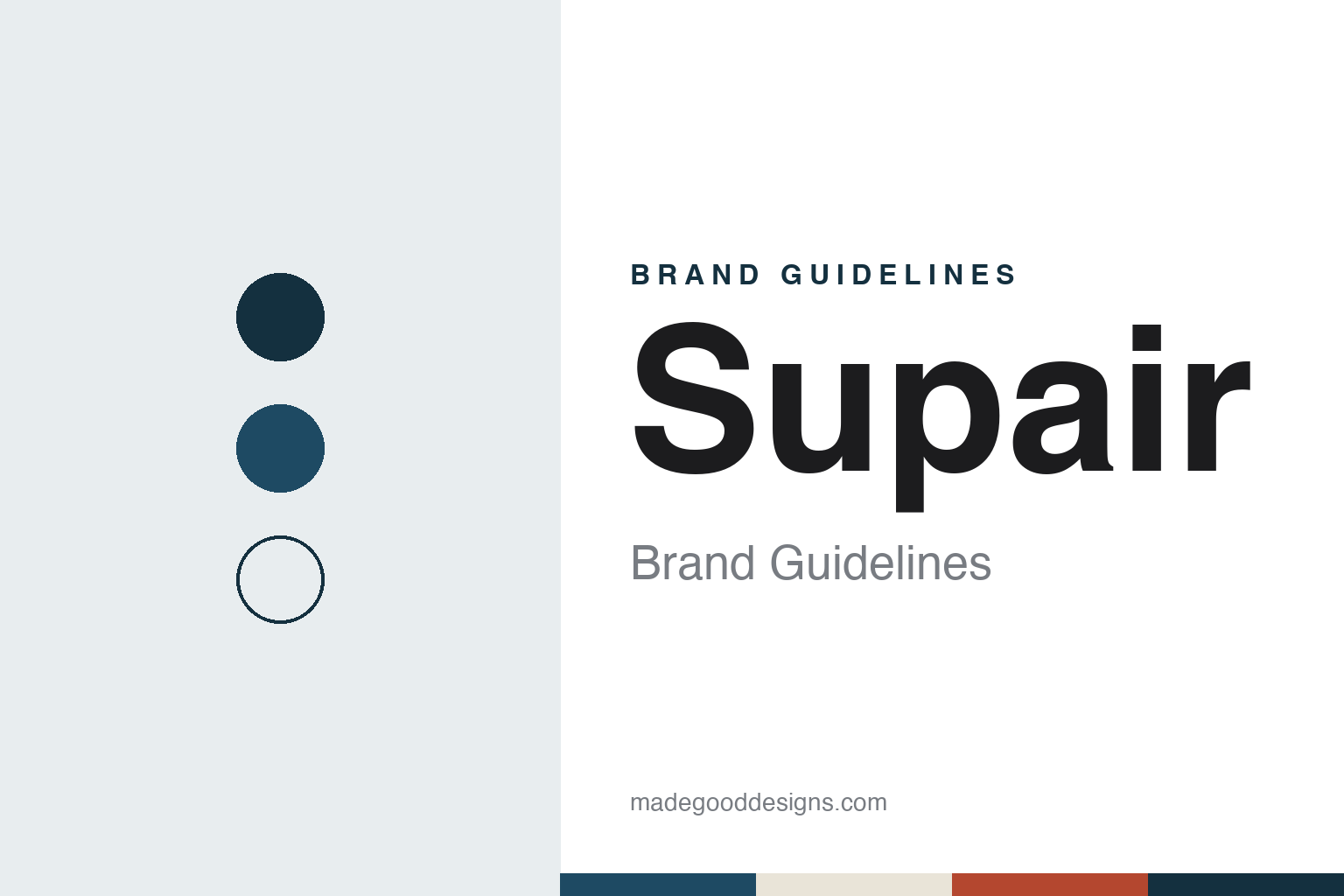
Supair Brand Guidelines
The Annecy harness maker that moved into wings.
Aa
Two constants: a Supair lake blue, sailcloth and stitch red palette and a Technical condensed sans register. Abstract homage — not a Supair product or mark; no wing, harness, logo or nameplate is reproduced.
A sewing machine in Annecy
A hang-gliding instructor turns to harnesses.
Supair gives two starting dates, and both are its own. The history page on its website opens in 1979, when the hang-gliding instructor Pierre Bouilloux turned his attention to harnesses, and it places the first “SUP’AIR” products in 1982. The website’s French homepage title says “since 1979.” A statement Supair issued in June 2017, printed by Cross Country magazine, says the company was “founded in 1982.” The same website also talks of “40 years” in the air.
The origin story comes from the company. Bouilloux’s passengers, Supair says, were fainting in flight because of pressure points, and his first sewing machine turned his apartment in Annecy, in Haute-Savoie, into a production workshop. Freedom Parapente, a French school and retailer, tells a similar story on its Supair brand page and adds two details: he began selling harnesses to his school in 1980, and he started the brand two years later.
The business grew with a new sport. Supair says its first harnesses reached the market between 1982 and 1985, “alongside the emergence of this new sport”; Freedom Parapente dates its first paragliding harnesses to 1985, built on what it had learned from hang-gliding harnesses.
Bouilloux was also a pilot of some standing. Supair says he was French paragliding distance champion from 1990 to 1994, broke FAI triangle world records several times and was one of the pioneers of bivouac flying. Its homepage says he developed the first harnesses on trips through the mountains with a paraglider on his back.
Colour
From seams to sails.
Supair began as a harness company, and its timeline reads as a run of harness features. It says the reserve parachute first appeared in its harnesses in 1988; that automatic buckles followed in the early 1990s, developed with a local company; that Anti-Balance Systems came next; and that it was “the first manufacturer to integrate an airbag into the harness,” a claim it makes for itself. An aerobatics team followed in 2007, and in 2012 a harness with a release system for the main glider and a steerable rescue BASE system.
Wings came late. The 2017 statement says Supair moved into glider and parachute design in 2012, “under the initiative of manager Laurent Chiabaut.” Its history page dates its first canopy, the Sora tandem, to 2014, and its first solo wings to 2015: the Eona, the Eiko and the Leaf. The Eona is its EN-A school wing and the Leaf its EN-B progression wing. In 2017, Supair says, Benoit Outters took second place in the X-Alps on its Wild.
Cross Country has followed the range since. The Leaf 3, reviewed in October 2023, was the first wing with Supair’s new colour scheme, in blue or red. The Eona 4, announced in March 2024, was the first of the brand’s designs with winglets. The two-line Wild 2 EN-D arrived in March 2025, and the 2.5-line Savage 2 EN-C was announced that October.
Harnesses have kept pace. The Alp of July 2024, whose name stands for Aerodynamics, Light, Performance, is a racing pod. The Strike 3 followed in March 2026, and in September 2026 sales director Clément Latour explained the Pulse at the Coupe Icare festival: “The idea was to make an accessible submarine for any pilot,” Cross Country reported. The same magazine reported in October 2024 that Supair’s Skymate system, developed by Chiabaut and the engineer Roman Barthélémy, had split opinion at that year’s Coupe Icare.
Typography
Design and documentation.
A paraglider has no bodywork or badge plate, so most of what a maker shows the world is cloth. The wing is the largest thing it builds, and it is seen in two main ways: spread out on a launch slope before take-off, or overhead in the air. Makers’ websites and catalogues return to those two views again and again.
Colour comes in panels, because a wing is sewn from many pieces of sail cloth rather than painted. Makers often sell a small set of schemes: Cross Country reported in February 2026 that one new wing came in two standard colour schemes. The cloth is named as well, by mill and weight, in launch notes and reviews, and the stitched cell openings along the leading edge are among the details a close-up photograph tends to pick out.
Engineering drawing is part of the look. Manuals carry line plans and riser diagrams, and catalogues add feature tables and glossaries, so a brand’s printed material can read like technical documentation. Video does a similar job in a friendlier voice. Test pilots and designers appear on camera to explain what went into a new wing, and Cross Country has filmed one such session at a maker’s headquarters.
The trade’s shop window is the Coupe Icare festival. Cross Country describes its expo as a chance to see all the free-flight brands together in one space, and as the moment when companies celebrate their successes and announce next season’s gliders and harnesses. Stands there can be part of the brand: Ojo Volador reported that one maker marked its founder’s 40 years in free flight in 2018 with a party on its stand, a special red harness and live Korean folk music. This guide sets out what can be checked about each maker, and marks what rests only on the company’s own word.
Aa
A technical condensed sans, in keeping with spec sheets and labels. (Specimen set in Barlow Semi Condensed, a sans STAND-IN; NOT the Supair logo.)
Chavanod
“We do not give ourselves airs.”
Supair says it moved into its present building at Chavanod, near Annecy, in 2006; it holds the offices, warehouse and design and development workshops. Its website says the company has about 30 staff, a third of them in research and development, and names Laurent Chiabaut as president, leading the team for 11 years. Cross Country described him in 2024 as chair of the Paraglider Manufacturers’ Association. Swiss and German subsidiaries opened in 2018–2019, the company says.
On manufacturing, the claims are the company’s own. Supair says it opened a workshop in Romania in 2000, that “all Supair harnesses are manufactured in Europe,” and that most of its production partners and raw-material suppliers for wings and harnesses are in France or elsewhere in Europe. Each harness received from its European manufacturing sites, it says, is inspected at Chavanod and fitted with its accessories before shipping “ready to fly.”
A move into a second brand did not go to plan. Supair announced on 16 June 2017 that it had bought Gradient, the Czech wing maker founded in 1997 by Ondrej Dupal. Cross Country reported in February 2020 that Gradient had stopped taking orders and that production had stopped. Chiabaut told the magazine that Supair had begun making part of its own range in the Gradient factory in 2018 and had bought new premises that year, but that for many reasons the plan had not worked. He said then that production was closed “for the time being,” that Gradient was not in liquidation, and that the brand still existed.
The brand’s voice leans on the word in its own name. Its history page says: “We do not give ourselves airs, we simply have the air of what we are.” The same page speaks of creators and “children of flight.” Product names are short: the helmet is the Supairvisor, and the “X” in Step X stands for “cross,” the crossroads of performance and low weight, Cross Country explained in 2023. Spelling has also moved, from the “SUP’AIR” of the early products to the Supair and SUPAIR of today’s site. The site lists a brand-design and visual-communication post in its marketing team and, in 2026, a photo exhibition called RESET tied to the Coupe Icare.
For a design guide, Supair shows how a maker can carry a craft identity from a single sewing machine into a full range of equipment. Compare Ozone, another glider maker based in France, and Petzl, a French mountain-equipment name. For this guide we use a lake blue, a sailcloth and a stitch red with a condensed sans, an unofficial interpretation; no product or logo is reproduced.
Explore & save
Keep Supair’s identity on hand — save it to a board in the Made Good inspiration library.
Supair identity set
Pin the Supair lake blue, sailcloth and stitch red palette and the Technical condensed sans register to your own board.