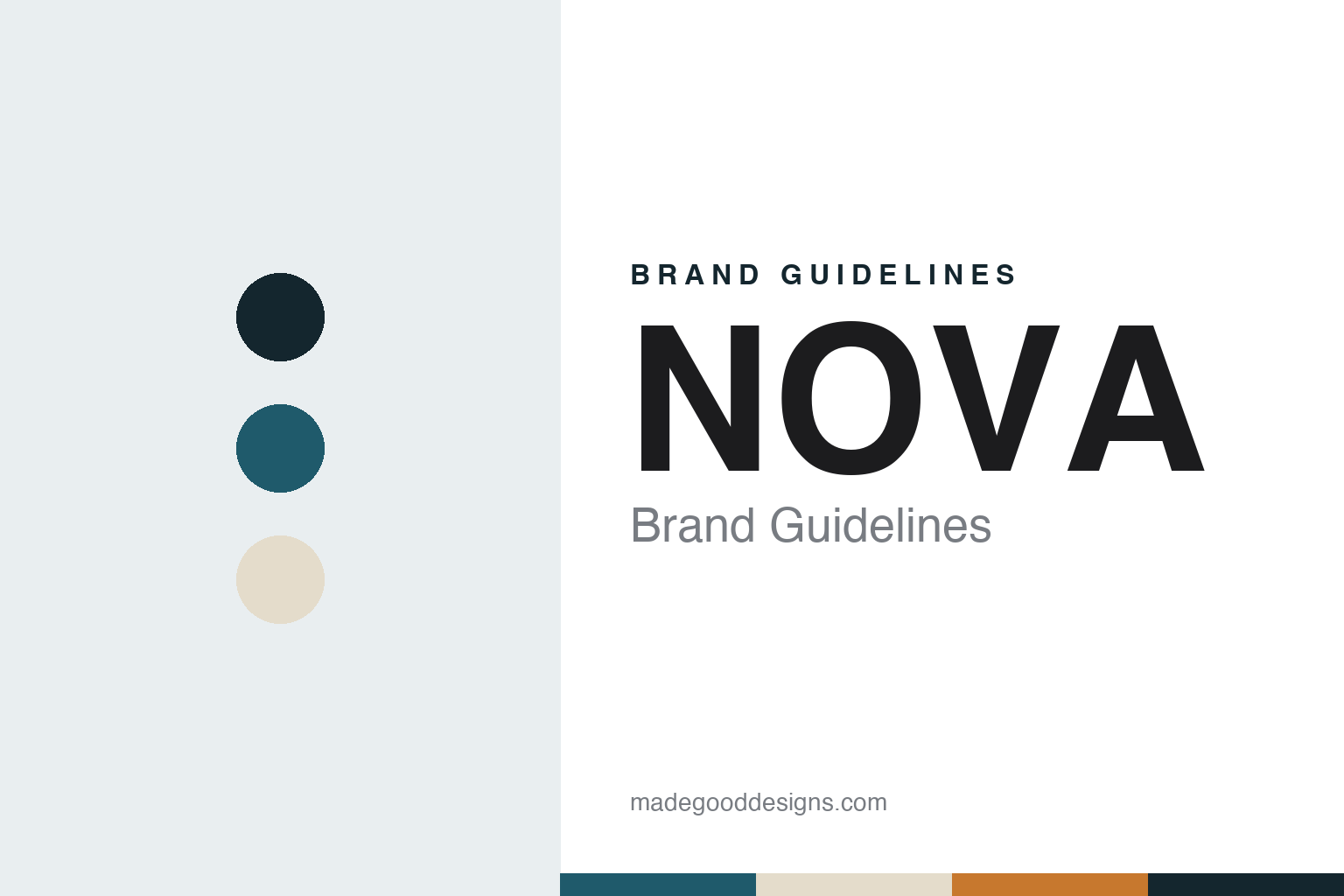
NOVA Brand Guidelines
The Tyrolean paraglider maker that began with a student’s first wing.
Aa
Two constants: a NOVA teal, limestone and amber palette and a technical sans register. Abstract homage — not a NOVA product or mark; no wing, logo or nameplate is reproduced.
Innsbruck, 1989
A student’s software, a sewing machine and a flat.
NOVA is an Austrian paraglider maker. Its website gives 1989 as the year its operating company was founded, and Cross Country magazine reported in February 2021 that the business began in Innsbruck. It writes its name in capitals, as NOVA, and trades as NOVA Performance Paragliders.
The company’s origins lie with the designer Hannes Papesh. In a Cross Country interview published in May 2018, he described being a student with no money who wanted to fly, writing his own computer program, buying material and webbing, and making his first wing. That wing, the Comet CX of 1988, was by his account one of the biggest sellers and most copied wings of its time. “With some friends we founded Nova in 1989,” he said.
English Wikipedia, citing a company history page, names Papesh as the first designer and Hermann Habe and the competition pilot Toni Bender as other founders. It says the first design, the CXC, was sewn by Papesh on his mother’s home sewing machine, and that the young company worked from Wolfgang Lechner’s apartment.
Lechner’s own part is better documented. Cross Country called him one of NOVA’s founding members when he officially retired at the start of February 2021. The magazine quoted the company’s list of his early jobs: head of sales, test pilot, warehouse worker, secretary and managing director. He handed on to a new chief executive, Sissi Eisl, in 2018, and the company said he would stay on in reduced form, looking after sales in Austria. In July 2024 the role passed to Ferdinand Vogel, a German competition pilot and flight instructor who had been linked with NOVA since 2009, Cross Country reported. NOVA’s imprint now lists Vogel and Kerim Jaspersen as chief executive officers.
Colour
Pécs, Terfens and the Alps.
NOVA’s wings have long been made away from its Alpine base. English Wikipedia says that in 1990 the company began working with Mecsek Ballon KFT in the Hungarian town of Pécs, a firm that had made balloons and mountaineering clothing in the communist era. A statement from NOVA quoted by Cross Country in April 2020 describes the arrangement as its own production facility, run as a joint venture with a Hungarian partner since 1990. A NOVA manual from January 2013 says production took place in its factory in Pécs and speaks of about 100 employees in Hungary. English Wikipedia gives 110 staff by 2016, with 95 in Pécs and 15 in Terfens.
That plant made the magazine’s news in April 2020, when it reported that the factory had moved from paragliders to masks and gowns as demand for wings collapsed. Cross Country noted that these were not medically certified items. A 2018 NOVA manual for the ION 5, hosted by the German pilots’ association DHV, says the company owns two production sites, the first opened in Hungary in 1990 and the second in Vietnam in 2015. NOVA’s service page now recommends Mecsek Ballon for glider service and calls it “our former production”.
The head office moved from Innsbruck to Terfens in 2010, according to English Wikipedia. NOVA describes Terfens as a small municipality in the Inn valley, about 25 minutes east of Innsbruck, and says design, development, back office and distribution are there. It says the Rofan, its local flying site near Lake Achensee, is 20 minutes away and suits glider testing.
The design lead changed in the 2010s. Papesh told Cross Country he quit NOVA in 2013; English Wikipedia says he left in 2014, after 25 years. His later work included three years of cooperation with Advance and a new company, Phi, by his account. Philipp Medicus took over as head designer, English Wikipedia says, and NOVA’s Mentor 7 page calls him head of research and development.
Typography
How paraglider makers present themselves.
A paraglider has no bodywork or badge plate, so most of what a maker shows the world is cloth. The wing is the largest thing it builds, and it is seen in two main ways: spread out on a launch slope before take-off, or overhead in the air. Makers’ websites and catalogues return to those two views again and again.
Colour comes in panels, because a wing is sewn from many pieces of sail cloth rather than painted. Makers often sell a small set of schemes: Cross Country reported in February 2026 that one new wing came in two standard colour schemes. The cloth is named as well, by mill and weight, in launch notes and reviews, and the stitched cell openings along the leading edge are among the details a close-up photograph tends to pick out.
Engineering drawing is part of the look. Manuals carry line plans and riser diagrams, and catalogues add feature tables and glossaries, so a brand’s printed material can read like technical documentation. Video does a similar job in a friendlier voice. Test pilots and designers appear on camera to explain what went into a new wing, and Cross Country has filmed one such session at a maker’s headquarters.
The trade’s shop window is the Coupe Icare festival. Cross Country describes its expo as a chance to see all the free-flight brands together in one space, and as the moment when companies celebrate their successes and announce next season’s gliders and harnesses. Stands there can be part of the brand: Ojo Volador reported that one maker marked its founder’s 40 years in free flight in 2018 with a party on its stand, a special red harness and live Korean folk music. This guide sets out what can be checked about each maker, and marks what rests only on the company’s own word.
Aa
A technical sans for a maker of engineered sail cloth. (Specimen set in Archivo, a sans STAND-IN; NOT the NOVA logo.)
NOVA
Named ranges, team pilots and a colour model.
NOVA’s range is built around long-running names. The Mentor line has reached its seventh version: the company’s site describes the Mentor 7 as a 2.5-liner with 66 cells, two lines at the wing tips and three in the centre, classed EN/LTF B. The Aonic line is the one Philipp Medicus discussed with Cross Country in January 2021 as an EN A wing aimed at qualified pilots rather than schools, where he said the challenge was handling and a pilot’s first impression.
The company has signed well-known pilots. In January 2020 Cross Country reported that the acro pilot Théo de Blic had signed a long-term contract and that his main role would be helping to promote the brand. The magazine added that NOVA was not known as an acro maker. In March 2024 it reported that Aaron Durogati had joined at the Stubai Cup in Austria, in a move billed as a return to his roots. His father had sold NOVA wings in South Tyrol, and his early competitions were on them.
Durogati won the Red Bull X-Alps 2025 on a Xenon 2, a wing developed for that race and never sold, Cross Country reported in March 2026; the public version, the Xenon 3, is an EN-D wing, and the magazine reported that its canopy was unchanged. NOVA’s own report credited a flight-testing programme led by Durogati with Nicola Donini. Not every venture has continued: NOVA’s site says new ELOWIN electric winches are no longer produced or offered, while existing ones keep technical support and spare parts.
NOVA’s stated values are short. Its website says it is guided in development by pilot ability, not certification criteria, and that “our central concern is honesty” when classifying products. Its quality page defines quality as a cycle running from the first idea through development, testing and serial production to customer service.
Some of its visual work is credited. The website’s imprint names Bureau Rabensteiner and Werner Luidolt for the design concept, and the staff page lists Luidolt under graphics and design. English Wikipedia says NOVA marked its 30th year in 2019 with a new wing design and the first issue of a house magazine, Airtime. The Mentor 7 page offers a 3D model for trying a custom colour, with a warning that real colours may vary from the model.
For a design guide, NOVA shows how an Alpine company can keep one name and a few long-running range names across decades of changing designers and managers. Compare Niviuk, a younger European paraglider maker with its design team in Switzerland, and Ozone, which also makes paragliders. For this guide we use a deep teal, limestone and amber with a sans, an unofficial interpretation; no product or logo is reproduced.
Explore & save
Keep NOVA’s identity on hand — save it to a board in the Made Good inspiration library.
NOVA identity set
Pin the NOVA teal, limestone and amber palette and the technical sans register to your own board.