Arad Brand Guidelines
The kibbutz water meter maker founded in 1941.
Aa
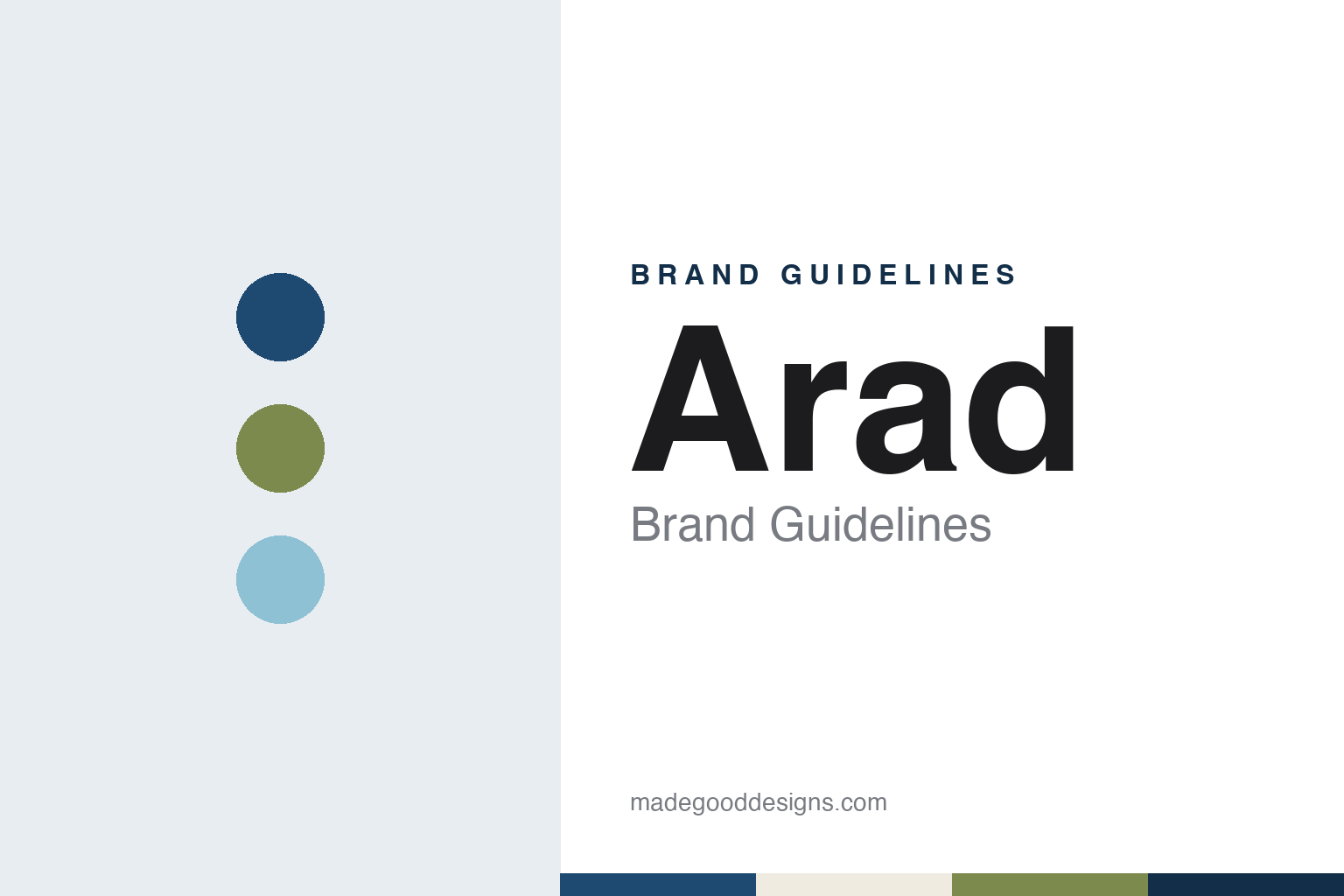
Two constants: a reservoir blue, Carmel olive and limestone palette and an humanist sans register. Abstract homage — not an Arad product or mark; no meter, logo or nameplate is reproduced.
Alliance Rakabi Daliya
A Haifa workshop moves to a kibbutz.
Arad is an Israeli maker of water meters and water-metering systems, based at Kibbutz Dalia in northern Israel. The company dates itself to 1941, seven years before the State of Israel was established. In its own history, published for its 80th anniversary in January 2021, Arad says that a Mr. Rakabi, who ran a small workshop making parts for water meters, joined forces that year with the two-year-old Kibbutz Daliya and moved the factory about 35 kilometres from Haifa to the kibbutz. The name, the company says, comes from the initials of “Alliance Rakabi Daliya.”
The Jerusalem Report, in a Jerusalem Post article of March 2023, told the same story: the business was founded in Haifa before the state existed, as a workshop producing parts for water meters, then moved to Kibbutz Dalia and has stayed there since. Sources differ on when the neighbouring kibbutz Ramot Menashe joined. Arad says the two kibbutzim combined forces in 1954; Globes, the Israeli business daily, wrote in June 2020 that Kibbutz Dalia founded the company in 1941 together with Ramot Menashe. Either way, the two kibbutzim became the company’s long-standing owners, and Arad says it is still headquartered in their valley.
Growth came abroad. In 1985 Arad set up Master Meter, a wholly owned subsidiary in the United States, and in 2000 it launched Arad Technologies, a division devoted to software for water management, the company says. As the business grew and the kibbutz changed its organisation, Arad decided to go public; its shares have traded on the Tel Aviv Stock Exchange since 2004.
Colour
From meter parts to ultrasonic meters.
Arad’s products trace a shift from mechanical counting to electronic measurement. In 2009 the company launched Octave, its first ultrasonic water meter, designed for bulk metering, and in 2016 it added Sonata, a residential ultrasonic meter. In 2014 came Allegro, which Arad describes as its first end-to-end two-way AMI system, giving utilities and their customers meter data from a distance. From 2018 it added IoT networks using LoRa and other technologies for continuous automatic meter reading. Its range today spans residential and bulk water meters, agricultural metering, drive-by and walk-by reading, fixed networks and cellular communication.
The company names the approvals it works to in different markets, among them the AS/NZS 4020 certificate for Australia and New Zealand, the WRAS certificate in the United Kingdom and the requirements of the American Water Works Association. In the Jerusalem Report interview of March 2023, chief executive Gabi Yankovitz described a “rebirth” from a maker of water-meter parts into a technology company. The article put the group at about 600 employees, roughly 120 of them engineers, and said Arad’s technology was in use in cities such as Mexico City, Paris, London and New Delhi.
At home the deployments are large. In May 2025 the Jerusalem Post reported that Mei Avivim, the municipal water and sewage corporation of Tel Aviv-Yafo, had completed the installation of about 250,000 smart water meters made by Arad across the city, together with a communication network that Arad deployed for the utility. The same report put smart water meter coverage at 75 percent across Israel and at full coverage in Tel Aviv-Yafo.
Typography
Metering as identity.
Utility meters are everywhere and rarely looked at. They sit in cupboards and basements, in pits under the pavement and in boxes on outside walls, and today they are read far more often by machines than by people. The makers in this guide build electricity, water, gas and heat meters, and increasingly the radio networks and software that collect and manage their readings.
Their imagery follows that shift. Factory photographs show rows of grey and white meters clamped into test rigs, brass water-meter bodies waiting for assembly and the dials of mechanical registers. Newer material shows small digital displays and communication modules, and control-room screens where a utility follows consumption, outages and the state of its network across a town or a region. Product shots tend to sit on plain light backgrounds, close in spirit to the technical drawings of a catalogue.
People appear mostly as installers and operators: field engineers beside liveried utility vans, technicians opening a meter cabinet or lifting the lid of a water-meter pit, staff in front of dashboards. Trade fairs such as Enlit, where the power industry meets, and national utility shows are where these companies present themselves to their customers, and their stands lean on the same mix of hardware, maps and screens.
Ownership in the sector has changed often, with listed groups, private equity investors and family firms buying and selling meter businesses across borders. This guide sets out what can be checked about each brand — who founded it, who owns it now and where its products are made — and marks clearly what rests only on the company’s own word.
Aa
A humanist sans for a four-letter name. (Specimen set in Assistant, a sans STAND-IN; NOT the Arad logo.)
Arad
A listed group with kibbutz roots.
Arad is now a group of companies. Its profile lists Arad Ltd and Arad Technologies as the headquarters companies in Israel, with operating subsidiaries Master Meter in the United States, Cicasa in Mexico, Contazara in Spain and Arad China, together with WaterTech in Italy and Colombia. Arad says it partnered with Contazara, a Spanish maker of smart water meters, towards the end of 2013, and joined forces with WaterTech in 2018. The company says its products are distributed in more than 60 countries.
Ownership has moved gradually away from the founding kibbutzim. Globes reported that Kibbutz Dalia sold an 8.5 percent stake to the Davidson Fund in 2007 and an 11.8 percent stake in 2020, after which Ramot Menashe became the largest shareholder. In September 2023 Globes reported further sales by both kibbutzim, leaving Ramot Menashe with 20.1 percent and Dalia with 14 percent, while Milestones Metering held 15.5 percent and institutional investors including Clal, Migdal and Harel also held shares. That report named Gabi Yankovitz as chief executive and Hugo Chaufan as chairman. Arad’s leadership page says Chaufan has chaired the group since 2001 and that Yankovitz has led it since 2004, having been its finance chief from 1999; the Jerusalem Post still described him as Arad Group CEO in May 2025.
The name needs care: Arad is also a city in southern Israel and a city in western Romania, neither connected with the company, whose website is arad.co.il. For a design guide, Arad shows a four-letter name built from its founders’ initials, carried from a kibbutz workshop to a listed group with subsidiaries on four continents. Compare Xylem and Badger Meter, both makers of water-metering products. For this guide we use reservoir blue, Carmel olive and limestone with a sans, an unofficial interpretation; no product or logo is reproduced.
Explore & save
Keep Arad’s identity on hand — save it to a board in the Made Good inspiration library.
Arad identity set
Pin the Arad reservoir blue, Carmel olive and limestone palette and the humanist sans register to your own board.