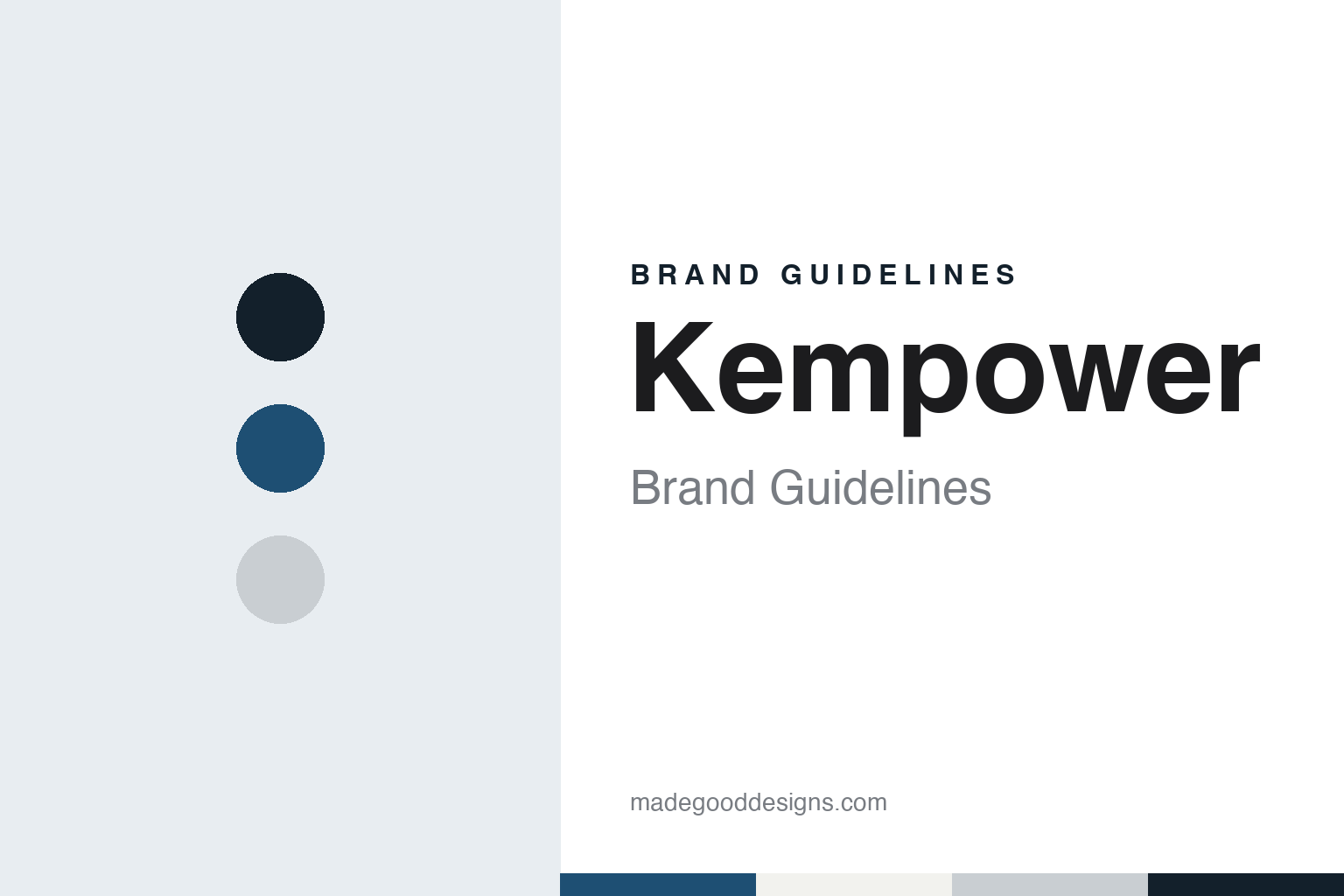
Kempower Brand Guidelines
A Lahti welding family’s fast-charger spin-off.
Aa
Two constants: a lake blue, aluminium and birch white palette and a Nordic sans register. Abstract homage — not a Kempower product or mark; no charger, logo or nameplate is reproduced.
Lahti
A welding family’s charging spin-off.
Kempower comes from Lahti, in southern Finland, and its roots are in welding. The welding-equipment maker Kemppi was founded in Lahti in 1949 by Martti Kemppi, English Wikipedia says, and Kempower grew out of the family-owned Kemppi Group. Finnish Wikipedia says Kempower Oyj was registered in 2017 and began operating in 2018, and that Kemppi Group, owned by the Kemppi family, holds nearly 70 per cent of the company; the group also owns the welding business.
The company presents that inheritance plainly. Material from its 2021 public offering says its mission is to enable clean mobility by drawing on Kemppi Oy’s 70 years of experience in demanding electric power supply, and that its edge is built on the Kemppi Group legacy. Kemppi said on 22 November 2023 that the family company had received the Strategy Action of the Year recognition from the Strategic Management Society of Finland for the spin-off of Kempower; the society’s chairman praised how the new business had made use of Kemppi’s traditional expertise in power sources.
Kempower went public quickly. Its shares began trading on Nasdaq Helsinki’s First North Growth Market in December 2021, the company’s offering pages show, and on 4 June 2024 it applied to move to the main Nasdaq Helsinki list, with trading expected from 12 June 2024 under the existing ticker KEMPOWR. Tomi Ristimäki led the company through those years as chief executive. The Finnish public broadcaster Yle reported on 6 May 2025 that Bhasker Kaushal, an executive with long experience of running international supply chains, would take over as chief executive in early June 2025.
Colour
Satellites, power units and aluminium.
Kempower’s chargers are built around a split between power and plug. Its range, as the company lists it, centres on a Power Unit that holds the power modules and slim Satellite charging posts that stand apart from it, with power shared between them as vehicles need it. Around that sit a Station Charger, a Megawatt Charging System, pantographs for buses and the ChargEye software for managing chargers. The company says its customers range from public charging operators and retailers to truck depots, public transport, off-road machinery and ports.
The satellite has carried the design story. On 4 May 2022 the company announced an Honourable Mention in Fennia Prize 22, a Finnish design competition run by Design Forum Finland and the insurer Fennia, for its S-Series charging satellite system. The release cited the narrow satellites’ small footprint, which suits tight spaces such as parking garages, their cable management and interface, and an aluminium structure. Six months earlier, in November 2021, Kempower had said it won the AluINNO competition of Technology Industries of Finland for the extruded aluminium frame of the Kempower Satellite.
The company frames its design through its staff’s own driving. Its about page says that its people are electric-car drivers who design and make chargers, and that the team is used to charging in harsh Nordic winters. At the 2022 award, chief technology officer Mikko Veikkolainen said that management and many employees drove electric vehicles, and that this hands-on experience had helped the company understand what drivers need from a charger.
Typography
How charger makers show themselves.
Makers of electric-vehicle chargers sell a box that most people only notice when they need it. Their pictures therefore tend to put the hardware where it lives: a wallbox on a garage wall beside a parked car, a row of rapid chargers under a canopy at a motorway service area, a cable plugged into a car at dusk with the screen lit. The setting tells the buyer which kind of charging the company means, from overnight at home to a short stop on a long trip.
The second set of images is about the system rather than the plug. App screens show a charging session, a schedule or a fleet of chargers on a map, and diagrams show how power cabinets, posts and software connect. For makers that sell mainly to charging operators, depots and retailers, these pictures often matter more than the car, because the customer is buying a network that has to be installed, monitored and serviced.
Factories are the third theme. Many charger makers show their own production lines, with cabinets moving between stations, technicians testing power electronics and finished units waiting to be shipped, as a way of making engineering visible. Trade fairs play a similar part: events such as Power2Drive in Munich and the international EVS electric-vehicle symposium are where new chargers are unveiled, photographed and compared.
Many of these chargers spend their working lives in someone else’s colours. A rapid charger may carry the livery of the operator, the supermarket or the fuel company whose forecourt it stands on, so a maker’s identity often rests on form: the shape of the cabinet, the placement of screen and cable holders, and a name that may appear only in small type. Reading these brands means looking at the hardware as closely as at the logo.
Aa
A Nordic sans — a plain name on a slim aluminium post. (Specimen set in Manrope, a sans STAND-IN; NOT the Kempower logo.)
Kempower
From Lahti to Durham.
Production has stayed close to home while adding a second continent. At its 2021 listing the company said its products were designed and manufactured in Lahti, where its headquarters and two production facilities were located. Yle reported in August 2023 that Kempower had moved into a new production facility in Lahti in the summer of 2022 and that the city was negotiating a cooperation agreement to support its growth; Finnish Wikipedia says one of its Lahti plants is in a former Scania bus factory.
In the United States, Kempower chose Durham, North Carolina. Yle reported in December 2024 that the factory had opened the previous year in the premises of a former textile mill, and the company’s stock exchange release of 4 June 2024 marked the plant’s official opening that day. Kemppi’s statement of November 2023 added that Kempower’s product development and production were in Finland and that most of its materials and components were sourced locally.
The growth was fast enough to draw the city in. Yle put the company’s workforce at 596 people at the end of June 2023, and reported that Lahti’s director of city development wanted to do a great deal to keep that growth going, with the regional development company Ladec also involved; the city had signed a similar agreement with the confectioner Fazer the year before. In its June 2024 release the company said it planned to strengthen its market presence and widen its footprint, particularly in Europe and North America.
For a design guide, Kempower shows how a charger maker can make a slim, extruded aluminium post the visible face of a much larger system, and how a family firm’s engineering history can be told as part of a new brand. Compare alpitronic, the Bolzano maker of the Hypercharger, and Zaptec, the Norwegian charger maker. For this guide we use a deep lake blue, aluminium grey and birch white with a sans, an unofficial interpretation; no product or logo is reproduced.
Explore & save
Keep Kempower’s identity on hand — save it to a board in the Made Good inspiration library.
Kempower identity set
Pin the lake blue, aluminium and birch white palette and the Nordic sans register to your own board.