Heliox Brand Guidelines
The bus charger maker from Best that Siemens bought in 2024.
Aa
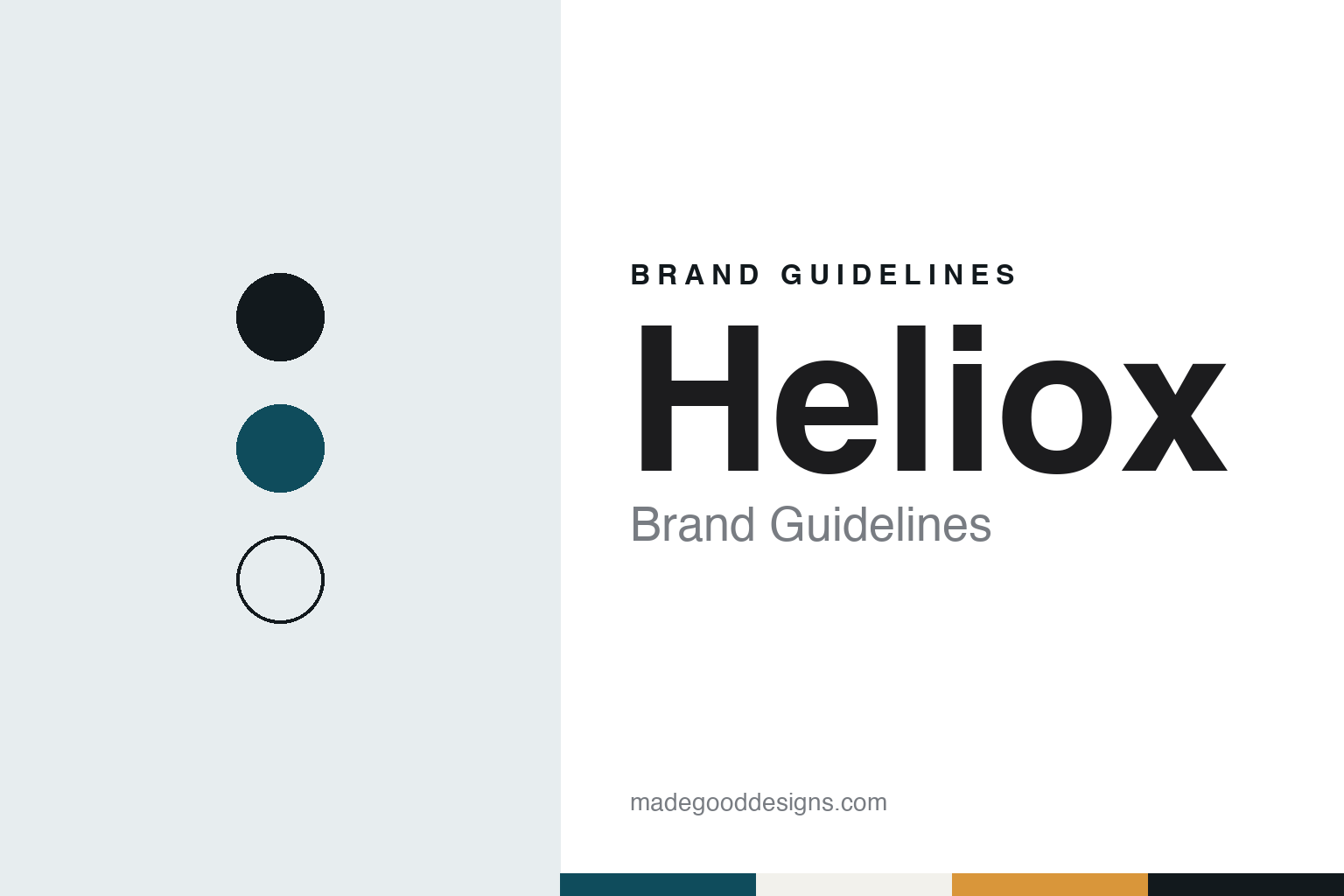
Two constants: a teal, slate and off-white palette and a geometric sans register. Abstract homage — not a Heliox product or mark; no charger, logo or nameplate is reproduced.
Out of Philips
Power converters first, bus chargers next.
Heliox is a Dutch maker of DC fast chargers for electric buses, trucks and cars. The company says it was founded in 2009 in Best, a town near Eindhoven in the province of North Brabant, and its website now gives its headquarters as Veldhoven, in the same region. Since January 2024 it has belonged to Siemens.
It started as a spin-off. In a 2018 interview with the Brabant innovation site IO+, chief executive Jaap Schuddemat said the business had begun as a unit of Philips, which sold it to a Spanish company that went bankrupt a little over a year later; he and four colleagues then decided they could do better and started Heliox. It made power converters — electronics that turn electricity into other voltages and currents, for example to charge batteries — first for consumer electronics and later for medical systems and industrial uses. Three years after the start, Schuddemat said, it added chargers for electric vehicles, and after market research it focused on electric buses.
Schuddemat told IO+ that important customers, suppliers and sources of knowledge sat within about 20 kilometres of Best, and credited Eindhoven University of Technology, Fontys and Avans for trained staff. In September 2015 Solar Magazine reported that the Brabantse Ontwikkelings Maatschappij, the province’s regional development company, was investing in Heliox because of its ultra-fast charging system for city buses; by then VDL Bus & Coach, another Brabant firm, had delivered an electric bus in Sweden fitted with it. The magazine noted that Heliox had also developed a micro-inverter.
Colour
From Eindhoven depots to Atlanta.
Bus depots remain the core of the business. The company’s timeline lists an electric bus depot in Eindhoven in 2014, which it presents as a pioneer, and in 2017 what it describes as an early, large rapid-charging network for the Eindhoven bus fleet. It says it delivered a 32-megawatt fast-charging network at Amsterdam’s airport in 2019 and commissioned pantograph chargers for the Chicago Transit Authority at Navy Pier in 2020. In the United Kingdom it says it built a large electric bus depot with First Bus in Glasgow ahead of the COP26 summit in 2021, and has since worked with the operator on depots across Scotland and England.
North America became a second home. Heliox says it incorporated its North American business in Atlanta in 2021, installed Flex 180 dynamic chargers for transit and fleet operators in Knoxville and San Diego, designed and built Flex 360 dynamic chargers for the transit authority in Washington in 2022, and opened a manufacturing plant in North Carolina in 2025. Its website groups the range into three families — Mobile, listed at 40 kW; Rapid, from 50 to 300 kW; and Flex, from 180 to 360 kW — and says that in 2026 it launched a dual-port 60 kW dynamic charger and the Flex Pro 480. The timeline also lists a charger built to the SAE J3105 standard and an H60 charger designed and made in North America for Volvo and Mack fleets in 2024, and a vehicle-to-grid charger to ISO 15118-20 for the utility Dominion and school buses in 2025, each of which the company calls a first.
The company says it has installed more than 5,000 charge points in more than 150 cities, employs more than 300 people and has five offices; its about page lists a presence in Germany, Sweden, the United Kingdom, Italy, Spain and the United States. Alongside hardware it sells charger monitoring software, energy management, maintenance and charging as a service — the monitoring and energy-management side was one of the strengths Siemens named when it bought the firm.
Typography
Design and documentation.
Makers of electric-vehicle chargers sell a box that most people only notice when they need it. Their pictures therefore tend to put the hardware where it lives: a wallbox on a garage wall beside a parked car, a row of rapid chargers under a canopy at a motorway service area, a cable plugged into a car at dusk with the screen lit. The setting tells the buyer which kind of charging the company means, from overnight at home to a short stop on a long trip.
The second set of images is about the system rather than the plug. App screens show a charging session, a schedule or a fleet of chargers on a map, and diagrams show how power cabinets, posts and software connect. For makers that sell mainly to charging operators, depots and retailers, these pictures often matter more than the car, because the customer is buying a network that has to be installed, monitored and serviced.
Factories are the third theme. Many charger makers show their own production lines, with cabinets moving between stations, technicians testing power electronics and finished units waiting to be shipped, as a way of making engineering visible. Trade fairs play a similar part: events such as Power2Drive in Munich and the international EVS electric-vehicle symposium are where new chargers are unveiled, photographed and compared.
Many of these chargers spend their working lives in someone else’s colours. A rapid charger may carry the livery of the operator, the supermarket or the fuel company whose forecourt it stands on, so a maker’s identity often rests on form: the shape of the cabinet, the placement of screen and cable holders, and a name that may appear only in small type. Reading these brands means looking at the hardware as closely as at the logo.
Aa
A geometric sans — clean, open and calm on a depot sign. (Specimen set in Manrope, a sans STAND-IN; NOT the Heliox logo.)
Heliox
An endorsement line under a parent’s name.
Siemens bought Heliox in two steps. On 22 August 2023 Siemens AG announced an agreement to acquire the company from the private equity firm Waterland and an entity owned by a group of employees and individual shareholders, Sustainable Bus and Charged EVs reported. Siemens said the deal was completed on 11 January 2024. Its release described Heliox as headquartered in the Netherlands with about 330 employees and products from 40 kW up to megawatt charging for depots and en-route charging, and said the purchase would extend Siemens’ reach, primarily in Europe and North America, and add power-electronics capability. Siemens added that Heliox would gain from its industrialisation capabilities, global sales network and infrastructure, so that it could scale up production.
Integration followed. In 2024 Siemens said it intended to carve out its eMobility business unit and combine it with Heliox in a new dedicated legal structure, Motor Transport reported in October 2024, quoting the company on the “pioneering culture” of Heliox. Heliox’s own timeline says it was integrated with Siemens eMobility in 2025 and rebranded as “Heliox, A Siemens Business,” the line it now uses on its website, where links for jobs and contacts lead to Siemens.
For a design guide, Heliox shows how an acquired specialist can keep its own name beneath a parent’s endorsement line. Compare Ekoenergetyka, a Polish maker that also grew up charging electric buses, and Kempower, a Finnish maker of DC fast chargers. For this guide we use a deep teal, slate and a soft off-white with a sans, an unofficial interpretation; no product or logo is reproduced.
Explore & save
Keep Heliox’s identity on hand — save it to a board in the Made Good inspiration library.
Heliox identity set
Pin the Heliox teal, slate and off-white palette and the geometric sans register to your own board.